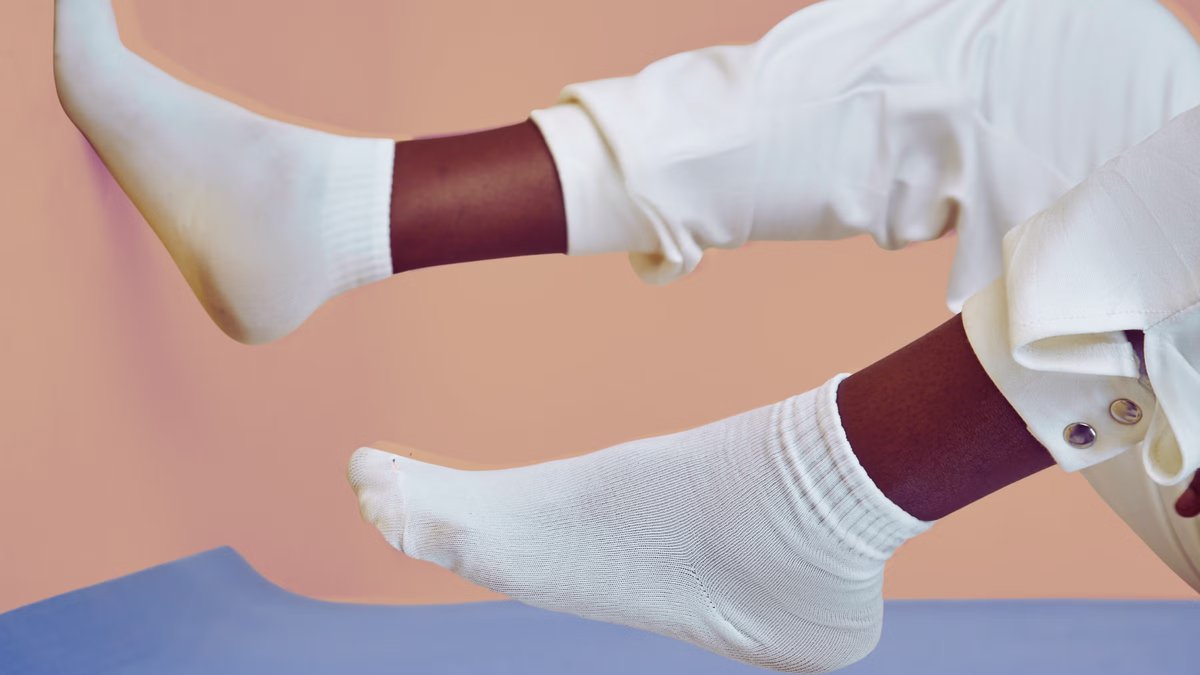
(Photo: Jade Emperor | Pexels | Design in Canva by Laura Harold)
So you want me to take my socks off in your yoga class?
I appreciate the fact, dear yoga teacher, that you’re probably worried my socks will bother me. It’s true that regular socks can prove to be a slippery experience even on the stickiest of mats.
But, as a sock lover, I’ve discovered I can simply make my stance slightly shorter—in Downward-Facing Dog, Warrior 2, and more poses—and that keeps me sturdily in place.
And I’ve spent my entire yoga life practicing in chilly studios with cold floorboards. When most people would characterize the temperature in the room as comfortable to warm, I’d be shivering in the corner. You know those women in Victorian novels who are always worried they’ve felt the slightest hint of a draft? That’s me.
Not to mention, I’m betting you’re going to cue us to step off the mat at some point. I can see you eyeing the walls, perhaps considering how we might use them to help us balance in Warrior 3 or for Legs Up the Wall. Besides, you might feel greater confidence in this studio floor’s cleanliness than I do. So, yeah, I prefer to retain a sock boundary between my feet and the potential sweat puddle that awaits, quietly breeding its pathogens. (If I do step in a sweat puddle, I promise I’ll take off my socks.)
But keeping my socks securely on my feet isn’t just a matter of temperature. Frankly, I’m not thrilled about my newly-bony-feeling middle-aged feet. Did you know that by age 50, you may have lost around half the fat padding in your feet? In standing poses, in which I am now uncomfortably aware of the hardness of the floor under my mat, my socks offer me a millimeter more cushioning and allow me to stave off potentially distracting reflections on the ravages of time.
In other words, wearing socks during yoga works just fine for me.
Yoga is partly about feeling comfortable in our bodies. And making the choices that work for us. Socks are part of that for me—and, I suspect, others. Let me keep them, please.
Sentinel — Human
The text reads as a highly personalized, opinionated reflection using anecdotal evidence to build a nuanced argument about comfort, self-awareness, and bodily experience, characteristic of personal essay writing rather than objective reporting.