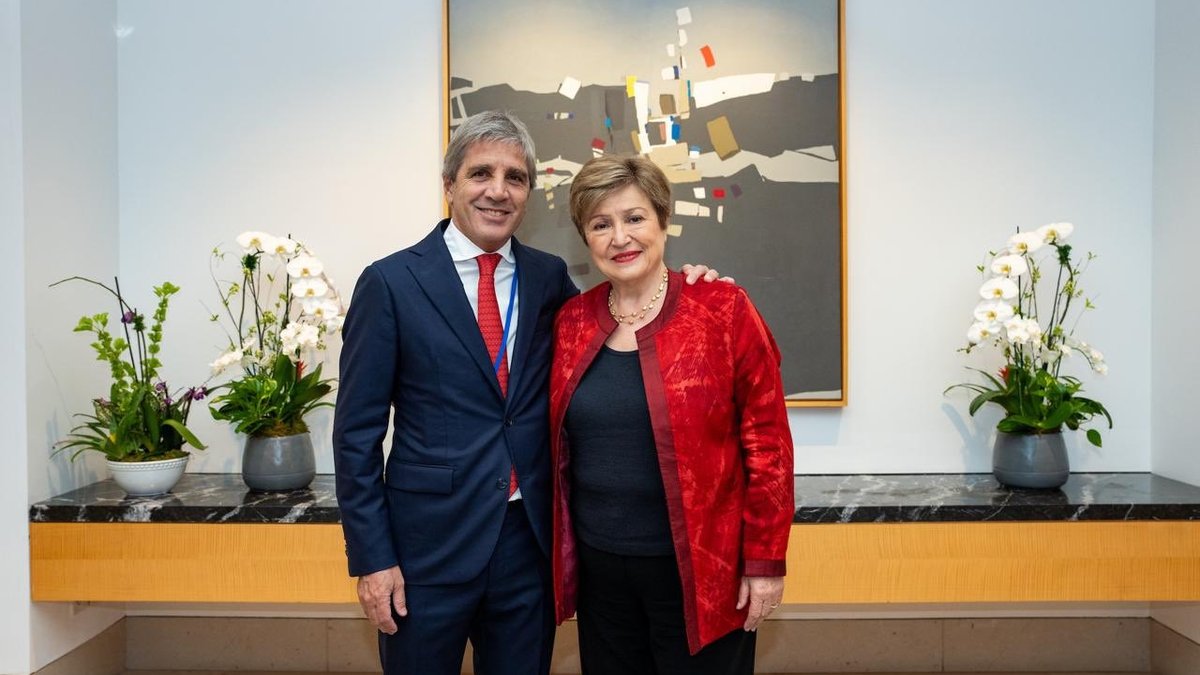
International Monetary Fund (IMF) Managing Director Kristalina Georgieva will travel to Argentina at the end of the month at the invitation of President Javier Milei.
The announcement comes on the heels of an IMF report maintaining its economic growth forecasts for the country and the appointment of an Argentine economist as the fund’s new chief economist.
Georgieva’s visit was confirmed by Economy Minister Luis Caputo, who highlighted the strong relationship between the Milei administration and the international financial institution.
“I am pleased to announce that at the end of the month we will welcome IMF Managing Director Kristalina Georgieva to Argentina, where she will visit our country at the invitation of President Javier Milei,” Caputo tweeted.
The minister described the dialogue between the government and the IMF as “excellent” and said the visit comes “within the framework of the successful economic program currently underway.”
Caputo also emphasized that Georgieva’s visit “will allow us to continue deepening our joint work and the IMF’s support to consolidate the progress achieved in terms of economic stability and growth.”
The most recent meeting between Caputo and Georgieva took place in April in Washington, D.C., during the IMF and World Bank Spring Meetings.
As for Milei, his last meeting with the IMF chief was on September 24, 2025, in New York, with Caputo also in attendance.
During that meeting, they discussed the economic and financial impact of the US$20 billion currency swap that U.S. President Donald Trump had recently granted Argentina.
IMF maintains Argentina’s growth forecasts
The July edition of the IMF’s World Economic Outlook, which was published on Wednesday, left its projections for Argentina’s GDP growth unchanged, forecasting 3.5% growth in 2026 and 4% in 2027, both above the regional and global averages.
At the press conference following the report’s release, IMF Deputy Director of the Research Department Petya Koeva Brooks also noted that “the disinflation process has resumed, and inflation is expected to continue declining gradually, reaching 25% by the end of 2026.”
For Latin America as a whole, the IMF raised its 2026 growth forecast by 0.1 percentage points to 2.4%, while leaving its 2027 projection unchanged at 2.7%, citing “heterogeneous dynamics across countries.”
The report includes data only for Brazil, Mexico, and Argentina, with the latter receiving the strongest growth projections among the three.
Argentine economist named IMF chief economist
The third major development involving Argentina and the IMF on Wednesday was the appointment of Argentine economist Silvana Tenreyro as the Fund’s new chief economist.
“She brings exceptional academic & policymaking experience that will further strengthen the IMF’s analysis & policy advice to help our membership navigate a complex global economy,” Georgieva wrote on X.
Caputo also welcomed the announcement. “Congratulations, Silvana! What a tremendous recognition!” he tweeted.
The IMF said Tenreyro will succeed Pierre-Olivier Gourinchas and will assume the position on August 10.
Tenreyro earned an economics degree from the National University of Tucumán in 1997. She later completed a master’s degree at Harvard University in 1999 and earned her Ph.D. there in 2002.
She served as an economist at the Federal Reserve Bank of Boston from 2002 to 2004. In 2004, she moved to the United Kingdom to join the London School of Economics. She later served as an external member of the Bank of Mauritius’ monetary policy committee from 2012 to 2014.
Between 2017 and 2023, Tenreyro was a member of the Monetary Policy Committee of the Bank of England. She has also been a visiting scholar at the European Central Bank and, since 2023, has served on the IMF managing director’s external advisory group.
Facts Only
* IMF Managing Director Kristalina Georgieva will travel to Argentina at the end of the month by invitation of President Javier Milei.
* The IMF report maintained Argentina's economic growth forecasts for 2026 and 2027.
* The report forecasted 3.5% GDP growth in 2026 and 4% in 2027 for Argentina.
* IMF Deputy Director of the Research Department Petya Koeva Brooks noted disinflation resumed, with inflation expected to reach 25% by the end of 2026.
* The IMF raised its Latin America 2026 growth forecast by 0.1 percentage points to 2.4%.
* Argentine economist Silvana Tenreyro was appointed as the IMF’s new chief economist, succeeding Pierre-Olivier Gourinchas, effective August 10th.
* Tenreyro earned a Ph.D. from Harvard University and served in various roles including at the Federal Reserve Bank of Boston and the Bank of England Monetary Policy Committee.
Executive Summary
Full Take
Sentinel — Human
The text reads as a factual summary of recent high-level economic and personnel announcements, strongly supported by direct quotes and specific institutional references.