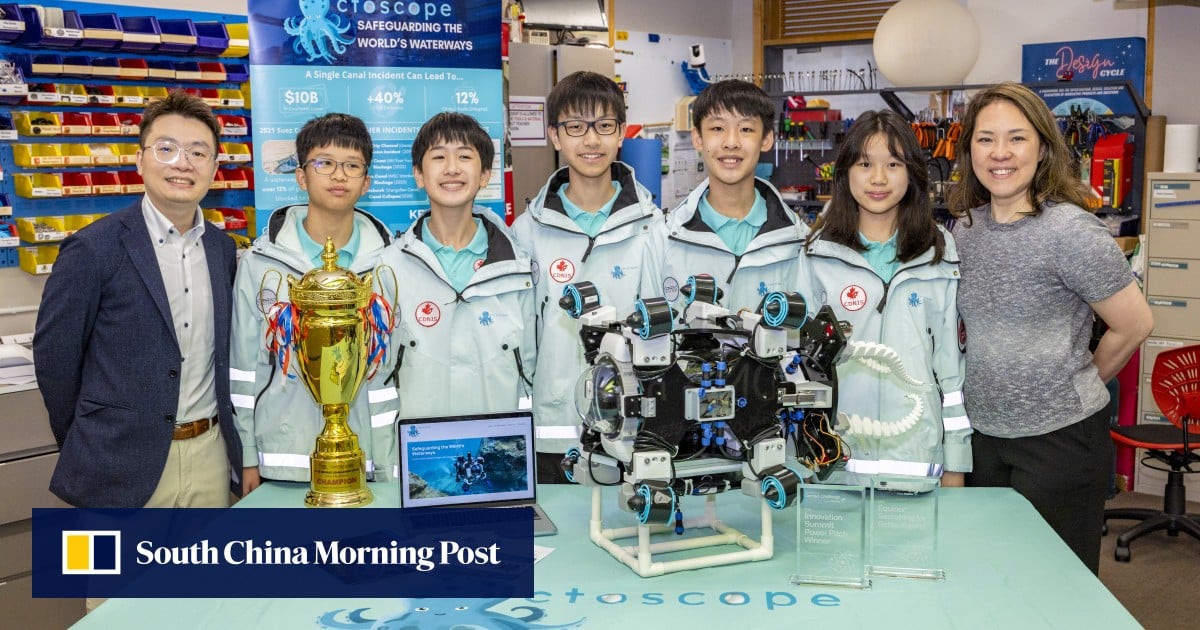
Students from Canadian International School of Hong Kong take home second place and special awards at the Conrad Challenge in Houston
[The content of this article has been produced by our advertising partner.]
A group of Grade 8 students from Canadian International School of Hong Kong (CDNIS) has made waves on the global innovation stage, returning from the Conrad Challenge Global Innovation Summit in Houston with multiple top honours. The team captured the coveted Innovation Summit Power Pitch Award and the Equinor Searching for Better Award – achievements that also earned them a sponsored educational trip to Boston, including hands-on workshops and a visit to the Massachusetts Institute of Technology (MIT).
The five students, aged 13 to 14, spent months designing and building OctoScope, an autonomous underwater vehicle developed to monitor busy canals and remove debris before it can disrupt global shipping routes. The project tackles a high-stakes real-world problem: major maritime chokepoints are vulnerable to trade blockages that can paralyse trade, as seen in the 2021 grounding of the Ever Given in the Suez Canal, which triggered billions of dollars in losses and widespread supply-chain disruption.
Lucas, the team’s chief technology officer, said OctoScope was engineered with flexibility and real-time responsiveness in mind. The vehicle features a modular design with interchangeable components, including sensors that monitor water conditions, sonar and onboard cameras to detect underwater obstacles, and an AI-powered processor analyses incoming data on the fly. Multi-directional thrusters allow for precise maneuvering in tight spaces, while an octopus-inspired gripper enables the robot to remove debris efficiently beneath the surface.
Beyond the technical build, the students also considered the project’s long-term potential. “We aimed to design a practical and scalable solution to improve monitoring of global waterways,” said Shou Jeng, the team’s chief executive officer. He added, “We’re not going to just stop here. The global summit provided us with an opportunity to engage with industry experts, receive professional feedback, and explore how our solution could be applied in the real world.”
Commercialisation was another key focus. Chief financial officer Caden said “we identified three primary target markets, shipping companies, canal authorities and marine insurers.” When judges raised concerns about market size, he pointed to strong near-term applications in major waterways, with additional uses in areas such as fisheries management and water-quality monitoring.
As finalists, the team also had the chance to exchange ideas with a team from Panama, home to one of the world’s most important canals. “Discussions with the Panamanian students helped validate the importance and relevance of our solution. We will continue to refine the prototype and explore the potential for future collaboration with real-life users,” said Season, the team’s chief marketing officer.
The students were supported throughout the project by teachers Vivian Fung and Kenneth Tang, who have more than a decade of experience in the school’s robotics and business programmes respectively. Their combined expertise played a pivotal role in guiding the team from concept development to international competition, continuing a track record of mentoring students for success on the global stage.
Hong Kong’s international school sector operates in a competitive environment, attracting students from a wide range of cultural and national backgrounds. At Canadian International School, the student body represents more than 40 nationalities, reflecting the city’s global character and the diverse perspectives that help shape collaborative, future-focussed learning communities.
Facts Only
* Five Grade 8 students from Canadian International School of Hong Kong participated in the Conrad Challenge Global Innovation Summit in Houston.
* The team received the Innovation Summit Power Pitch Award and the Equinor Searching for Better Award.
* The students designed and built OctoScope, an autonomous underwater vehicle.
* OctoScope is designed to monitor busy canals and remove debris before it disrupts global shipping routes.
* The project addresses the vulnerability of major maritime chokepoints to trade blockages.
* OctoScope features modular components, sensors, sonar, onboard cameras, and an AI-powered processor.
* The vehicle uses multi-directional thrusters and an octopus-inspired gripper for debris removal.
* The team identified three primary target markets for commercialization: shipping companies, canal authorities, and marine insurers.
* The team exchanged ideas with a student team from Panama.
* The project was supported by teachers Vivian Fung and Kenneth Tang.
Executive Summary
Full Take
Sentinel — Human
The text exhibits the structural complexity and specific attribution patterns characteristic of human journalistic reporting, suggesting a high probability of human authorship.