Skip to content
Chimera readability score 0.6732 out of 100, reading level.

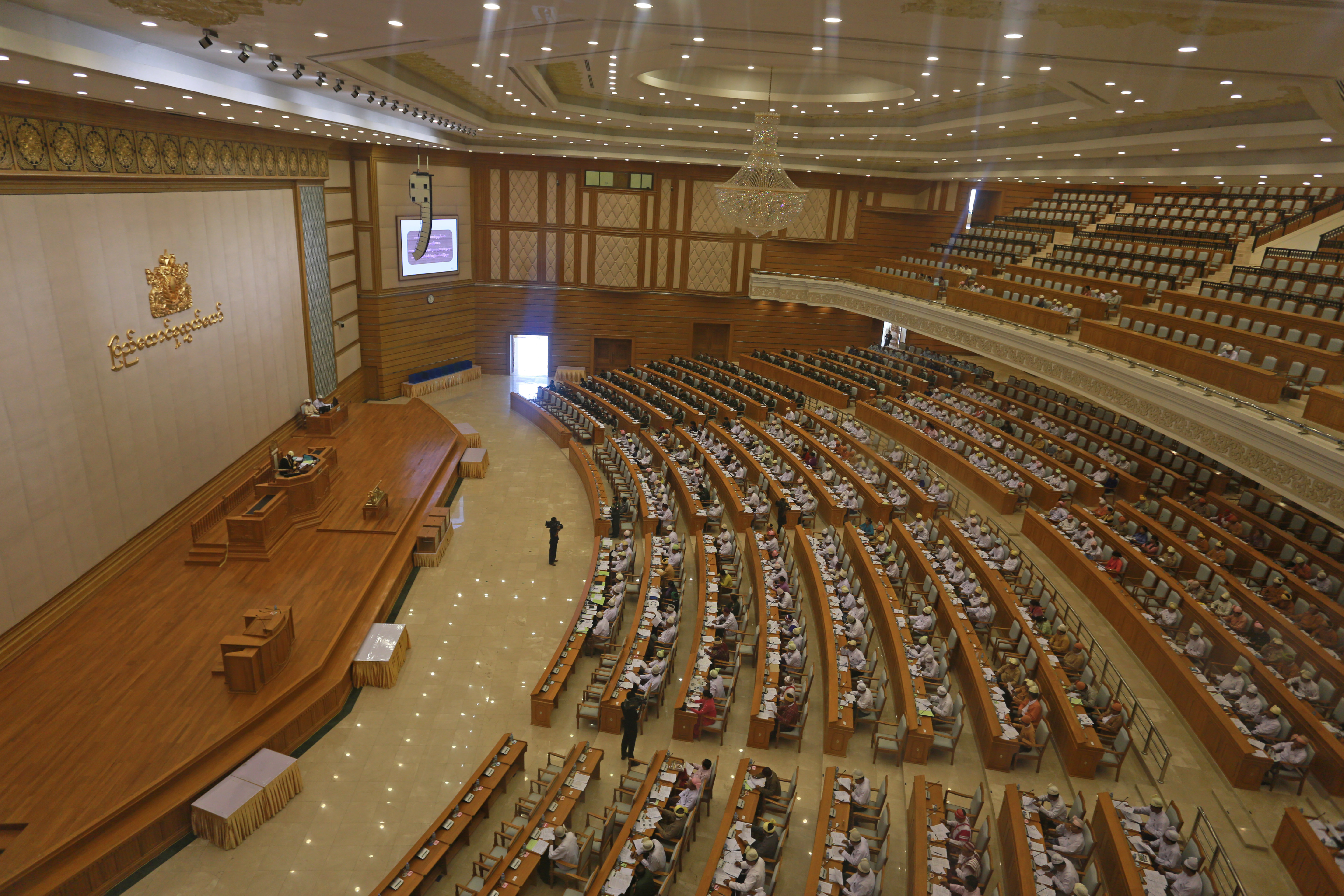
Myanmar’s parliament convened for the first time in five years Monday, marking a formal restoration of legislative proceedings in the country following widely contested national elections held by the military junta government.
The reopening of the legislature has raised important legal questions regarding the constitutional framework of governance, the legality of the elections held under military rule, and the resulting composition of the parliamentary body.
The Committee Representing Pyidaungsu Hluttaw—the bi-cameral legislature established under the nation’s 2008 constitution—has claimed it is the country’s sole legitimate parliament. An opposition shadow parliament, formed by elected lawmakers who were removed from their seats after the military seized power in a 2021 coup, also held an online session on Monday refusing to recognize the newly seated Pyidaungsu Hluttaw.
Myanmar’s 2008 constitution grants the military a significant institutional role in the country’s political system. Under this charter, 25 percent of parliamentary seats are reserved for military officers appointed directly by the commander-in-chief. The arrangement ensures that the armed forces maintain a guaranteed presence in the legislature with the ability to block constitutional amendments, which require approval from over 75 percent of the legislature.
The recent national elections were widely criticized, having been conducted under electoral rules introduced by the junta government. Several opposition parties, including those linked to the former governing National League for Democracy (NLD), were dissolved, barred from participation, or chose to boycott the vote. As a result, military-aligned parties secured a large share of the contested seats in the election, which, when combined with the constitutionally reserved military seats, produced a legislature dominated by junta-aligned actors.
The junta seized power in February 2021, ousting the elected civilian government led by the NLD. The military detained several senior officials, including State Counsellor Aung San Suu Kyi and President Win Myint, and declared a nationwide state of emergency. Military leaders justified the coup by alleging widespread fraud in November 2020 general elections, which the NLD won by a large margin. However, the country’s election commission rejected these claims, and critics maintain that the military’s actions violated the rule of law.
The coup ended a decade-long period of limited civilian rule and effectively returned Myanmar to direct military control, triggering widespread protests, violent repression, and ongoing political conflict. While the nation now sees a formal return to legislative proceedings after years of disruption, the coup, questionable elections and the junta’s continued political dominance raise unresolved questions about the legitimacy of the new legislature.

Facts Only

* The parliament convened for the first time in five years.
* The Committee Representing Pyidaungsu Hluttaw claims legitimacy.
* An opposition shadow parliament was formed.
* The 2008 constitution reserves 25% of parliamentary seats for military officers.
* The military seized power in February 2021.
* State Counsellor Aung San Suu Kyi and President Win Myint were detained.
* The junta justified the coup by alleging widespread fraud in the 2020 general elections.
* The NLD won the 2020 general elections by a large margin.
* The election commission rejected the junta’s claims of fraud.
* The coup ended a decade-long period of limited civilian rule.
* The legislature is dominated by junta-aligned actors.

Executive Summary

Following a five-year hiatus, Myanmar’s parliament convened, marking a formal restoration of legislative proceedings. This event is complicated by the contested nature of the current governing body, established following the 2021 military coup. The Committee Representing Pyidaungsu Hluttaw, claiming legitimacy, operates alongside an opposition shadow parliament formed by ousted lawmakers. The 2008 constitution, which remains in effect, guarantees 25% of parliamentary seats to military appointees, effectively maintaining a significant military presence and the ability to block constitutional changes. The recent elections, held under junta rule, resulted in a legislature dominated by military-aligned parties, exacerbated by the constitution’s provisions. This situation raises fundamental questions regarding the legitimacy of the newly seated parliament and the broader political landscape in Myanmar. The ongoing state of emergency and the military’s justification based on alleged election fraud further complicate the situation, presenting significant uncertainty.

Full Take

The article presents a situation characterized by a critical lack of legitimacy, a consequence of the 2021 coup and its associated actions. The STEELMAN perspective reveals the core conflict: the Committee Representing Pyidaungsu Hluttaw, despite its claim, is fundamentally unrepresentative, its legitimacy entirely manufactured by the military junta. This isn’t simply about differing political opinions; it’s a fundamental challenge to the very concept of democratic governance. Patterns detected: ARC-0043 Motte-and-Bailey (the junta presents a “restoration” while simultaneously maintaining control), ARC-0024 Ambiguity (the extent to which the 2020 elections were truly fraudulent is deliberately obscured). The narrative hinges on the unstated assumption that any semblance of governance, however imposed, is preferable to complete chaos. This echoes historical patterns of military intervention in civilian affairs, consistently leveraging constitutional provisions to maintain power. The root cause is the enduring grip of the military on the state, a system predicated on a denial of popular sovereignty. The implications extend beyond Myanmar; it’s a case study in how authoritarian regimes manipulate constitutional frameworks to perpetuate their rule. The 25% military seat allocation isn't just a procedural detail; it’s a structural barrier to genuine democratic transition. Counterstrike scan: a coordinated disinformation campaign would likely amplify the junta’s claims of fraud while simultaneously suppressing any credible evidence of opposition support. This suggests a strategic deployment of manufactured outrage – a familiar tactic. Bridge questions: What metrics would genuinely indicate a return to democratic governance in Myanmar? How can international pressure effectively challenge the military's continued control without exacerbating the conflict?

Sentinel — Human

Confidence

The article exhibits strong human signals, including domain-specific detail and structural irregularity, with minimal stylometric or coordination red flags. Likely human-written with no significant synthetic indicators.

Signals Detected
low severity: Moderate sentence length variance with some structural repetition (e.g., 'widely contested,' 'widely criticized'), but no overtly mechanical transitions or hedging density.
low severity: Balanced framing of competing claims (e.g., junta's justification vs. critics' rebuttals) but includes idiosyncratic details (e.g., specific constitutional provisions, NLD's 2020 victory margin) that suggest human curation.
low severity: No verbatim talking points or vague attributions; sources are named (e.g., 'Committee Representing Pyidaungsu Hluttaw,' 'NLD') with specific contextual references.
low severity: Claims are verifiable (e.g., 2021 coup timeline, 25% military seats) with no convenient or uncheckable assertions.
Human Indicators
Nuanced legal and political context (e.g., constitutional amendment thresholds, shadow parliament dynamics) unlikely to be generated without domain expertise.
Idiosyncratic phrasing (e.g., 'coups ended a decade-long period of limited civilian rule') and historical specificity (e.g., NLD's 2020 margin) suggest human authorship.
Absence of AI-typical 'both sides' symmetry; the text acknowledges complexity without forced balance.