Syria’s Jihadist Crackdown Could Lead to Islamic State Defections
Executive Summary;
- Mounting pressure from Syria’s new authorities, limited prospects for citizenship, fears of deportation, and growing ideological tensions may drive some Central Asian and North Caucasus jihadists to relocate to Afghanistan.
- Moscow has warned that this relocation could strengthen al-Qaeda and Islamic State in Khorasan Province (ISKP) networks, posing a growing security threat to Russia and Central Asia.
- An ISKP strengthened by relocated Idlib militants could intensify suicide attacks against the Taliban, Central Asian states, and U.S. interests while further radicalizing Central Asian migrant communities in Europe and the United States, potentially facilitating external attack plots.
A March Russian Ministry of Foreign Affairs (MID) report notes that Afghanistan hosts between 20,000 and 23,000 militants affiliated with various international terrorist organizations, with more than half foreign fighters. The report attributes around 3,000 operatives to Islamic State in Khorasan Province (ISKP), and 5,000–7,000 fighters to Tehrik-e Taliban Pakistan (TTP). Al-Qaeda’s presence is assessed at more than 1,500 operatives (Russian Ministry of Foreign Affairs, March 2026). In Central Asia, the Turkistan Islamic Party (TIP) fields up to 1,200 militants, the Islamic Movement of Uzbekistan (IMU) up to 500 fighters, and the Tajik group Jamaat Ansarullah (JA) around 250 members (EurAsiaDaily, February 24).
The Russian MID emphasizes that ISKP remains active across eastern, northern, and northeastern Afghanistan, and seeks to expand into Central Asia to undermine secular governments and establish an Islamic Caliphate (Russian Ministry of Foreign Affairs, March 2026). Following this assessment, a pro-Kremlin outlet claimed that up to 8,500–9,000 Uzbek, Tajik, Turkmen, Uyghur, and Caucasian jihadists have relocated from Syria to Afghanistan (Nezavisimaya Gazeta, November 24, 2025). The same sources allege that returning Central Asian militants are being coordinated by Abu Bakr al-Badakhshani—a former al-Qaeda operative from Afghanistan’s Badakhshan province who reportedly fought in Syria against the Bashar al-Assad government before relocating to Afghanistan. There, he maintained close contacts with the governor of northern Panjshir province, Mawlawi Mohammad Agha Hakim, who was a “key al-Qaeda figure within the Taliban regime” (Hasht-e Subh, June 30, 2024). A Russian researcher claimed that Agha Hakim also had established a militant base in Panjshir’s Tunghu Valley, reportedly hosting Uzbek, Tajik, and North Caucasian fighters under al-Qaeda coordination (Telegram/@anserenko, February 6, 2024).
Moscow has frequently amplified the Afghan terrorist threat to maintain its security influence over post-Soviet Central Asia and strengthen institutions such as the Collective Security Treaty Organization (CSTO) and the Shanghai Cooperation Organization (SCO). The reported relocation of Uzbek, Tajik, and Chechen militants from Syria amid tightening Syrian security measures, however, appears increasingly plausible—and threatening
The Fragmentation of Foreign Jihadist Factions in Syria
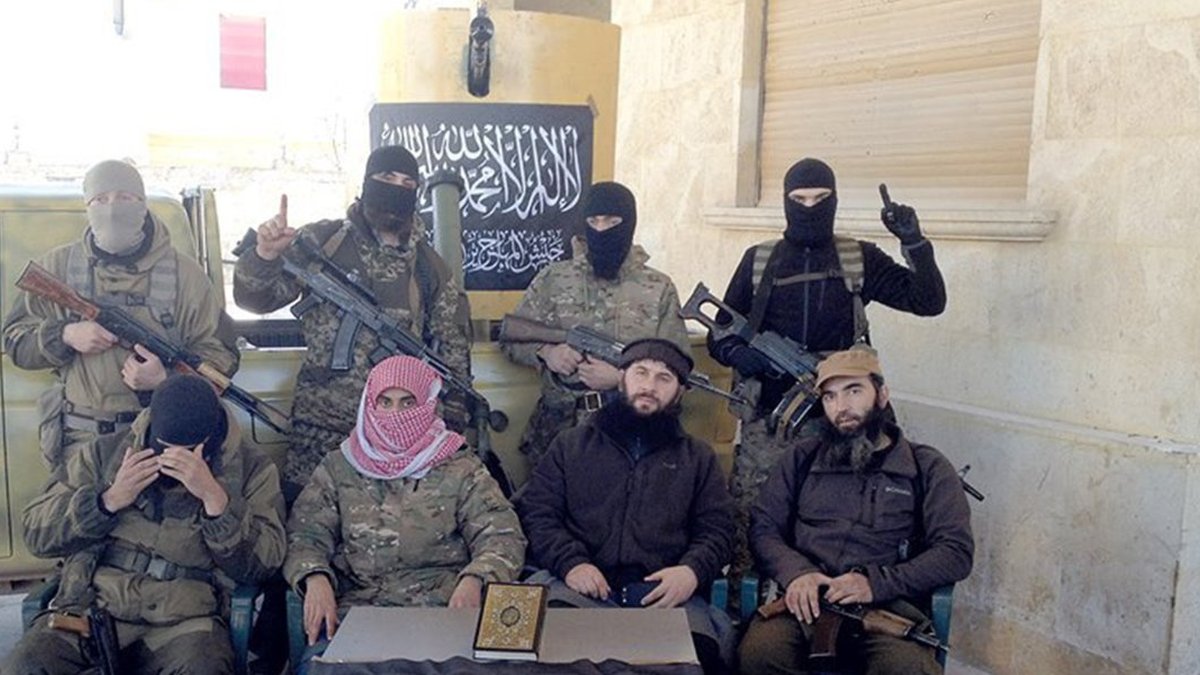
Following the fall of Bashar al-Assad in December 2024, Hay’at Tahrir al-Sham (HTS) leader Abu Mohammad al-Joulani rose to the Syrian Presidency as Ahmed al-Sharaa. Central Asian and North Caucasian militant factions initially celebrated what they described as the victory of “sacred jihad” in Damascus, viewing it as a model for future Islamist governance. The new Syrian authorities have adopted a pragmatic approach, however. Al-Sharaa’s government has tightened control over foreign fighters, prohibited public threats against Central Asian states, Russia, and the People’s Republic of China, curbed global Salafi-jihadi narratives, and dissolved foreign battalions. Opportunities to integrate into the new Syrian army and pathways to citizenship were offered in return.
Foreign fighters have been partially integrated into the 84th Division of the new Syrian army. Uzbek fighters from Katibat Imam al-Bukhari (KIB) and Katibat Tawhid wal-Jihad (KTJ), Chechen elements of Ajnad al-Kavkaz (AK) and Jaysh al-Muhajireen wal-Ansar (JMA), as well as approximately 3,000 Uyghur fighters from the TIP, were among the groups that integrated into this division. This process has diluted their organizational identities and constrained their ability to project transnational jihadist activity.
Post-Soviet jihadist groups that fought alongside HTS have become increasingly fragmented and restricted under strict media controls prohibiting group branding, banners, and external Salafi-Jihadi propaganda. A segment of Central Asian foreign fighters who have been excluded from integration into the Syrian army has, however, expressed growing discontent. They accuse KTJ emir Abdul Aziz al-Uzbeki and his military deputy, Saifuddin Tojiboy, of deviating from the principles of “sacred jihad” and engaging in corruption and nepotism in the distribution of salaries by the Syrian Ministry of Defense (MoD).
Clashes with Uzbek Militants in Idlib
Syrian authorities have dealt harshly with Uzbek militants who violate new government restrictions. Abu Dujana al-Turkistani (formerly Ayub Hawk), his deputy Islomjon al-Uzbeki, and Kyrgyz militant Koshoy Khan were imprisoned from August 2025 to April 2026 following a raid on a Druze community in Daraa, Syria, and the promotion of his Muhajir Tactical group (see Militant Leadership Monitor, December 11, 2025). More than 10 post-Soviet militants have been detained in Syria on charges of illegally occupying homes belonging to former Assad-era officials and Druze, Alawite, and Christian residents in northern Syria. These properties are now being returned to their original owners by the new authorities (YouTube/@1MUHOJIRUZ, April 10).
On May 5, Syrian security forces arrested more than 24 Uzbek militants in Idlib, following an armed standoff in Kafriya and al-Foua (Asharq Al-Awsat, May 7). The confrontation was reportedly triggered by a raid on the residence of Abu Ali al-Tajiki, an Uzbek militant suspected of involvement in highway robberies, who was killed in the ensuing firefight. More than 50 Uzbek fighters reportedly surrounded a Criminal Security headquarters in Idlib, demanding the release of detained militants, prompting Syrian forces to deploy heavy military equipment (see Terrorism Monitor, June 5). The standoff was eventually defused following mediation by Uzbek elders led by KTJ emir Abdul Aziz al-Uzbeki, who reportedly reaffirmed his loyalty to the Syrian state (BBC O‘zbek, May 7).
Tensions between post-Soviet jihadists and the Syrian government remain unresolved and only temporarily contained. Efforts are being made to find a long-term solution, however. For example, a dissident segment of Uzbek militants claimed in a statement that “a trilateral meeting was held on May 9 between Uzbek fighters affiliated with the Syrian Army, a Syrian defense official, and independent Uzbek Muhajireen, organized by Abdul Aziz al-Uzbeki, a brigade commander linked to the Ministry of Defense” (Telegram/@directorate4, May 14). There are divisions within the Uzbek foreign fighter community over these rapprochement efforts, however.
In another statement, Uzbek militants who had not integrated into the Syrian army complained of repression by al-Sharaa’s government, citing widespread accusations of links to the Islamic State (IS). According to the statement, during the meeting the spokesperson of the Syrian MoD—identified by the militants as “Abu Abdou Tauma”—warned that Uzbek fighters operating outside the MoD structure would be treated as Islamic State militants and detained. The statement further alleged that Abdul Aziz al-Uzbeki reinforced this position by declaring that Uzbek militants opposing government forces would face arrest.
According to dissenting Uzbek militants, refusal to integrate into the new Syrian army has led to detentions, with detainees allegedly subjected to torture during interrogations to extract confessions of Islamic State (IS) affiliation or information on other Uzbek fighters. They claim that the “persecution of hundreds of Uzbek Muhajireen for not being affiliated with the MoD is illegal, unjust, and dangerous, as they refused to allow their women and children to live under conditions of terror and intimidation.” In sum, dissident Uzbek jihadists recalled having fought alongside HTS during its most difficult periods, describing themselves as long-standing comrades in jihad, and demanded that any allegations of wrongdoing be substantiated under Sharia, rather than reflecting pressure from Russia and the United States, which have urged al-Sharaa to crack down on foreign jihadist elements.
ISKP Exploits Emerging Divisions Among Uzbek Jihadists
IS quickly exploited the growing tensions between dissident Uzbek militants and Syria’s new authorities. In issue 547 of its al-Naba journal, the group urged foreign fighters to abandon HTS- and al-Sharaa–aligned military structures and defect to IS. The group portrays itself as the lone movement still committed to a borderless transnational Islamic Caliphate (X/@Minalami, May 15).
Uzbek, Tajik, and Russian ISKP supporters have mocked the deteriorating position of dissident Uzbek jihadists in Syria. Arabic-language pro-IS accounts argue that foreign fighters now face consequences for failing to join the group earlier, with one user, Al-Battar al-Janubi, writing that they are “reaping what they sowed.” Another account, Amjad al-Hashimi, cited earlier warnings attributed to the late IS spokesman Abu Muhammad al-Adnani, suggesting that al-Jolani would eventually “consume them.” Some ISKP supporters have further framed the developments as a “last opportunity” for Uzbek fighters, urging them to join the group (BBC O‘zbek, May 7).
Online debates across Telegram and Facebook further intensified over reports of violence against Uzbek jihadists by Syrian forces. A pro-ISKP supporter using the Facebook alias “Majora Markazi” accused pro-HTS Uzbek jihadists of abandoning Islamic principles, recalling their earlier denunciations of “Islamic Khilafah fighters as proponents of kharijism and takfirism.” He further claimed that Uzbek foreign fighters had become targets of “al-Jolani the munafiq (hypocrite),” portraying the situation as evidence of the need to embrace the “true path of Allah.” Indeed, ISKP’s Voice of Khurasan magazine portrayed al-Jolani as a munafiq and accused his administration of betraying Islamic principles through its embrace of nationalism, political pragmatism, and cooperation with what the publication described as “Zio-Crusader kuffar and mushrikin (polytheists).” The magazine framed these policies as evidence of the Syrian leadership’s departure from “true jihad” and the broader transnational Salafi-jihadi project (icct, January 30).
Amid rising tensions, some Uzbek militants expressed fears that Syrian authorities could transfer them to Türkiye’s National Intelligence Organization (MIT) for possible deportation to Central Asia (Telegram/@directorate4, May 3). Such concerns appear plausible given Türkiye’s intensified counterterrorism campaign against IS financial networks across Türkiye, Syria, and Iraq. A December 2025 operation reportedly led to the detention of 357 suspects in the region suspected of IS financial connections. Central Asian jihadists in Syria and Iraq have long relied on Türkiye as a key transit hub, while the presence of their families there may have exposed their financial remittances to MIT scrutiny (Dalga, December 12, 2025).
Conclusion
Foreign fighters in Syria may ultimately seek to return to Afghanistan, where many began their military trajectories. Several factors are contributing to this possibility. These include the intensifying military pressure on Central Asian and North Caucasus jihadists, the absence of prospects for Syrian citizenship, and fears of deportation to their countries of origin—where they face likely repression and long prison terms—combined with ideological tensions with the emerging Syrian state. The fragmentation of KIB, KTJ, AK, and JMA is also reshaping the trajectory of post-Soviet jihadist networks. This will likely have a significant impact on Syria, Türkiye, Russia, Central Asia, and Western regional security interests.
Sentinel — Human
LIKELY_HUMAN (confidence: 0.15)