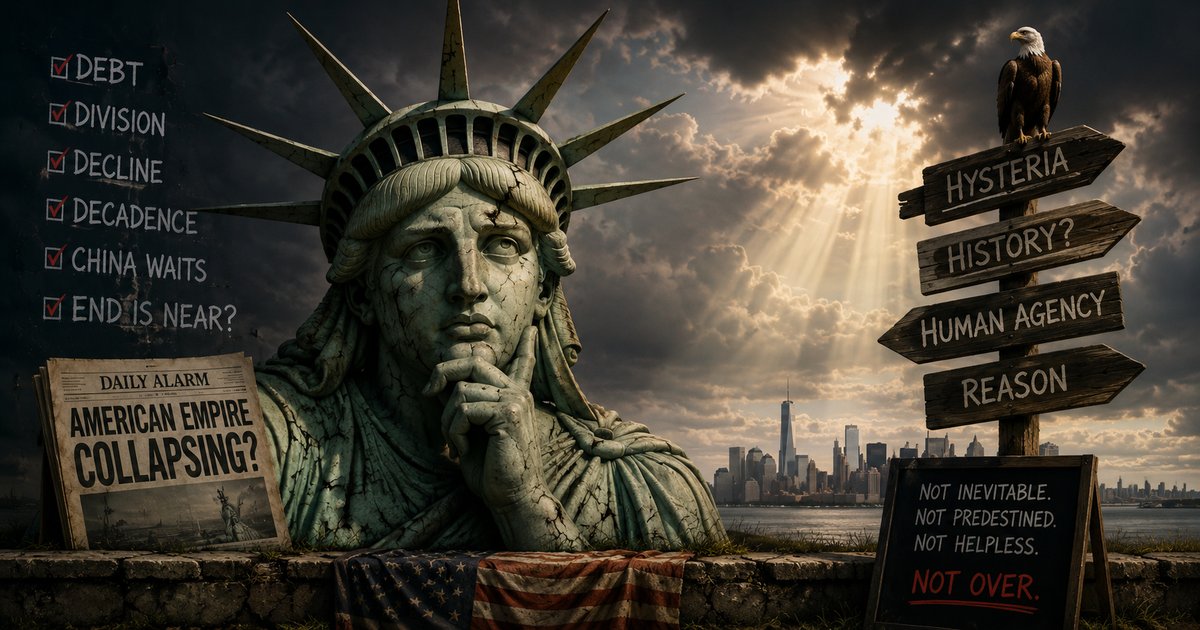
Every prosperous civilization eventually develops a class of well-appointed mourners. They sit comfortably amid abundance and announce, with an air of tragic sophistication, that the end is near. Rome is falling. The republic is dying. Barbarians gather at the gates. The currency is debased. The young are decadent. The enemy is patient. The center cannot hold.
The appetite for these pronouncements is perennial because decline is one of the few narratives that flatters both pessimists and elites simultaneously. It allows the speaker to appear prophetic while absolving him of the vulgar burden of optimism. One need not build anything. One need only gesture grandly toward entropy.
And so we arrive at the modern spectacle of billionaire Cassandras warning America of imperial doom.
The latest variation comes packaged in the language of systems theory and historical cycles. The United States, we are told, has entered the late phase of imperial decadence. Debt mounts. Political polarization deepens. China waits in silence like some patient mandarin dynasty observing the barbarian collapse from afar. The diagnosis is delivered with the grave confidence of a man reading blood pressure charts at the bedside of a dying republic.
But before surrendering ourselves to this theater of cultivated fatalism, one ought to ask a few elementary questions.
First: compared to what?
The declinist habit almost always depends upon an act of historical romanticism. America is compared not to the actual past, but to an imaginary one — a fictitious era of cohesion, competence, and virtue that never truly existed outside commemorative speeches and nostalgic documentaries.
The United States survived a civil war that killed hundreds of thousands of its own citizens. It survived industrial massacres, anarchist bombings, lynching, urban riots, world wars, McCarthyism, presidential assassinations, Watergate, stagflation, and the genuine nuclear possibility of planetary annihilation. During many of these moments, intelligent observers confidently predicted terminal collapse.
Yet the republic persisted.
Indeed, one notices something curious about open societies: they often appear weakest precisely because they conduct their arguments in public. Democracies advertise their disagreements. Authoritarian systems conceal theirs until the moment of rupture.
This is especially amusing in discussions of China, which is so often invoked as the patient and disciplined alternative to Western disorder. There is a peculiar naiveté among certain Western intellectuals regarding authoritarian competence. Because censorship suppresses visible dissent, outsiders mistake silence for stability. But opacity is not resilience. A system that cannot publicly argue cannot publicly correct itself either.
The Soviet Union appeared formidable until the week before it did not.
Nor is there anything especially novel about debt, political hysteria, or geopolitical rivalry. These conditions are not signs of uniquely American collapse; they are recurring features of modern statecraft. To elevate them into evidence of imminent civilizational death requires less historical rigor than theatrical instinct.
There is also something faintly comic about financiers discovering the moral hazards of materialism after benefiting spectacularly from it. One listens respectfully enough when hedge-fund managers warn against excess, but one cannot entirely suppress the suspicion that the sermon arrives after the collection plate has already passed.
Still, the more serious problem with the declinist mood is not that it is wrong in every respect. Nations can decay. Institutions can rot. Empires can overextend themselves. History contains graveyards full of vanished powers.
The problem is that the rhetoric of inevitability encourages passivity disguised as wisdom.
Once decline becomes destiny, citizenship gives way to spectatorship. Politics becomes astrology for educated adults. Every crisis is interpreted not as a contingent problem to be solved but as another sign in the sacred text of collapse. Inflation? Decline. Campus protests? Decline. Military stalemate? Decline. Social media hysteria? Decline. One begins to suspect that if the trains arrived early the declinists would interpret punctuality itself as evidence of imperial overstretch.
The healthier democratic instinct is more prosaic and less glamorous. It assumes that societies are not governed by mystical historical cycles but by institutions, incentives, leadership, public habits, technological change, and human choices. In other words: politics, not prophecy.
And here lies the concealed arrogance of grand theories of collapse. They diminish human agency while pretending to illuminate it. The citizen becomes merely a passenger strapped into the machinery of historical inevitability.
But history is littered with failed predictions precisely because human beings are adaptive creatures. They innovate under pressure. They reform badly designed systems. They muddle through. They improvise. They quarrel. They recover.
Indeed, much of what is currently described as evidence of American weakness may instead reflect the untidy vitality of a free society still capable of self-criticism. The argument itself is proof of remaining civic energy. Dead societies do not debate their future; they merely obey.
The old temptation is always the same: to mistake turbulence for doom.
Yet disorder is often the tax one pays for pluralism. A nation noisy with disagreement may be irritating, unstable, and vulgar. It may also be alive.
And perhaps that is the final irony. The societies most obsessed with preventing discord often become brittle. They suppress criticism in the name of unity and discover too late that unanimity is not strength but anesthesia.
The Greeks understood this better than many modern technocrats. They placed Eris — discord herself — among the gods because they recognized that conflict is ineradicable. The challenge of civilization is not to abolish disagreement but to survive it without surrendering either liberty or reason.
That task is difficult enough without the assistance of fashionable prophets announcing the end of the world from podcast studios and Aspen conferences.
Facts Only
* The decline narrative is presented as a way to flatter pessimists and elites.
* The United States is warned of imperial doom by some figures.
* The contemporary variation of this warning uses systems theory and historical cycles.
* The United States is compared to an imaginary past of cohesion, competence, and virtue.
* The United States survived civil war, industrial massacres, world wars, and nuclear possibility of planetary annihilation.
* Open societies often appear weakest because they conduct arguments in public.
* Authoritarian systems conceal disagreements until rupture.
* The Soviet Union appeared formidable until before its collapse.
* Debt, political hysteria, and geopolitical rivalry are recurring features of modern statecraft, not unique signs of American collapse.
* The argument is made that disorder is often the tax paid for pluralism.
Executive Summary
Full Take
The narrative of decline functions by exploiting a perceived vulnerability: the desire for order and certainty in a chaotic world. It frames contemporary turbulence not as contingent problems requiring adaptive solutions, but as a predetermined fate, which serves as a powerful emotional appeal that bypasses critical analysis. This is an example of emotional exploitation, leveraging fear of collapse to enforce passivity.
The core tension in the text lies between the perception of historical inevitability and the reality of human agency. The author effectively argues that focusing solely on grand historical cycles diminishes human capacity for innovation and self-correction, which is supported by the evidence of resilient societies that adapted under extreme pressure. The implication is that the decline narrative is a form of intellectual control, positioning the citizen as a passive spectator rather than an active agent.
The pattern detected is the use of historical macro-narratives to manage micro-level political anxiety. The narrative relies on false equivalence, equating adaptive, messy societal survival with a predetermined trajectory of fatalistic collapse. The root cause of this framing is the need to assign coherent meaning to uncontrollable crises. The ultimate implication is that intellectual humility—recognizing that societies are governed by dynamic institutions and choices, not mystical cycles—is essential for developing cognitive sovereignty. The cost of adopting the declinist mood is the suppression of civic energy and the abdication of the role of the active, critical citizen.
Sentinel — Human
This text reads as a carefully crafted philosophical essay rather than a standard news report; the strong, idiosyncratic voice and complex rhetorical weaving strongly suggest human authorship.