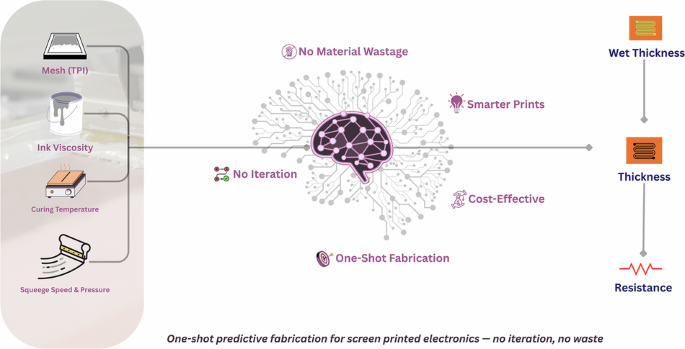
Abstract
Screen printing is a widely adopted technique in flexible printed electronics, but accurate control over deposition thickness and electrical resistance remains challenging due to complex interactions among process parameters. This study presents a two-stage neural network-based framework that predicts wet thickness, dry thickness, and electrical resistance from key printing parameters, including mesh count, ink viscosity, squeegee speed, and curing conditions. A Multi-Layer Perceptron (MLP) model, trained on experimentally collected data, achieves high predictive accuracy (R² > 0.98) with low mean squared error (MSE), effectively capturing nonlinear dependencies and curing-induced variations. Compared to traditional empirical models, the MLP approach eliminates trial-and-error iterations, reduces material waste, and enhances process reproducibility. The proposed framework enables real-time, data-driven optimization and offers a scalable solution for improving fabrication efficiency in printed electronics.
Data availability
A representative sample of the dataset used in this study has been made publicly available via GitHub at: https://github.com/celestialbody1 The complete datasets used and/or analyzed during the current study are available from the corresponding author on reasonable request.
Code availability
The implementation details, including the basic architecture and source code, are available at https://github.com/celestialbody1
References
Arias, A. C., MacKenzie, J. D., McCulloch, I., Rivnay, J. & Salleo, A. Materials and applications for large-area electronics: solution-based approaches. Chem. Rev. 110, 3–24 (2010).
Shang, J. et al. Fully screen printed stretchable liquid metal multilayer circuits using green solvents and scalable water-spray sintering. npj Flex. Electron. 9, 19 (2025).
Tüzün, E. et al. Dual-functionality of Hibiscus sabdariffa-CuO nanoparticles in chemotherapy and textile screen-printing on cellulose-based textiles. Cellulose 32, 2471–2488 (2025).
Afroj, S., Tan, S., Abdelkader, A. M., Novoselov, K. S. & Karim, N. Highly conductive, scalable, and machine washable graphene-based e-textiles for multifunctional wearable electronic applications. Adv. Funct. Mater. 30, 2000293 (2020).
Wei, R. et al. Revolutionizing wearable technology: advanced fabrication techniques for body-conformable electronics. npj Flex. Electron. 8, 83 (2024).
Lu, Q. et al. Strain-insensitive and multiplexed potentiometric ion sensors via printed PMMA molecular layer. Anal. Chim. Acta 1287, 342083 (2024).
Wu, Q. et al. Laser-assisted screen-printing of graphene folded reflectarray antenna for millimeter-wave applications. Carbon 227, 119235 (2024).
Azadmanjiri, J., Thuniki, N. R., Guzzetta, F. & Sofer, Z. Liquid metals-assisted synthesis of scalable 2D nanomaterials: prospective sediment inks for screen-printed energy storage applications. Adv. Funct. Mater. 31, 2010320 (2021).
Jha, S., Agrawal, H., Pant, B. K., Kumar, A. & Kumari, P. Fine line printing for solar cells with knotless screens. in Renewable Energy and Storage Devices for Sustainable Development, Vol. 1 (eds Jain, V. K., Gomes, C. & Verma, A.) 180–181 (Springer, 2022).
Lei, X. et al. Design and analysis of a novel compact metamaterial absorber based on double-layer ITO resistive film for improving signal integrity. IEEE Access 10, 24067–24079 (2022).
Hossain, M. A. et al. Tuning printability and adhesion of a silver-based ink for high-performance strain gauges manufactured via direct ink writing. ACS Omega 10, 1429–1439 (2025).
Wang, Y., Qu, Z., Wang, W. & Yu, D. PVA/CMC/PEDOT:PSS mixture hydrogels with high response and low impedance electronic signals for ECG monitoring. Colloids Surf. B Biointerfaces 208, 112088 (2021).
Ding, Y., Shi, Y., Yu, D. & Wang, W. All-in-one sandwich-like PVA/PEDOT:PSS/WPU electrodes with low impedance and high stretchability for ECG monitoring. Colloids Surf. A Physicochem. Eng. Asp. 675, 132060 (2023).
Lepola, P. et al. Screen-printed EEG electrode set for emergency use. Sens. Actuators A Phys. 213, 19–26 (2014).
Reddy, R. K., Gandla, S. & Gupta, D. Highly sensitive, rugged, and wearable fabric strain sensor based on graphene-clad polyester knitted elastic band for human motion monitoring. Adv. Mater. Interfaces 6, 1900409 (2019).
Yeo, W.-H. et al. Multifunctional epidermal electronics printed directly onto the skin. Adv. Mater. 25, 2773–2778 (2013).
Patil, N., Venkatesh, S., Swaminathan, P. & Sumathi, P. Design evaluation and performance analysis of silver nanoparticle ink-based printed heaters. Flex. Print. Electron. 10, 015001 (2025).
Sun, R. et al. High-speed sequential deposition of photoactive layers for organic solar cell manufacturing. Nat. Energy 7, 1087–1099 (2022).
Liu, Y. et al. Mathematical modelling of flow field in 3-dimensional additive printing. Int. J. Mech. Sci. 224, 107326 (2022).
Krammer, O. & Dušek, K. Numerical investigation on the effect of the printing force and squeegee geometry on stencil printing. J. Manuf. Process. 45, 188–193 (2019).
Kapur, N., Abbott, S. J., Dolden, E. D. & Gaskell, P. H. Predicting the behavior of screen printing. IEEE Trans. Compon. Packag. Manuf. Technol. 3, 465–473 (2013).
Tepner, S. et al. Screen pattern simulation for an improved front-side Ag-electrode metallization of Si-solar cells. Prog. Photovolt. Res. Appl. 28, 1054–1062 (2020).
Tepner, S. et al. Screen utility simulation—explaining the evolution and future of screen-printed metallization of Si-solar cells. Proc. EU PVSEC 433–443 https://doi.org/10.4229/EUPVSEC20202020-2CV.1.61 (2020).
Goh, G. L., Yap, Y. L., Zhang, H. & Yeong, W. Y. 3D printing of multilayered and multimaterial electronics: a review. Adv. Electron. Mater. 7, 2100913 (2021).
Rana, A. et al. Prediction of printing quality and output characteristics of printed electronics using machine learning models. J. Electron. Mater. 51, 4727–4737 (2022).
Zhang, X. et al. Multi-objective optimization of intense pulsed light sintering process for aerosol jet printed thin film. Mater. Sci. Addit. Manuf. 1, 100026 (2022).
Zhang, X., Wong, C. H. & Wang, Z. Hybrid machine learning method to determine the optimal operating process window in aerosol jet 3D printing. ACS Appl. Mater. Interfaces 11, 41638–41650 (2019).
Chen, K. et al. A comparative study of GNN and MLP based machine learning for the diagnosis of Alzheimer’s disease involving data synthesis. Neural Netw. 169, 442–452 (2024).
Pal, P. et al. Fault sensitivity analysis of printed bespoke multilayer perceptron classifiers. Proc. IEEE Eur. Test. Symp. (ETS) 2024, 1–6 (2024).
Kim, S. J. et al. Accelerated deep-learning-based process monitoring of microfluidic inkjet printing. CIRP J. Manuf. Sci. Technol. 46, 65–73 (2023).
Jeong, J.-W. et al. Materials and optimized designs for human-machine interfaces via epidermal electronics. Adv. Mater. 25, 6839–6846 (2013).
LeCun, Y., Bottou, L., Bengio, Y. & Haffner, P. Gradient-based learning applied to document recognition. Proc. IEEE 86, 2278–2324 (1998).
Choi, E. et al. Image-based impedance spectroscopy for printed electronics. npj Flex. Electron. 9, 11 (2025).
Nguyen, J. D., Kumar, S., Frisbie, C. D. & Francis, L. F. Leveraging process fundamentals to improve semiconductor thickness control and uniformity in inkjet-printed Schottky diodes. ACS Appl. Eng. Mater. 2, 693–705 (2024).
Zeng, M. et al. High-throughput printing of combinatorial materials from aerosols. Nature 617, 292–298 (2023).
Chen, X. et al. 3D-printed hierarchical pillar array electrodes for high-performance semi-artificial photosynthesis. Nat. Mater. 21, 811–818 (2022).
Zhang, L. et al. Vertically grown metal nanosheets integrated with atomic-layer-deposited dielectrics for transistors with subnanometre capacitance-equivalent thicknesses. Nat. Electron. 7, 662–670 (2024).
Rajak, P. et al. Autonomous reinforcement learning agent for chemical vapor deposition synthesis of quantum materials. npj Comput. Mater. 7, 108 (2021).
Zhang, P. et al. Fabrication of nano copper highly conductive and flexible printed electronics by direct ink writing. ACS Appl. Mater. Interfaces 17, 1847–1860 (2025).
Dabbagh, S. R., Ozcan, O. & Tasoglu, S. Machine learning-enabled optimization of extrusion-based 3D printing. Methods 206, 27–40 (2022).
Choudhury, A., Mondal, A. & Sarkar, S. Searches for the BSM scenarios at the LHC using decision tree-based machine learning algorithms: a comparative study and review of random forest, AdaBoost, XGBoost and LightGBM frameworks. Eur. Phys. J. Spec. Top. 233, 2425–2463 (2024).
Huang, X., Ng, W. & Yeong, W. Predicting the number of printed cells during inkjet-based bioprinting process based on droplet velocity profile using machine learning approaches. J. Intell. Manuf. 35, 2349–2364 (2024).
Mustapha, I. B. et al. Comparative analysis of gradient-boosting ensembles for estimation of compressive strength of quaternary blend concrete. Int. J. Concr. Struct. Mater. 18, 20 (2024).
Acknowledgements
The authors express their sincere gratitude to Prasad Date from Avery Dennison and Harshad Murlidhar Thombare from SEFAR for their valuable support and data contributions. The authors also thank Afferent Technology Pvt. Ltd. for their assistance in screen printing experiments. The authors acknowledge the FedEX Center at IIT Bombay for their support.
Author information
Authors and Affiliations
Contributions
A.N.K.R. conceived the idea, performed the experiments, developed the neural network framework, and wrote the main manuscript. S.S.D. contributed to data generation, assisted in experiments, and supported manuscript editing. P.K. helped with experimental execution, benchmarking, and code management. R.R. contributed to the development of the neural network code and supported result interpretation. D.G. supervised the project, provided conceptual guidance, and critically reviewed the manuscript. All authors reviewed and approved the final version of the manuscript.
Corresponding authors
Ethics declarations
Competing interests
The authors declare no competing interests.
Additional information
Publisher’s note Springer Nature remains neutral with regard to jurisdictional claims in published maps and institutional affiliations.
Supplementary information
Rights and permissions
Open Access This article is licensed under a Creative Commons Attribution 4.0 International License, which permits use, sharing, adaptation, distribution and reproduction in any medium or format, as long as you give appropriate credit to the original author(s) and the source, provide a link to the Creative Commons licence, and indicate if changes were made. The images or other third party material in this article are included in the article’s Creative Commons licence, unless indicated otherwise in a credit line to the material. If material is not included in the article’s Creative Commons licence and your intended use is not permitted by statutory regulation or exceeds the permitted use, you will need to obtain permission directly from the copyright holder. To view a copy of this licence, visit http://creativecommons.org/licenses/by/4.0/
About this article
Cite this article
Konda Ravindranath, A.N., Domala, S.S., Kannan, P. et al. Neural network framework for predicting deposition thickness and electrical resistance in printed electronics. npj Flex Electron (2026). https://doi.org/10.1038/s41528-025-00471-y
Received:
Accepted:
Published:
DOI: https://doi.org/10.1038/s41528-025-00471-y
Facts Only
A two-stage neural network framework predicts wet thickness, dry thickness, and electrical resistance in screen-printed flexible electronics.
The framework uses a Multi-Layer Perceptron (MLP) model trained on experimental data.
Key input parameters include mesh count, ink viscosity, squeegee speed, and curing conditions.
The model achieves high predictive accuracy (R² > 0.98) and low mean squared error (MSE).
The approach reduces trial-and-error iterations, material waste, and improves process reproducibility.
A representative dataset is publicly available on GitHub, with full datasets accessible upon request.
The code implementation is also available on GitHub.
Industry collaborators include Avery Dennison, SEFAR, and Afferent Technology Pvt. Ltd.
Experimental support was provided by the FedEX Center at IIT Bombay.
The study is published in *npj Flexible Electronics* under an open-access license.
Authors include A.N. Konda Ravindranath, S.S. Domala, P. Kannan, R. R., and D. G.
The research was conducted at IIT Bombay.
Executive Summary
Full Take
This study presents a compelling advancement in the fabrication of flexible printed electronics by replacing traditional empirical methods with a data-driven neural network approach. The strongest version of this narrative highlights its potential to streamline manufacturing processes, reduce waste, and improve consistency—critical factors in scaling up printed electronics for commercial applications. The integration of machine learning into screen printing optimization aligns with broader trends in Industry 4.0, where predictive modeling is increasingly used to enhance precision and efficiency.
However, the narrative assumes that the neural network's high accuracy in controlled experimental conditions will translate seamlessly to real-world manufacturing environments, where variability in materials, equipment, and environmental factors may introduce unforeseen challenges. The study acknowledges the need for further validation but does not deeply explore potential limitations, such as the generalizability of the model across different ink formulations or substrate materials. Additionally, while the framework reduces trial-and-error iterations, it still relies on high-quality experimental data, which may not be readily available in all manufacturing settings.
The broader implication of this work is the shift toward automation and AI-driven optimization in electronics manufacturing, which could democratize access to high-precision fabrication techniques. Yet, this also raises questions about the accessibility of such tools for smaller manufacturers or research labs with limited resources. Who stands to benefit most from this innovation—large-scale producers with existing data infrastructure, or will it trickle down to smaller players? Furthermore, the reliance on neural networks introduces dependencies on data quality and model interpretability, which could become points of failure if not carefully managed.
A critical question to consider: How might this framework adapt to novel materials or emerging printing techniques not represented in the training data? Additionally, what safeguards are in place to ensure that the model's predictions remain robust as manufacturing conditions evolve?
Patterns detected: none
If this narrative were part of a coordinated influence campaign, the playbook might emphasize the transformative potential of AI in manufacturing while downplaying practical challenges or resource disparities. However, the content itself appears to be a genuine scientific contribution, with transparent methodology and open-access data, suggesting no alignment with manipulative patterns.
Sentinel — Human
Sentinel analysis incomplete — fallback model returned prose instead of JSON.