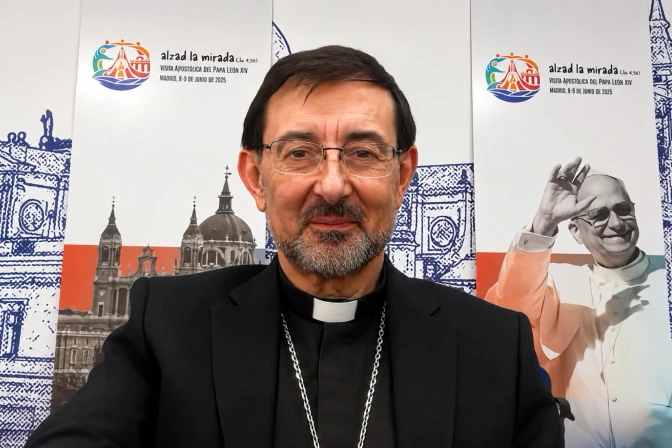
Madrid Archbishop Cardinal José Cobo Cano said that the imminent visit of Pope Leo XIV to Spain has generated “incredible expectations” and that the main challenge will not only be organizational, but pastoral.
“The challenge is that it is not an event. We are used to concerts, which are prepared, closed and thatʼs it," he said in an interview with EWTN News about the preparations for the trip of Pope Leo XIV, who will visit Madrid, Barcelona and the Canary Islands from June 6 to 12.
He expressed hope that the visit will be “a moment of experience and ... a moment also that will be slow, that it helps us to look up and take a step forward.”
Preparations in record time
Cardinal Cobo explained that the visit has been organized in “record time,” with just three months of work, and with a much greater social and ecclesial response than expected.
“We have had three scarce months to prepare a trip, during which we have also found that there is a great desire and an incredible expectation. I think we thought it was going to be something [for which] we had to motivate [Catholics] a lot, but nothing was needed,” he said.
As he highlighted, the popeʼs program in Madrid has been designed as a “pastoral triptych” with three major components: the celebration of the Eucharist on the feast of Corpus Christi, the great meeting with the Church of Madrid at the Santiago Bernabéu stadium, and a space for dialogue with leaders of culture, economy and sport.
“The celebration of the Eucharist, [especially on] Corpus Christi — which is a very important holiday for us — and celebrating it with the successor of Peter, is a gift for the whole Church of Madrid and for the whole Church of Spain, because they will come from all places. This is the most celebratory central moment,” said the cardinal.
The pope and “politics with capital letters”
In Coboʼs opinion, one of the most delicate moments will be the appearance of the Holy Father in the Cortes, or the Spanish parliament, before a joint session of both the Congress of Deputies and the Senate.
Cobo warned that he is concerned that a message about “politics with capital letters” may be reduced to a partisan reading.
“In a society where we are used to talking about political parties, that moment is important,” he said.
“Of course the intention is that the pope will come, that he will support politicians, that he will support politics and that he will thus be able to reinforce democracy from the experience and tradition of the Church,” he said.
Asked if the recent accusation of alleged corruption of the former Spanish Prime Minister José Luis Rodríguez Zapatero could have any impact on the visit, Cobo indicated it was unlikely.
“We are used to working with many events in political life. Thatʼs already part of life and the headlines are moving,” he said. “I think the good thing about a papal visit is that ... it can help us look up and see that despite the political situation that is painful ... there is a higher level.”
“There is another level, a level that speaks to us of hope, it is a level that speaks to us of responsibility, that speaks to us of ethics,” he said.
“I believe that we are not going to contradict one thing with another, but we are going to get used to being also in another space, which is that of non-confrontation and welcoming wounds and difficulties and putting them in front of the space of meaning that life gives and that faith tells us.”
The hope of the young, and not so young
The cardinal also noted that for young people the visit could represent a response to a climate of “disorientation”, “uprooting” and “hopelessness.”
He maintained that many are looking for “anchors” and answers about the meaning of life, something that, in his opinion, explains the renewed interest in the figure of the pope among new generations.
“I think it is a response to a longing that young people have ... and not only young people, I think it is from a very broad generation, I believe that there is an experience of a certain discomfort, a disorientation ... a certain de-rooting. People need anchors that they donʼt have.”
A meeting between Pope Leo XIV and Bad Bunny?
Regarding the coincidence of the popeʼs presence in Madrid occurring at the same time as the rapper Bad Bunnyʼs concerts, Cobo did not close the door to a possible meeting, although he left it in the hands of both parties.
“The pope is never closed to talking to anyone who wants to enter into dialogue with him,” he said.
“If at some point that can happen, we wouldnʼt rule it out of course, but that depends on the two of them. What is certain is that indeed Madrid is very big and can have different events on the same day,” he said.
Sign up for the EWTN News Email and Stay Connected
In addition, the pope will declare four other religious from various countries as venerable.
Facts Only
* The visit of Pope Leo XIV is scheduled for June 6 to 12 in Madrid, Barcelona, and the Canary Islands.
* Preparations for the trip were organized in three months.
* The program in Madrid includes the celebration of the Eucharist on the feast of Corpus Christi, a meeting at the Santiago Bernabéu stadium, and dialogue with leaders in culture, economy, and sport.
* The visit is intended to be a moment of experience and a step forward.
* The Cardinal expressed concern that a message about "politics with capital letters" could be reduced to a partisan reading.
* The Cardinal stated that the papal visit can help people see a higher level of hope, responsibility, and ethics despite political pain.
* The visit is viewed by young people as a response to a climate of disorientation and a search for anchors.
* The Pope will declare four other religious from various countries as venerable.
Executive Summary
Full Take
The narrative positions the papal visit not merely as a religious event but as a necessary corrective mechanism for societal fragmentation. The focus on "disorientation" and the search for "anchors" targets a widespread psychological and generational discomfort, framing the religious visit as a therapeutic response to contemporary angst. This framing allows the event to bypass specific political conflicts and address existential needs, thereby achieving broad emotional buy-in.
The handling of the political dimension is a critical point of tension. By explicitly warning against the interpretation of the visit as a partisan tool ("politics with capital letters"), the text attempts to inoculate the event from cynical political exploitation. However, the subsequent argument—that the visit offers a "higher level" of ethics and non-confrontation—subtly shifts the focus from political outcome to moral aspiration. This is a classic maneuver: transforming a potentially divisive political act into a universally palatable moral experience.
The connection drawn between the papal visit and the desire for stability among youth suggests a systemic pattern: when external structures (political, economic) fail to provide concrete meaning, people seek transcendent, unambiguous authority. The concern regarding the potential for dialogue with figures like Bad Bunny highlights the real-world pressure to reconcile sacred authority with contemporary cultural figures, emphasizing that even spiritual authority is permeable to secular celebrity and shared cultural moments. The implicit question is whether this synthesis of faith and celebrity serves genuine liberation or merely acts as another system of managed comfort in an unstable world.
Sentinel — Human
The analysis reads as a high-quality, human-sourced interview transcript, exhibiting a nuanced, reflective tone rather than the mechanical uniformity of synthetic content.