Nuclear Integration With Russia Eroding Belarusian Sovereignty
Executive Summary:
- Russia and Belarus conducted joint nuclear exercises in May involving Belarusian missile units and aircraft training to receive, handle, and prepare Russian tactical nuclear weapons, signaling deeper integration of Belarus into Moscow’s nuclear command structure.
- Since Russia’s full-scale invasion of Ukraine, Belarus has increasingly functioned as a Russian military and hybrid operations staging ground, shifting the line of strategic confrontation to NATO’s eastern borders. Belarusian President Alyaksandr Lukashenka’s dependence on Moscow after the 2020 protests has reduced Minsk’s defense and foreign policy autonomy.
- Belarus’s official abandonment of a non-nuclear status in 2022 and the deployment of Russian tactical nuclear warheads and advanced delivery systems on Belarusian territory in 2023 have dismantled the post-Soviet security architecture, establishing a permanent platform for Russian nuclear blackmail against NATO.
- Any future European security arrangements that fail to address Belarus’s military status will leave a critical source of instability unresolved. Belarus’ military sovereignty and demilitarization should be a central issue on the future diplomatic agendas.
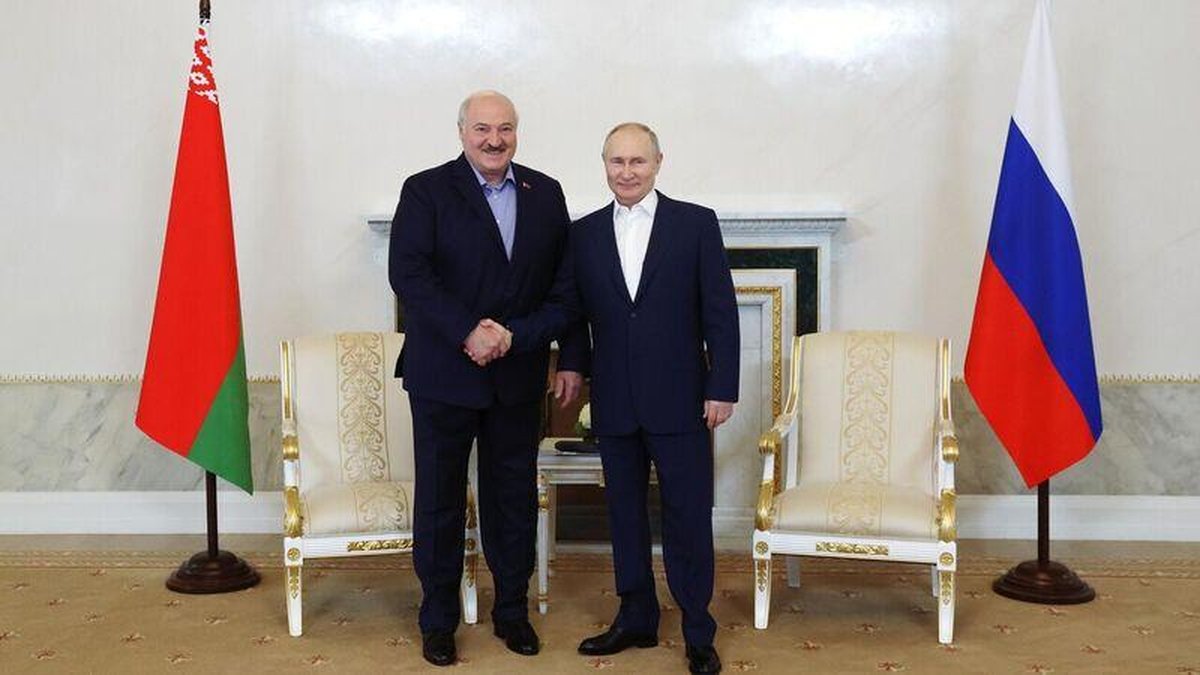
Belarus served as one of the principal venues for a new phase of joint Russian–Belarusian nuclear exercises in May (see EDM, June 30). The drills involved Belarusian missile units and aircraft training with Russian tactical nuclear weapons, including procedures for receiving, handling, and preparing nuclear munitions for employment. The Russian and Belarusian leaders jointly oversaw the exercises, which Moscow described as the first integrated training of the two countries’ strategic and tactical nuclear forces. These exercises, conducted on the North Atlantic Treaty Organization’s (NATO) eastern frontier, demonstrated the growing integration of Belarus into Russia’s nuclear command architecture and reinforced its role as a forward platform for Moscow’s nuclear posturing toward the Alliance (TASS, May 19; President of Russia, May 21). Russia’s use of Belarus as a military-strategic staging ground since 2022 is a radical shift in the architecture of European security. Over the past few years, Belarus has lost much of its autonomy in foreign policy and defense and has likely become a permanent platform for Russian force projection, extended directly to the borders of Poland, Lithuania, and Latvia.
Belarus’s current military relationship with Russia has undermined Minsk’s adherence to the 1994 Budapest Memorandum. Belarus, Ukraine, and Kazakhstan agreed to the full withdrawal of Soviet strategic nuclear weapons from their territory under this memorandum. In exchange, nuclear powers, including Russia, the United States, and the United Kingdom, committed to respecting the independence, sovereignty, and existing borders of these states and to refrain from economic or military pressure (United Nations Treaty Collection, December 5, 1994). Since relying on Russia for economic and political support during and after large-scale pro-democracy protests in 2020 ahead of Belarus’ presidential elections, Belarusian President Alyaksandr Lukashenka has ceded much of his autonomy in defense and foreign policy to Russian President Vladimir Putin. Before the protests, Lukashenka often resisted Kremlin pressure and balanced competition between Russia and the West to ensure his autonomy. After relying on Putin to survive the 2020 protests and ongoing international sanctions, Lukashenka is dependent and increasingly responsive to Putin’s demands.
The withdrawal of nuclear arsenals from Belarus was completed in November 1996, when the last “Topol” intercontinental ballistic missiles (ICBMs) were sent to the Russian Federation. This step was positioned as a key contribution to international détente and the strengthening of the global non-proliferation regime. The Budapest Memorandum did not require parliamentary ratification and, as later became clear, was merely an agreement of intent without binding obligations (RBC, February 16, 2022). Russia’s war against Ukraine and the subsequent political and military absorption of much of Belarus’ sovereignty by Moscow have devalued the agreements of thirty years ago.
In December 2021, Russia publicly issued ultimatums to the United States and NATO regarding security guarantees. In draft treaties published at that time, Moscow officially proposed that the United States completely “exclude the deployment of nuclear weapons outside its national territory” (RBC, December 17, 2021). Having failed in its diplomatic pressure, the Kremlin moved to put tactical nuclear weapons in Belarusian territory. On February 27, 2022, just three days after Russia’s full-scale invasion of Ukraine, Belarus held a constitutional referendum. The updated text of the Basic Law entirely removed the article concerning the state’s aspiration for a non-nuclear status and neutrality. This referendum opened the door for Moscow to officially deploy its nuclear forces on Belarusian territory (DW, March 1, 2022). By June 2023, the Kremlin had deployed tactical nuclear weapons in Belarus, marking the first known peacetime deployment of Russian nuclear weapons outside Russia since the collapse of the Soviet Union in 1991 (see EDM, May 9, 23, 2024, March 13, April 17, 2025).
Moscow has consistently worked to increase its operational and administrative control over the Armed Forces of Belarus. The creation of joint training and combat centers for Belarus’ Air Force and Air Defense in Grodno and Baranovichi has cemented the presence of the Russian military on Belarusian soil (BelTA, March 16, 2021). Connections between the Belarusian and Russian railways have been modernized, allowing the end-to-end transfer of troops from the depths of Russia to the borders of NATO in a matter of days.
Belarus no longer serves as a buffer zone between NATO and Russia. It can be viewed as an integrated military district of the Russian Federation, diminishing NATO’s strategic depth in the region. Belarus risks losing even the formal signs of military-political independence. If current integration dynamics continue, Moscow will be able to build Belarusian territory even more deeply into its own military planning, effectively shifting the line of strategic confrontation several hundred miles toward the borders of Poland, Lithuania, and Latvia. In that case, Belarus would turn into an element of Russian defense infrastructure, complicating any future negotiations on European security.
Belarusian Su-25 attack aircraft have been modernized for the use of special aviation munitions, and Minsk has received Iskander-M operational-tactical missile systems from Russia with a range of up to 500 kilometers (311 miles) (see EDM, June 30). The construction and certification of positioning areas and storage facilities are carried out under the strict control of the Russian Ministry of Defense. The Belarusian side does not have independent access to the charges, which excludes Minsk from the decision-making chain but makes it a direct accomplice in nuclear blackmail.
The deployment of Russian nuclear-capable systems in Belarus has raised renewed concerns about the credibility of the global non-proliferation regime while reinforcing Moscow’s strategy of nuclear coercion toward NATO (see Special Report, February 5; see EDM, March 26). The forward positioning of dual-capable missile systems shortens warning and response times for potential targets across Europe, increasing the psychological and strategic pressure on neighboring states. Moreover, repeated statements by Moscow and Minsk regarding the deployment of the intermediate-range Oreshnik missile system indicate that Belarus is becoming a long-term platform for Russian nuclear signaling rather than a temporary location for military deployments (see EDM, January 13, July 15).
Belarus forms a geographic pincer around the Baltic states. It is separated from Russia’s Kaliningrad semi-exclave by the Suwałki Gap, a narrow 65-kilometer (40-mile) isthmus connecting Poland and Lithuania. The closure of the Suwałki Gap would sever the Baltic states’ only land connection to the rest of NATO, significantly complicating reinforcement efforts and increasing the risk that Russia could isolate the region during a conflict (see EDM, June 3, 2025). In such a scenario, the corridor would be under threat from Russian anti-access and area-denial (A2/AD) capabilities deployed in Belarus’ Grodno and Brest oblasts.
NATO faces significant challenges in responding to potential Russian aggression against the Baltic states, particularly because of geographic constraints and Russia’s proximity. Potential options include strengthening forward conventional deterrence, expanding missile defense systems, increasing NATO’s long-range strike capabilities, and revising its nuclear deterrence policy.
Integration processes within the Union State have led to the liquidation of Minsk’s military-political agency [1]. Belarus has completely lost its status as a regional buffer, turning into an advanced nuclear outpost and an operational base for the Russian Federation’s hybrid warfare against NATO. In the event of a hypothetical clash between Russia and NATO, Belarusian military infrastructure, command posts, and supply depots could be viewed by alliance planners as combatants and legitimate targets from the first minutes of the conflict. For the West, deterring threats emanating from Belarusian territory has turned into a long-term strategic task requiring a permanent military presence and deep integration of air and missile defense systems along the entire line of contact.
The main escalation in Belarus’ military integration with Russia is the institutional inclusion of Belarusian space into a unified Russian system of strategic planning. Belarus has become a seemingly permanent element of Russian military architecture, changing the geography of deterrence, the structure of risks, and NATO’s long-term defense planning. In 2022, Russia used Belarusian territory as a staging ground to invade Ukraine. Consequently, a long-term European security system cannot view the Belarusian border as a secondary issue. Any future agreements on European security that do not affect the military status of Belarus will leave one of the key sources of instability unresolved. One of the key issues for future negotiations will be the status of Belarus, including guarantees of sovereignty, restrictions on foreign military presence, the presence of nuclear weapons, and the parameters of possible demilitarization. Without resolving these issues, the sustainability of any new European security architecture will remain limited.
Note:
[1] The Union State is a supranational union comprising Belarus and Russia, with the stated aim of deepening the relationship between the two states through integration in economic and defense policy.