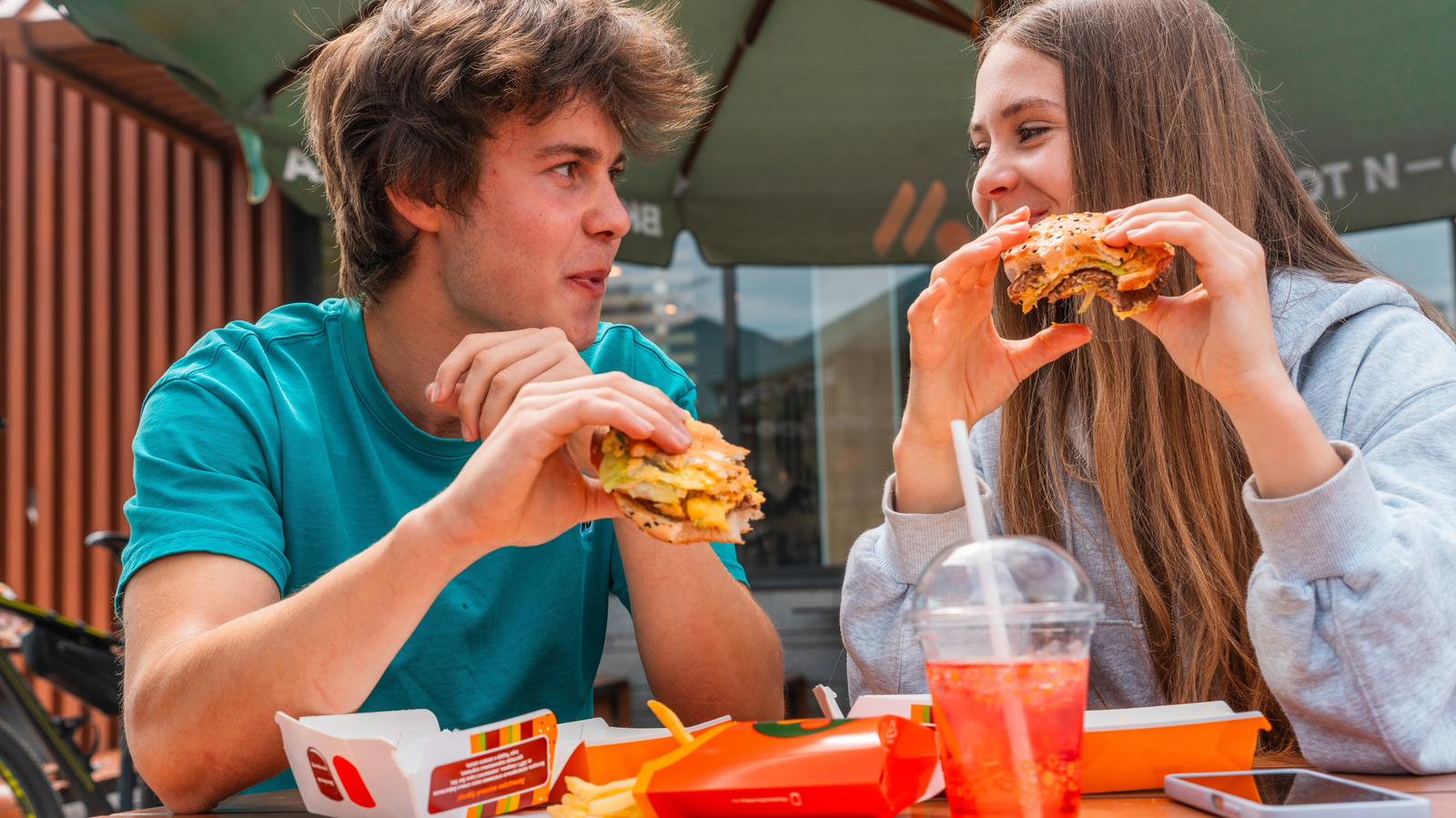
Hunger strikes, and those tummy grumbles are steering you toward the Golden Arches. But, in these inflation-plagued times, once-affordable McDonald's is now among fast-food burger chains that customers consider overpriced. A Big Mac, for instance, can cost over $8 for just the sandwich, depending on where you live. What to do?
Hiked prices have done away with the Dollar Menu McDonald's had back in fast food's glory days, replacing it with the McValue menu, which has prices ranging from around $6 on down, depending on location. But while there certainly isn't anything that costs $1 anymore, it's still possible to score a reasonably-ish priced burger at Mickey D's.
As of June 2026, the lowest-cost sammie on the menu, not surprisingly, is the regular hamburger — no cheese, no frills. Just a beef patty, ketchup, mustard, pickles, and chopped onions. The price of this most basic of all McD's burgers ranges from around $1.69 at the lower end to close to $4 at the high end.
While this burger is the cheapest at McDonald's in 2026, the drawback is it's very small — the patty is only ⅒ of a pound, or 1.6 ounces. That's about the weight of a hard-boiled egg. I don't know about you, but a single boiled egg doesn't satisfy my appetite, much less sustain me. With a modest 12 grams of protein, McD's basic hamburger will never rank among fast-food burgers with the most protein, and at just 250 calories, this teeniest of McBurgers really isn't enough to fill up on, meaning you may need at least two or three to feel reasonably full. At that point, you haven't really saved money and were better off spending a bit more for a more fulsome burger.
Other, more filling McDonald's burgers that are still on the affordable side
Which brings us to some other McOptions that are more filling without being total bank-busters. Your second and third runners-up for cheapest McDonald's burger are the Double Hamburger and the McDouble, both of which have two beef patties and a little more pith. Pricewise, these sammies are still reasonably affordable options.
At the McDonald's in Stigler, Oklahoma, identified as one of the cheapest Mickey D's in the United States (per price tracking site McCheapest), you'll pay just $1.99 for a Double Hamburger and $2.49 for a McDouble. At the McDonald's on Interstate 95 in Darien, Connecticut, noted as one of the most expensive Mickey D's in the United States, a Double Hamburger will cost you $4.79, while a McDouble rings up at $5.59. This location is a rest stop-slash-service center that caters to truck drivers and travelers, which would explain the expensive price gouge — truck stops are notorious for having higher-than-average fast-food prices. Even at that top end, though, these burgers will give you a more filling, quick-bite option without totally draining your wallet.
A Double Hamburger is largely the same as the classic burger — same bun and topped with ketchup, mustard, pickles, and onions — but it doubles up on the beef, delivering two patties. This brings the calorie and protein counts to a more filling 340 and 20 grams, respectively.
The McDouble only differs slightly from the Double Hamburger in its composition, having all the same toppings but adding a single slice of American cheese. It weighs in at 390 calories, with 22 grams of protein.
Facts Only
The lowest-cost sandwich available is the regular hamburger, with prices ranging from $1.69 to $4.00.
The McValue menu ranges from approximately $6.00.
The basic hamburger weighs 1.6 ounces (250 calories) and contains 12 grams of protein.
The Double Hamburger costs $1.99 at the McDonald's in Stigler, Oklahoma.
The McDouble costs $2.49 at the McDonald's on Interstate 95 in Darien, Connecticut.
The Double Hamburger provides 340 calories and 20 grams of protein.
The McDouble provides 390 calories and 22 grams of protein.
Executive Summary
Full Take
The narrative juxtaposes extreme price inflation with minimal nutritional return, establishing a tension between perceived affordability and actual consumer value. The data highlights how economic pressure forces menu evolution (McValue) while maintaining access to cheap food items that offer poor caloric or protein density. This framing suggests that cost-cutting by corporations is not solely driven by operational efficiency but also leverages market anxiety to redefine what constitutes an "affordable" meal for the consumer. The structure of the analysis implicitly directs attention toward the *deficit* (low protein, low calories) when focusing on the *cost*.
The pattern detected is ARC-0043 Motte-and-Bailey regarding false equivalence: comparing a minimal quantity burger to a more substantial one and implying that price difference alone justifies the selection. This exploits the psychological tendency to associate higher cost with greater quality or satisfaction, irrespective of the tangible nutritional data. The root cause driving this narrative is the manipulation of public fear related to inflation, positioning the cheapest items not as genuine value, but as insufficient compromises.
The implications concern consumer agency: when prices are inflated, consumers must navigate a landscape where cheaper options exist but offer less actual sustenance. This dynamic tests whether economic necessity overrides nutritional mandates and whether market behavior can be successfully reframed through emotional appeals rather than objective data about satiety and health.
Sentinel — Human
The article exhibits a style and voice consistent with human journalistic or blog writing, utilizing personal commentary while incorporating specific data points that suggest real-world research.