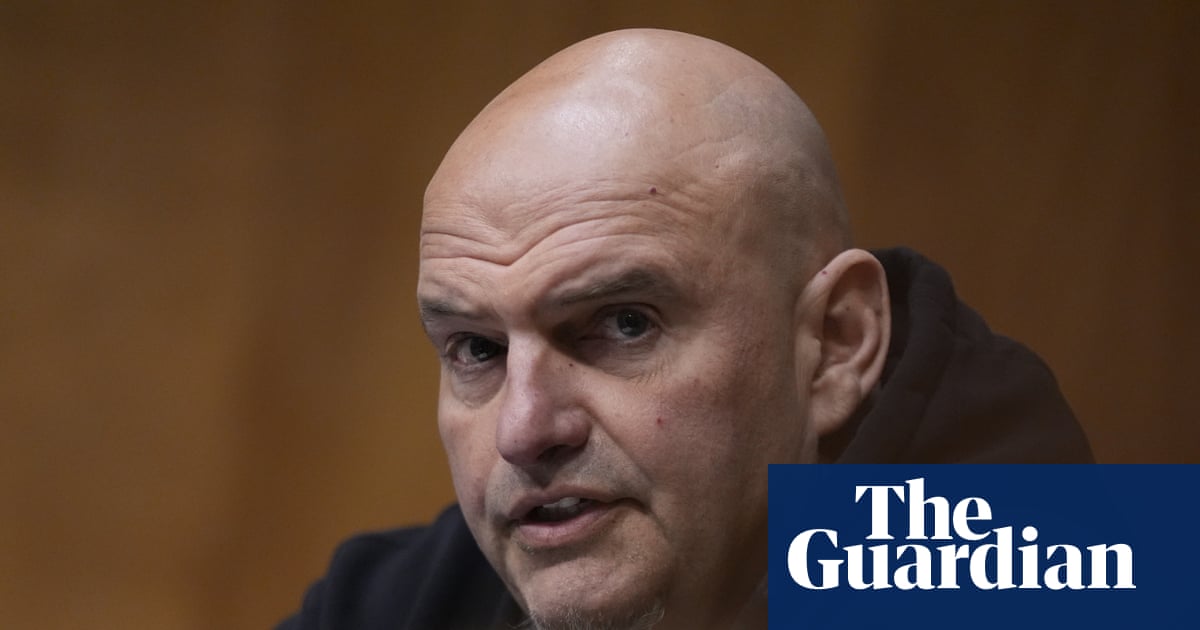
Democrats reacted with outrage to their party colleague John Fetterman’s decision to advance the nomination of Republican US senator Markwayne Mullin as homeland security secretary.
Fetterman, the senior US senator from Pennsylvania, has in recent months broken with the party several times to support Republican proposals, and has routinely expressed staunch support for Israel. He cast the decisive committee vote on Thursday to advance Mullin’s nomination to succeed Kristi Noem as homeland security secretary.
That prompted US House member Brendan Boyle, another Pennsylvania Democrat, to say that the vote showed why Fetterman was Donald Trump’s “favorite Democrat”.
“He needs to go,” Boyle added.
US House member Pat Ryan, a New York Democrat, said: “If you needed any more proof that Fetterman has completely abandoned his constituents, here it is. Pennsylvanians deserve a senator that actually fights for them.”
Meanwhile, at a town hall on Thursday night, US House member Chrissy Houlahan – another Pennsylvania Democrat – suggested Fetterman was more difficult to work with than the their state’s junior senator, Republican Dave McCormick.
“Well, we have this senator – we have two, actually … and I have to be really honest with you, of the two I have more success in working with the one on the [Republican] side of the aisle than the one on the [Democratic] side of the aisle,” Axios reported Houlahan saying.
Writing on X, Fetterman on Thursday alluded to how he had called on Trump to fire Noem from his presidential administration after federal immigration agents under her purview fatally shot two US citizens in January.
“And he did” fire Noem, Fetterman wrote, adding: “I truly approached the confirmation of my colleague and friend, Senator Mullin, with an open mind.”
Fetterman also alluded to how he voted “aye” in favor of appointing Mullin because he disagrees with his Democratic colleagues who have refused to fund the Department of Homeland Security in a bid to leverage immigration enforcement reforms, causing various DHS agencies to be temporarily shut down.
“We need a leader at DHS. We must reopen DHS,” Fetterman wrote. “My AYE is rooted in a strong committed, constructive working relationship with Senator Mullin for our nation’s security.”
Fetterman was the only Democrat to join seven Republicans on the Senate committee on homeland security and governmental affairs in advancing Mullin’s nomination from the panel to the full chamber. The Senate could confirm Mullin, of Oklahoma, next week.
Six other Democrats joined committee chair Rand Paul – a Kentucky Republican – in voting against advancing Mullin’s nomination, particularly due to their concerns over allegations that the nominee had encouraged political violence.
Facts Only
* John Fetterman, a US Senator from Pennsylvania, supported the nomination of Markwayne Mullin as Homeland Security Secretary.
* Markwayne Mullin is a Republican US Senator from Oklahoma.
* Kristi Noem was previously the Homeland Security Secretary.
* The vote was on Thursday.
* Brendan Boyle, a Pennsylvania Democrat, criticized Fetterman’s vote.
* Pat Ryan, a New York Democrat, expressed dissatisfaction with Fetterman’s actions.
* Chrissy Houlahan, another Pennsylvania Democrat, found Fetterman more difficult to work with than the Republican senator Dave McCormick.
* Fetterman cited disagreements over DHS funding and immigration reform as reasons for his vote.
* Seven Republicans joined Fetterman in advancing Mullin’s nomination.
* Six Democrats, including Rand Paul, voted against the nomination.
* Allegations of political violence against Mullin were cited as a reason for opposition.
Executive Summary
Full Take
The article exposes a core tension within the contemporary American political landscape – the increasingly fragmented loyalties of the Democratic party. Fetterman’s vote isn’t simply about Mullin; it's about a calculated break with established Democratic orthodoxy, mirroring the strategies of figures like Trump while simultaneously attempting to portray himself as pragmatic. The “steelman” version of this narrative is that Fetterman, recognizing the potential for DHS to be effective under a Republican leader, prioritized a functioning government over ideological purity. This immediately triggers ARC-0043 Motte-and-Bailey, because the article doesn't address the valid criticisms of Mullin’s record or the potential risks of his appointment, merely framing it as a strategic move. The pattern of "emotionally exploitative" rhetoric is evident in Boyle and Ryan's language, designed to generate outrage and drive home the perceived betrayal of their voters. The reliance on a “false equivalence” – equating Fetterman’s actions with Trump’s – further complicates the situation, likely intended to discredit him within the Democratic base. Furthermore, the source’s framing implicitly adopts a cynical view of political actors, suggesting that all action is driven by self-interest. Rooted in a historical echo of factionalism within the early American republic, this narrative underscores the challenges of governing in a deeply polarized environment. The implications are considerable: it demonstrates the potential for political figures to prioritize short-term gains over long-term policy goals, eroding public trust and further exacerbating divisions. The fact that Fetterman uses Trump’s firing of Noem as justification is a clear strategic move designed to preempt criticism and position himself as a sympathetic figure, despite the underlying issues. This represents a sophisticated, if ultimately self-serving, form of “systemic” manipulation. If this trend continues, it represents a significant decay of democratic norms.
Questions: How are individual politicians strategically deploying the rhetoric of “national security” to advance their own political agendas? What assumptions underlie the implicit narrative that any decision is “good for America” when made by a political figure?
Sentinel — Likely Human
This article presents a straightforward account of Senator Fetterman's actions and the reactions of his fellow Democrats, exhibiting features common in human-authored news reports but with a slight degree of stylistic uniformity suggesting potential assistance in production.