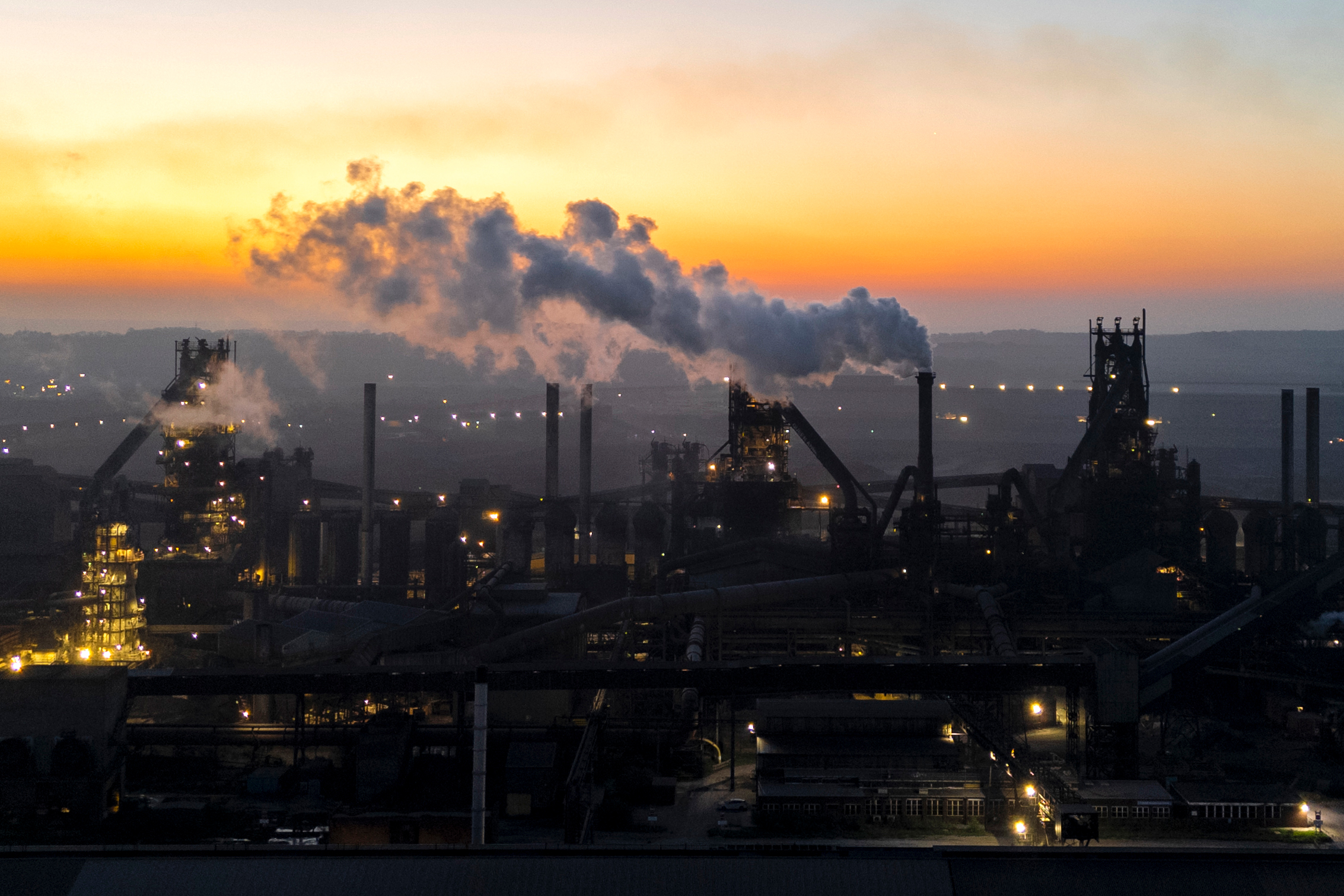
The world is in a state of climate emergency, the head of the United Nations declared Sunday, following the release of the latest State of the Global Climate report from the World Meteorological Organization.
“Earth is being pushed beyond its limits while every key climate indicator is flashing red,” said U.N. Secretary-General António Guterres. “Earth’s energy imbalance, the gap between heat absorbed and heat released, is the highest on record. Our planet is trapping heat faster than it can shed it.”
The consequences, he added, “are written into the daily lives of families struggling as droughts and storms drive up food prices, in workers pushed to the brink by extreme heat, in farmers watching crops wither, and in communities and homes swept away by floods.”
The report highlights the significance of record-high concentrations of greenhouse gases in the atmosphere and notes that the effects are visible everywhere, from the 11-year series of hottest-ever years to the way heat is accumulating deep in the oceans. For the first time, it includes a metric called Earth’s energy imbalance as a key climate indicator, measuring the rate at which energy from the sun enters and leaves the planet.
In a stable climate, incoming energy and outgoing energy are about the same. But activities such as burning fossil fuels, growing food and making steel, cement and plastic have upset that balance by pushing levels of heat-trapping carbon dioxide, methane and nitrous oxide in the atmosphere to the highest level in at least 800,000 years. That’s trapping more of the sun’s energy in the Earth’s climate system than ever previously recorded.
“Improved scientific understanding of Earth’s energy imbalance shows the disruption is real and the reality facing our planet and climate right now,” said World Meteorological Organization Secretary-General Celeste Saulo, adding that, “We will live with these consequences for hundreds and thousands of years.”
The new metric shows a more complete picture of how the climate system is responding to human emissions by integrating all the heat accumulating in the oceans and atmosphere, on land and melting ice, said oceanographer Karina von Schuckmann, a senior science adviser with Mercator Ocean International and member of the WMO’s ocean observations panel.
U.S. climate scientist Ko Barrett, deputy secretary-general of the WMO, said Earth’s energy imbalance also helps show how different parts of the climate system are connected and identifies the central role of the oceans in absorbing most of the trapped heat.
The energy balance indicator highlighted by the WMO focuses on the fundamentals of climate change, said independent climate analyst Leon Simons, who co-authored several recent papers on the topic.
“Energy coming in, energy going out,” he said. “Greenhouse gases change how much energy escapes, and the system responds. That’s really what’s driving everything.”
That basic energy measurement is a better starting point than trying to establish temperature change relative to 1850 in international forums, which then quickly start quibbling over what a tenth of a degree means, Simons said. The measurement is also more significant now because there are 20 to 25 years of data from satellite sensors designed to study Earth’s energy balance.
Science basics also help explain one of the report’s most memorable conclusions. The air temperature people experience is only about 1 to 2 percent of all the energy trapped in the Earth’s systems by greenhouse gases. About 90 to 93 percent heats the oceans while about 5 to 6 percent melts ice and heats land.
The WMO report is compiled with input from national weather agencies, international research programs and U.N. partners, drawing on data from satellites, ocean monitoring systems and weather stations worldwide. It reflects contributions from scientists and institutions across nearly 190 countries.
The information reflects the best available global science, despite concerns during the past year about cuts to U.S. climate programs, said Barrett, the WMO deputy and formerly a veteran leader of U.S. federal climate programs across several presidential administrations.
Critical data flows and climate observations have not been disrupted by any of the major contributors to the report, and she noted that Congress has restored “a lot of the funding” previously reported as having been cut. There also has been no decline in demand for accurate climate information, she added.
Guterres said that climate stress is exposing the fact that “our addiction to fossil fuels is destabilizing both the climate and global security.” Accelerating a global transition to renewable energy would “ deliver climate security, energy security and national security,” he said.
“Today’s report should come with a warning label,” he said. “Climate chaos is accelerating and delay is deadly. The way ahead must be grounded in science, common sense and the courage to act.”
About This Story
Perhaps you noticed: This story, like all the news we publish, is free to read. That’s because Inside Climate News is a 501c3 nonprofit organization. We do not charge a subscription fee, lock our news behind a paywall, or clutter our website with ads. We make our news on climate and the environment freely available to you and anyone who wants it.
That’s not all. We also share our news for free with scores of other media organizations around the country. Many of them can’t afford to do environmental journalism of their own. We’ve built bureaus from coast to coast to report local stories, collaborate with local newsrooms and co-publish articles so that this vital work is shared as widely as possible.
Two of us launched ICN in 2007. Six years later we earned a Pulitzer Prize for National Reporting, and now we run the oldest and largest dedicated climate newsroom in the nation. We tell the story in all its complexity. We hold polluters accountable. We expose environmental injustice. We debunk misinformation. We scrutinize solutions and inspire action.
Donations from readers like you fund every aspect of what we do. If you don’t already, will you support our ongoing work, our reporting on the biggest crisis facing our planet, and help us reach even more readers in more places?
Please take a moment to make a tax-deductible donation. Every one of them makes a difference.
Thank you,
Facts Only
The United Nations declared a global climate emergency following the release of the World Meteorological Organization's State of the Global Climate report.
U.N. Secretary-General António Guterres stated that Earth’s energy imbalance is at its highest recorded level.
The report introduces Earth’s energy imbalance as a key climate indicator, measuring the difference between absorbed and released heat.
Greenhouse gas concentrations in the atmosphere are at their highest levels in at least 800,000 years.
Human activities, including burning fossil fuels and industrial processes, have disrupted Earth’s energy balance.
About 90-93% of trapped heat is absorbed by oceans, while 1-2% affects air temperature.
The report compiles data from national weather agencies, research programs, and U.N. partners across nearly 190 countries.
U.S. climate programs faced funding cuts, but Congress has restored much of the previously reduced funding.
Guterres linked fossil fuel dependence to climate instability and global security risks.
The report warns of long-term climate consequences lasting hundreds to thousands of years.
Inside Climate News, a nonprofit organization, published the article and relies on reader donations for funding.
Executive Summary
Full Take
The strongest version of this narrative is grounded in scientific consensus: Earth’s climate system is destabilizing due to human-induced greenhouse gas emissions, with measurable impacts on global temperatures, ocean heat, and extreme weather. The introduction of Earth’s energy imbalance as a key metric provides a clearer, more direct measure of climate disruption than temperature anomalies alone, avoiding debates over fractional degree changes. The report’s reliance on global data sources and institutional collaboration strengthens its credibility, while Guterres’ framing of climate action as a security imperative adds urgency.
However, the narrative leans heavily on fear appeals (ARC-0012 Fear Appeals) and moral urgency (ARC-0030 Moral Panic), which can polarize rather than persuade. The emphasis on irreversible, long-term consequences may inadvertently foster fatalism rather than agency. The article also assumes a linear cause-effect relationship between emissions and climate impacts, downplaying uncertainties in regional variability and adaptation potential.
Root cause: The paradigm here is technocratic environmentalism, where climate change is framed as a solvable problem through policy and innovation, but the narrative risks oversimplifying complex socio-political barriers. The unstated assumption is that scientific consensus alone should drive action, ignoring cultural and economic resistance.
Implications: The focus on global metrics may obscure local disparities—who bears the costs of transition, and who benefits from the status quo? Second-order consequences include potential backlash against climate policies perceived as economically disruptive.
Bridge questions: How might climate communication balance urgency with agency? What role do non-Western knowledge systems play in adaptation strategies? Would evidence of successful local transitions shift your view on global feasibility?
Counterstrike scan: A coordinated influence campaign would amplify fear-based messaging while suppressing dissenting voices, but this article presents a mainstream scientific perspective without overt manipulation. No structural alignment with hypothetical attack patterns detected.
Patterns detected: ARC-0012 Fear Appeals, ARC-0030 Moral Panic
Sentinel — Human
The article shows strong human authorship signals, including natural stylistic variation, specific expert attributions, and organizational voice, with no detectable AI-generated patterns.