For decades, industrial automation has largely followed the same formula. Production lines have become faster, robots have become more capable, and software has steadily improved, but the underlying model has remained relatively fixed: automation systems are engineered for specific tasks, making flexibility expensive and time-consuming.
That model is increasingly being challenged.
Manufacturers today are under pressure to produce a wider variety of products, switch between production runs more quickly, cope with labour shortages and integrate artificial intelligence into existing operations.
The question is no longer whether factories will adopt AI, but how they can do so without rebuilding entire production systems.
At Automate 2026, Intrinsic, Google’s AI robotics company, offered perhaps its clearest answer yet.
From robots to intelligent production systems
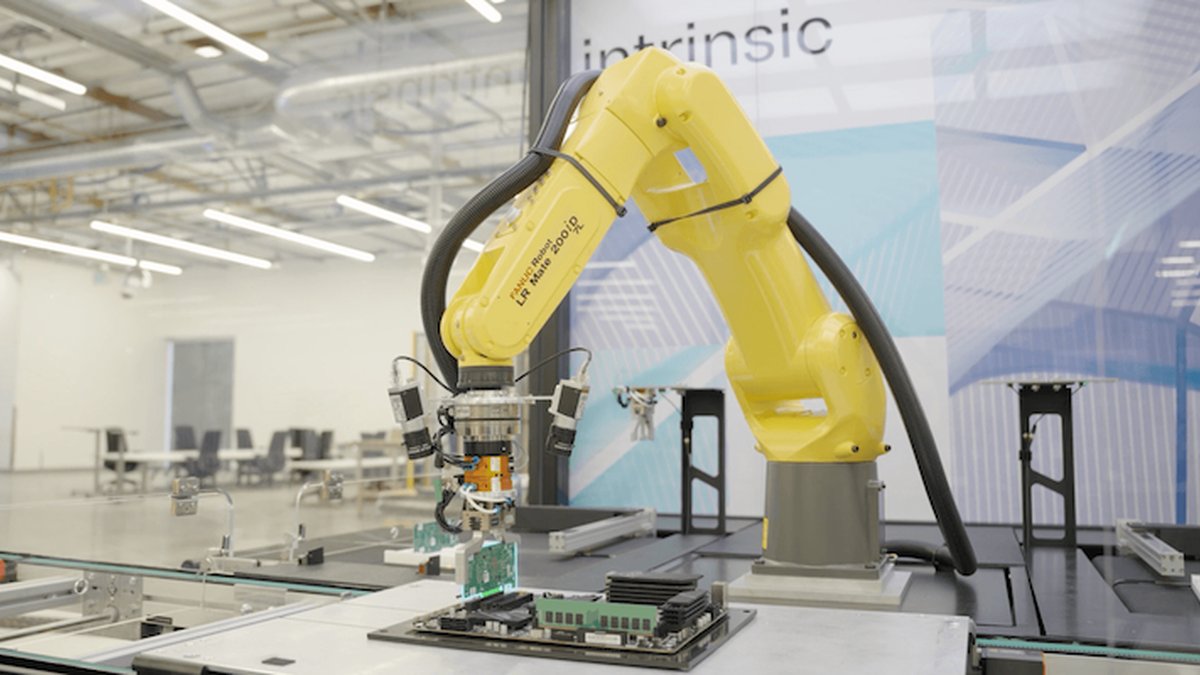
Rather than unveiling a new robot, Intrinsic introduced what it calls the Intrinsic Intelligence Cell – a modular robot workcell designed around software rather than hardware.
Powered by IntrinsicOS, the workcell is intended as a reference architecture that manufacturers, machine builders and systems integrators can adapt for their own applications.
The demonstration combines AI, industrial robotics and modular automation into a production cell capable of being reconfigured for different manufacturing tasks without extensive engineering or robot programming.
During Automate 2026, the system performs electronics assembly using a Fanuc industrial robot, showcasing AI-assisted perception, motion planning and manipulation operating together within a single software environment.
The significance extends beyond a single demonstration.
Rather than treating AI as an add-on to existing automation, Intrinsic is positioning intelligence as the central operating layer of future manufacturing systems.
The architecture behind Physical AI
The term “physical AI” has become increasingly common throughout the robotics industry, although its meaning often varies.
Intrinsic defines it as AI capable of understanding, reasoning about and interacting with the physical world in industrial environments.
That requires far more than a large language model.
Industrial AI must interpret sensor data, understand three-dimensional geometry, plan robot movements, adapt to changing conditions and execute tasks safely in real time.
The Intrinsic Intelligence Cell brings these capabilities together within a modular architecture designed to support multiple robot brands, tools and production processes.
Instead of rebuilding an automation line whenever products change, manufacturers can potentially reconfigure workcells through software, AI skills and modular hardware.
For high-mix manufacturing, where production batches may change frequently, this could significantly reduce engineering effort and deployment times.
From machine shops to global factories
Although large manufacturers have traditionally led industrial automation, Intrinsic argues that AI could make advanced robotics accessible to businesses of every size.
Machine tending provides one example.
Rather than requiring specialist robot programmers, future CNC cells could allow operators to deploy AI-powered capabilities such as automated perception, robot motion planning and intelligent grasping through simplified software interfaces.
Intrinsic says it is already working with CNC automation specialists including Trinity Automation and MartinSystems to integrate these capabilities into next-generation machine shop products.
The objective is straightforward: enable smaller manufacturers to introduce robotics without needing extensive in-house robotics expertise.
Foxconn becomes an early adopter
Perhaps the strongest validation of Intrinsic’s approach comes from manufacturing itself.
The company says a customised version of the Intrinsic Intelligence Cell will be piloted in Foxconn production facilities later this year for electronics assembly applications.
If successful, the pilot would demonstrate that modular AI-powered workcells can move beyond exhibition demonstrations into high-volume industrial production.
For an industry often criticised for over-promising AI capabilities, real production deployments may ultimately prove more significant than technical demonstrations.
Interoperability remains essential
One recurring theme throughout Intrinsic’s strategy is openness.
Rather than building a vertically integrated robotics ecosystem, the company is focusing on interoperability between different hardware platforms.
The Automate demonstration uses Fanuc robotics, reflecting an ongoing collaboration between the companies.
The workcell itself is designed to accommodate different hardware and software components while allowing AI capabilities to operate consistently across varying production environments.
For manufacturers with decades of investment in existing automation equipment, this interoperability may prove just as important as the AI itself.
Growing the industrial AI developer community
Intrinsic is also attempting to broaden the pool of developers building industrial robotics applications.
Its AI for Industry Challenge, launched with Open Robotics, focuses on one of manufacturing’s most difficult automation problems: dexterous manipulation of cables and electrical connectors.
The response has been substantial.
More than 5,000 participants representing 1,600 teams across 115 countries have entered the competition.
Interestingly, robotics professionals account for only a small proportion of entrants.
According to Intrinsic, 93 percent of participants are proficient in Python, 73 percent have experience with ROS, while only 14 percent work directly in robotics.
The figures suggest growing interest among software developers who may previously have viewed industrial robotics as inaccessible.
Participants are developing solutions using open-source simulation environments including Gazebo, Google DeepMind’s MuJoCo and NVIDIA Isaac Sim before progressing to validation using Intrinsic’s software platform and industrial vision models.
Finalists will eventually deploy their algorithms remotely onto a physical industrial workcell at Intrinsic’s California headquarters.
Software becomes the differentiator
Historically, industrial robotics has been driven by mechanical engineering.
Robot payload, repeatability, speed and reliability determined competitive advantage.
While these characteristics remain important, the emergence of AI increasingly shifts differentiation towards software.
Perception models, robot skills, motion planning, orchestration software and development environments may become as important as the robots themselves.
Intrinsic appears to be positioning itself precisely within this software layer.
Rather than competing directly with robot manufacturers, the company aims to provide the intelligence platform that enables different hardware platforms to perform more capable, adaptive manufacturing tasks.
A different vision of factory automation
The broader implication is that factories may become increasingly software-defined.
Production cells could be reconfigured through software updates rather than mechanical redesigns.
Robot capabilities may be expanded through downloadable AI skills rather than extensive engineering projects.
Smaller manufacturers could gain access to automation previously reserved for large enterprises.
Whether this vision materialises will depend on how quickly industrial AI proves itself outside carefully controlled demonstrations.
But the direction of travel appears increasingly clear.
The factory of the future may not be defined by entirely new robots, but by intelligent software architectures that allow existing robots to become substantially more adaptable.
Intrinsic’s modular Intelligence Cell offers an early glimpse of what that future could look like.
Sentinel — Human
The article presents a well-structured analysis of a new architectural approach to industrial AI, grounded in specific company demonstrations and broader industry trends.