HyperStrong will deploy sodium-ion BESS first in its home market of China, before bringing a product to the international markets, its president of technology said.
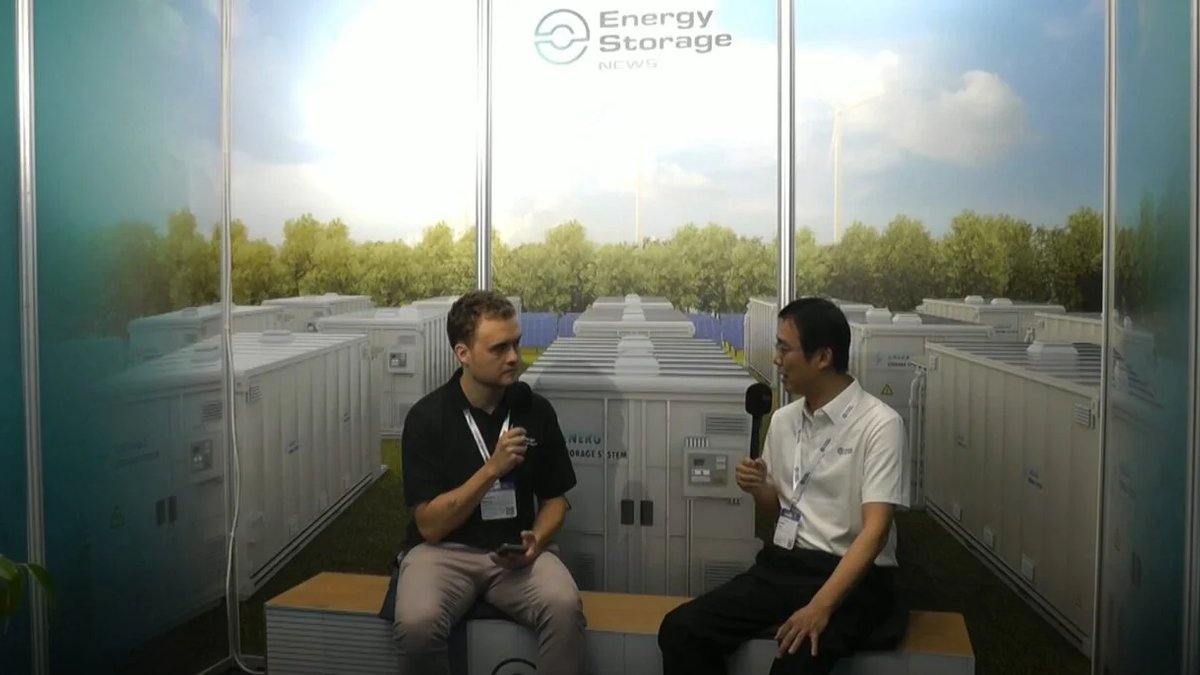
Dr. Yang Guang gave Energy-Storage.news details on its plans in a sit-down video interview at the Smarter E Europe trade show, colloquially known as Intersolar, last month (which we will post in the coming days). He also discussed how the firm is responding to increasing restrictions on Chinese battery tech in Europe and the US.
The company is China’s largest battery energy storage system (BESS) integrator and delivered 26GWh of product to international markets last year, and expects to ship about 60GWh in 2026, Dr Guang said. The company has scored some big deals in this period, including a 2GWh order from an unnamed New York-headquartered IPP and a 1.6GWh order from German power firm LEAG.
Dr Guang wasn’t afraid of discussing the industry challenges either. “BESS is a very hot area and the trade policy and regulations and changing constantly. We try and accommodate these things by creating a standardised product but also maintaining open architecture so we can quickly adapt to customer requirements and different regulations,” he said.
Try Premium for just $1
- Full premium access for the first month at only $1
- Converts to an annual rate after 30 days unless cancelled
- Cancel anytime during the trial period
Premium Benefits
- Expert industry analysis and interviews
- Digital access to PV Tech Power journal
- Exclusive event discounts
Or get the full Premium subscription right away
Or continue reading this article for free
Like other Chinese BESS suppliers, the firm is building up its local service capabilities and now local manufacturing. HyperStrong hadn’t announced it at the time of our meeting, but later on revealed it had partnered with RCT Power for BESS assembly in Malaysia. This may enable it to avoid US tariffs on Chinese batteries and BESS.
Sodium-ion technology and timeline
The company announced a 60GWh sodium-ion battery co-operation with CATL earlier this year, something many have said marks an inflection point in adoption for the alternative battery chemistry. Lithium-ion, lithium iron phosphate (LFP) batteries are currently the dominant chemistry for BESS.
Dr Guang said that the company had been waiting for sodium-ion cell manufacturing to scale and become more competitive, and that it also offers different use cases. Its wider operating temperature range allows for deployment in harsher climates and may even enable BESS deployed with no cooling system at all, which would save on auxiliary power and increase round-trip efficiency.
He also gave us an idea of how soon it is launching a sodium-ion BESS product.
“The timeline for HyperStrong is to deploy a sodium-ion BESS domestically (in China) to verify the technology, make sure we have everything ready, then we can roll it out into the international market,” he explained.
“In 2026 we will do a domestic project with sodium-ion batteries, the earliest (for international markets) will be next year.”
Dealing with increasing restrictions on Chinese tech
We also asked Dr Guang about how, as a Chinese company, it responds to an increasing trend in Europe and the US of restricting Chinese technologies in clean energy projects.
“We don’t see it as a completely negative thing because it drives us to innovate on our product,” he said. “Maintaining an open architecture means we can integrate different components into our system quickly.”
“For cybersecurity, for example, it pushes us to work with internationally recognised consulting companies so we can quickly have a fully cybersecure product for different companies.”
In discussing a separate question around its experience of expanding internationally more generally, he pointed to its partnership with European inverter firm SMA, which is particularly relevant in light of the EU’s funding ban on solar and BESS projects with Chinese inverters.
“We just mentioned regulations. Some domestic (Chinese) key component or PCS supplier may not be accepted by international markets,” he explained.
“One good example (or benefits of having that open architecture) is SMA PCS, which is very well recognised in the European market. We have signed a strategic contract with them for a huge amount of supply in the coming years. The integration work is actually very quick and we’re going to deliver a project using SMA PCS very quickly for the European market.”