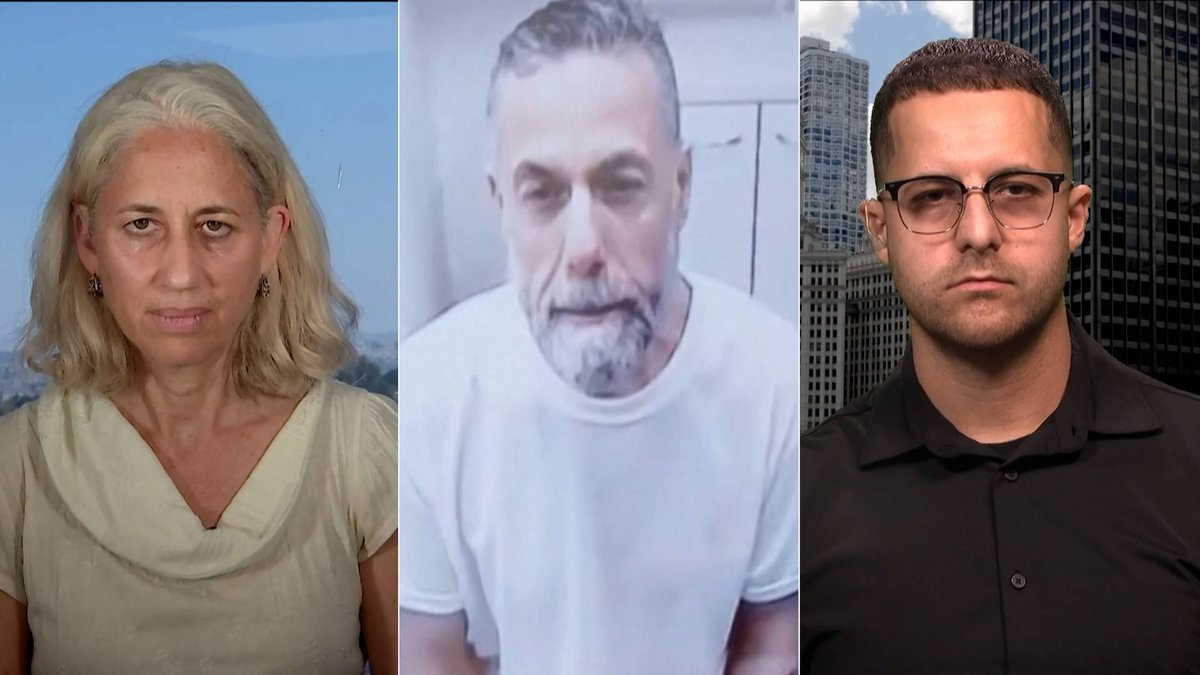
Guests
- Tirza Leibowitzdeputy director of Physicians for Human Rights Israel.
- Thaer Ahmademergency room physician based in Chicago who has volunteered in Gaza, Lebanon and the West Bank. He is a board member of the Palestinian American Medical Association.
Israel continues to ignore international calls to free the director of Gaza’s Kamal Adwan Hospital, Dr. Hussam Abu Safiya, from over 18 months of Israeli detention without charge. After seeing Dr. Abu Safiya on July 2, his attorney Nasser Odeh says the doctor faces “tangible danger to his life” from torture and medical neglect. For more, we speak to Tirza Leibowitz, the deputy director of Physicians for Human Rights Israel, about Abu Safiya’s case and efforts to secure his release. The group has filed an appeal in the Israeli courts requesting the release of Abu Safiya and 13 other Palestinian doctors who were captured in Gaza and imprisoned by the Israeli military.
We also hear from Dr. Thaer Ahmad, a Chicago-based emergency room physician and former colleague of Hussam Abu Safiya. Ahmad volunteered as a medical practitioner in Gaza in 2024. He says Abu Safiya has become a “symbol of Palestinian resilience” and, in particular, Israel’s systematic targeting of Gaza’s healthcare system, which continues to this day. “The necessary aid is not entering, the bombing still persists, people are still dying on a regular basis, and these hospitals don’t have the supplies that they need to be able to treat their patients,” says Ahmad.
Transcript
AMY GOODMAN: This is Democracy Now!, democracynow.org. I’m Amy Goodman, with Juan González.
We turn now to Gaza, to the case of Dr. Hussam Abu Safiya, the jailed pediatrician, director of Gaza’s Kamal Adwan Hospital, who’s been imprisoned since his arrest by Israeli troops in December of 2024. On Monday, the U.N. Working Group on Arbitrary Detention joined global calls for Israel to immediately release Dr. Abu Safiya.
Last week, his lawyer, from the group Physicians for Human Rights Israel, met with Dr. Abu Safiya and said the doctor had experienced an increase in beatings, violence and torture inside Israeli prisons. In a statement released Sunday, the lawyer said Dr. Abu Safiya told him, quote, “They brought me here to kill me. I don’t see myself surviving. This is the end,” he said. His lawyer reported seeing bruising so severe across the doctor’s body, including on his head and face, that he could barely recognize him.
This is a video message posted on Instagram Sunday from Dr. Abu Safiya’s son Elyas, who says his father showed clear signs of torture and medical neglect during the recent meeting with his lawyer in which Dr. Abu Safiya described being beaten with a hammer.
ELYAS ABU SAFIYA: [translated] My father was unable to breathe. My father was unable to speak. His face was disfigured from the marks of torture and pain, especially after the last court session held in Jerusalem at the Supreme Court. … We still call out, plead and appeal and beg to all the free people of the world and to everyone with an atom of humanity in their heart, to save my father’s life before it’s too late.
AMY GOODMAN: Dr. Abu Safiya is among at least 14 doctors from Gaza who have been detained by Israel without charge for more than a year. The Israeli Supreme Court rejected an appeal last month to release Abu Safiya, who’s being held under Israel’s Unlawful Combatants Law, which allows the indefinite detention of suspects. Palestinian officials say Israeli attacks have killed about 1,700 healthcare workers in Gaza since October 2023. At least 83 medical workers remain in Israeli prisons.
For more, we’re joined now by two guests. From Jerusalem, we’re joined by Tirza Leibowitz, the deputy director of Physicians for Human Rights Israel, and from Chicago, by Dr. Thaer Ahmad, an emergency room physician based in Chicago and board member of the Palestinian American Medical Association, who volunteered in Gaza in 2024 and was in frequent contact with Dr. Hussam Abu Safiya.
I want to go to Tirza Leibowitz first. This case, the case of Dr. Abu Safiya, is going through the Israeli courts. Isn’t there even a decision expected today? Can you explain what you understand at this point and what his lawyer saw when meeting with Dr. Abu Safiya for the first time in a number of months?
TIRZA LEIBOWITZ: So, in terms of what the lawyer saw, we heard correctly, as we heard it directly from the lawyer, the bruising on the face. The lawyers, under his watch, Dr. Abu Safiya had problems breathing, had problems speaking. It took time for him to be able to speak. A number of times, he was on the verge — he tilted in his seat and was on the verge of losing consciousness, which led the lawyer to report to us at Physicians for Human Rights Israel about the situation.
In terms of what’s expected, what’s expected is the response by the state to the appeal to release the 14 doctors. So, this appeal was submitted by Physicians for Human Rights Israel already at the end of April this year, so this is a number of months ago. And time after time, the state delayed the response that it was ordered to provide to that appeal. And the last time was last week. It asked for another delay. And we, of course, objected, because we know exactly what happens during these delays, as the case of Dr. Abu Safiya shows us. In response to our objection, the court ordered the state to provide — gave it, actually, an extension of several days, and today is the day in which the state has to respond to the appeal and address the situation of Dr. Abu Safiya. So, there is no court decision expected. This is only about the state response. And we have yet to see. We have not received it yet. And we are very concerned.
JUAN GONZÁLEZ: And, Tirza, what’s been the response on the streets of Israel among the public to these allegations of torture of Palestinian medical professionals?
TIRZA LEIBOWITZ: So, I’d like to address two kinds of public. Since we are a Physicians for Human Rights Israel, let me address the medical community. From the time that Dr. Abu Safiya was arrested, and even before, there were hundreds of healthcare workers arrested since October 2023, and we have continuously warned, turned to the Israeli Medical Association, to the Ministry of Health, to all the authorities, with knowing, having documented the abuse that the detainees were going through when unlawfully held, with no indictment against them. From the medical community, from the formal medical community, there has been no response, except when there was international pressure to say something, the likes of there shouldn’t be abuse of medical workers unless they are terrorists. So, you can imagine what the meaning of that is. And to date, even though we know that there have been numerous approaches since we came out with the information about Dr. Abu Safiya last — early this week, there have been numerous approaches to the medical association here in Israel, as well as to universities, to medical schools, to heads of medical schools. So, there have been doctors, members of the medical association, who have been asking and demanding for the authorized body to come out with a statement, which would be meaningful, and that has not happened to date.
On the streets, I can say that in terms of the Jewish Israeli public, there is anywhere between ignoring — this thing is not being reported on the mainstream Israeli media. It’s being reported only by the likes of Haaretz or +972. So, most people are either unaware or turning their eyes away from that. Of course, the Palestinian population in Israel, of course, are all aware of this and are actively also trying to take steps to put pressure both in Israel and abroad.
AMY GOODMAN: I wanted to bring in Dr. Thaer Ahmad, emergency room physician, who we spoke to when he went to Gaza, board member of the Palestinian American Medical Association. Can you explain the significance of who Dr. Abu Safiya is? I wanted to go to a clip, before you do, of Dr. Abu Safiya in one of his final interviews in 2024 before being detained, produced by Sotouries.
DR. HUSSAM ABU SAFIYA: [translated] I always say the situation requires one to stand by our people’s side and not run away from it. Gaza is our homeland, our mother, our beloved and everything to us. Gaza deserves all of this steadfastness and deserves all of the sacrifices. It is not just about Gaza, but we deserve to be a people that deserves freedom just like every other people on Earth. I think the occupation wants us to get out and for us to ask them to get us out, so they can publicly say that the healthcare system is the one asking to leave and that it wasn’t them who asked us to, but we are aware of that. But we will not leave, God willing, from this place, as I said, for as long as there are humanitarian services to be provided to our people in the northern Gaza Strip.
AMY GOODMAN: So, that was Dr. Hussam Abu Safiya in one of his final interviews before the Israeli military detained him. Dr. Thaer Ahmad, his significance in Gaza and the Kamal Adwan Hospital that he ran, this pediatric hospital, he himself a pediatrician?
DR. THAER AHMAD: Yeah, I mean, Dr. Hussam is somebody who I think most of the world became familiar with as the Israeli military was conducting their campaign and devastating the north of Gaza and the rest of the Gaza Strip. And we would consistently hear from him. He would give us updates about the situation that was taking place in Gaza. When he became the director of Kamal Adwan during the genocide, he was somebody that was telling us about how the diesel fuel was running out, and that there were children and babies in the incubators, and that they were at the very last moments of their lives unless there was some sort of aid entering. He’s somebody who’s written two op-eds in The New York Times, in October 2023 as well as December 2024, moments before he was abducted by the Israeli military. And he’s also somebody who his own son was killed by the Israeli military a month before he was abducted, and he had to bury his son in the compound of that hospital. He’s somebody who was injured.
This is somebody whose voice in Gaza and outside of Gaza had become sort of the symbol of Palestinian resilience, of the Palestinian medical care system. And he knew very well — he knew very well that the Israeli military was targeting the healthcare system. They were purposely trying to make sure that it collapsed. And they wanted to make sure that hospitals like Kamal Adwan, which was situated in the north of Gaza, near Jabaliya, Beit Lahia, Beit Hanoun, areas that the Israeli military was leveling, neighborhood by neighborhood, they wanted to make sure that it was destroyed. And Dr. Hussam knew that very well. And, I mean, even in his last moments right before the Israeli military had him approach a tank, you saw Dr. Hussam appeal to the world, saying that if this hospital goes down, people will unnecessarily suffer and die, and specifically children.
So, Dr. Hussam is a senior medical consultant in all of the Gaza Strip. And his presence, as long as he stayed at that hospital, as long as he remained present in the ICU of that pediatric hospital, there was at least some degree of reassurance to the patients and to the families who desperately needed his services and his help. And that was something that the Israeli military knew very well. It’s why he had to be abducted in December of 2024. It’s why he continues to remain in prison without any charge. Nothing has been brought against him. Not a single shred of evidence has been produced against somebody like Dr. Hussam.
And it’s a message that’s being sent to the entire healthcare system, to all of the healthcare workers. And it fits in line — I mean, I think it’s important for us to recognize, as you mentioned, how many healthcare workers have perished over the last two-plus years in Palestine. I mean, there is an intentional effort to make sure that healthcare workers are not safe and secure, that they are not protected, and that they continue to be killed, they continue to be abducted and continue to be displaced. If the healthcare workers do not have the protections that are supposed to be afforded to them, then what chance do the rest of Palestinians in the Gaza Strip have?
And so, I think that’s something that’s important for people to recognize, that Dr. Hussam, just like Dr. Adnan al-Bursh, who was murdered in an Israeli prison, just like Dr. Khaled Alser, who you interviewed on this program, was abducted for six months and then released, and like many of 14 doctors that still remain, it’s a message that’s being sent to all Palestinians. And that message is that nobody is safe and nobody is secure. I mean, I worked with two of the 14 doctors that are mentioned in this list, and I knew Dr. Hussam well, and I know his family, and I stay in contact with them. Dr. Nahed and Dr. Mahmud, I worked with them at Nasser Hospital, and I worked with them on patients who were being injured in this genocide. And they, for over two years, remain abducted without charge in Israeli prisons.
And the final thing I’ll say is, everybody knows what happens to Palestinians in Israeli prisons. They know the treatment that they are being subjected to. They know the conditions on the ground. So, when Nasser Odeh, Dr. Hussam’s lawyer, says, “I’m really worried that he may imminently die,” I mean, it’s not an exaggeration. It’s not performative. Almost a hundred Palestinians have been killed since October 7th in these prisons, in these dungeons. And so, it’s a cause for concern. There’s an incredible amount of urgency.
JUAN GONZÁLEZ: Dr. Ahmad, I wanted to ask you: The Israeli claims that he was somehow cooperating with Hamas, how do you respond to that? And also, what do you say to other doctors still working in Gaza who see what’s happening to their colleague?
DR. THAER AHMAD: I mean, that, it’s a joke. Nobody takes it seriously, what the Israeli military says about Palestinians, in general. Dr. Hussam, anybody that’s worked with him, anybody that’s worked alongside him knows that he’s a phenomenal pediatrician and that he’s an incredible hospital director. Same goes for all of the healthcare workers that are in these Israeli prisons currently. This idea that Palestinians could somehow spend their entire lives working and studying to become doctors and to professionally develop themselves, that they could also be something else, it’s a part of dehumanization. It’s a part of this sort of racism against Palestinians, that somehow they can be these phenomenal orthopedic surgeons and pediatricians and cancer doctors and nephrologists, and then, at night, they can turn into some nefarious character. It’s a joke. Nobody takes it seriously.
And anybody that’s worked alongside the healthcare workers in Palestine, anybody that’s worked with any sort of Palestinians on projects or research, understand that they are an incredible group of physicians, nurses, first responders. They take their job very seriously. And the things that we’ve asked them to do over the last two-plus years in the midst of a suffocating siege, of a famine that spread throughout all of the Gaza Strip, and a military that was absolutely leveling the entire of the Gaza Strip, it’s unreal that we asked them to do that, and we asked them to that in impossible conditions.
And so, when I talk to my colleagues on the ground every single day now, it’s very tough to be able to explain to them or to talk to them about the conditions on the ground, to ask them day after day, “Oh, how are things? Are there more cancer drugs? Are there more insulin for the diabetics? Are the kids with — who are malnourished, are they getting the nutrients that they need? Are they getting the food that they need?” And I think that’s an important point.
I mean, one thing is, I think there’s this idea that on October 9th there was this ceasefire announced in Palestine and in the Gaza Strip. But when I talk to my colleagues, that’s also a lie, just like the Israelis continue to lie about what — you know, Dr. Hussam or any of these other physicians, why they’re in these prisons. They continue to push this farce of a ceasefire. The necessary aid is not entering, the bombing still persists, people are still dying on a regular basis, and these hospitals don’t have the supplies that they need to be able to treat their patients. And if you look anywhere in the Gaza Strip right now, you’ll see that the Israeli military continues to encroach on the Gaza Strip, occupying more and more of the land. And so —
AMY GOODMAN: Dr. Thaer Ahmad, we —
DR. THAER AHMAD: — it’s devastating on the ground. Many of the healthcare workers there, I know, are fatigued, I know, are exhausted, I know, are burnt out. And it’s because of the silence of the international community. It’s the fact that —
AMY GOODMAN: Dr. Thaer Ahmad, we’re going to — we’re going to —
DR. THAER AHMAD: — there was this Board of Peace announcing a ceasefire, but on the ground, nothing has actually changed. And that’s something that I’m worried about —
AMY GOODMAN: We’re going to continue to talk about this in our next segment.
DR. THAER AHMAD: — of course, as a physician. But when I talk to my colleagues, and they tell me that there are 18,000 people that need to be urgently medically evacuated, that there are people with cancer every single day that are not getting the chemotherapy, that should be surviving but are dying —
AMY GOODMAN: Dr. Thaer Ahmad, we’re going to have to leave it there, because we’re going to continue to talk about Gaza in our next segment, what is happening there next. Dr. Thaer Ahmad is emergency room physician based in Chicago, volunteered in Gaza in 2024. And Tirza Leibowitz is the deputy director of Physicians for Human Rights Israel, speaking to us from Jerusalem.
Coming up, Hamas has announced it’s handing over governing authority in Gaza to an interim Palestinian administration overseen by President Trump’s Board of Peace. What does this mean for Gaza? Back in 15 seconds.
Media Options
Sentinel — Human
This text appears to be a professionally recorded transcript from a journalistic interview, characterized by direct testimony and contextual framing rather than synthesized argumentation.