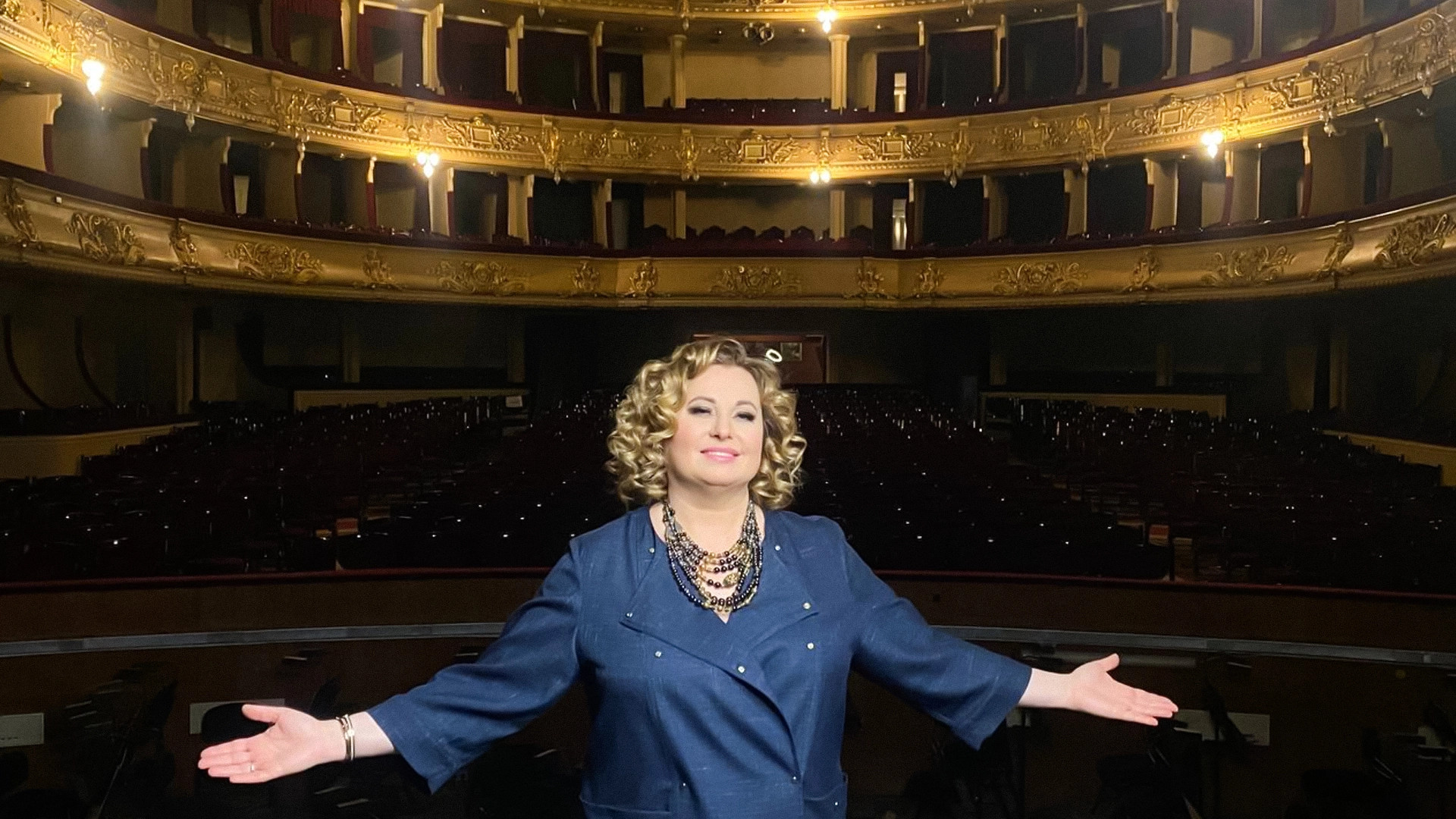
This spring, Ukrainian spinto soprano Liudmyla Monastyrska will once again perform the role of Turandot at the Metropolitan Opera.
This time, another renowned Ukrainian will stand at the conductor’s podium – Oksana Lyniv. For the international opera world, the moment is not only an artistic event but also a symbolic gesture: Ukraine’s presence on the world’s leading cultural stages.
JOIN US ON TELEGRAM
Follow our coverage of the war on the @Kyivpost_official.
Monastyrska’s name has long been associated with the Metropolitan Opera. It was here that she made her debut in 2012 in the role of Aida from “Aida.” In 2022, her appearance in “Turandot” – when she replaced Russian star Anna Netrebko – became a defining moment for the global cultural community.
After the performance, the singer took her curtain call, holding a Ukrainian flag, and the images quickly spread through international media.
In her conversation with Kyiv Post, Monastyrska reflects on those events, speaks about the role of culture during wartime, and explains why she has chosen to live in Ukraine.
Kyiv Post: New York will soon hear your voice again. The Metropolitan Opera has played a major role in your career.
Liudmyla Monastyrska: The Metropolitan Opera always means great responsibility and a great opportunity. For any singer, performing on this stage is a sign that you’ve truly made it – so to speak, hitting the happy jackpot. (Smiles.) I made my debut here in 2012 as Aida. Later I sang Tosca in “Tosca,” Cavalleria rusticana, and other roles.
ISW Russian Offensive Campaign Assessment, March 28, 2026
In 2022, many described your appearance on the Met stage as historic: you replaced Anna Netrebko, and the invitation from the theater’s general manager, Peter Gelb, sent a clear signal from one of the world’s most influential opera institutions. How do you assess the power of that gesture of solidarity today?
When the full-scale invasion began, the organizers immediately contacted my manager. At first, I hesitated to step in so quickly, explaining that I hadn’t performed the role for quite some time. But after Peter Gelb personally called my Ukrainian phone number, I accepted the offer. About a month and a half after the full-scale war began, I traveled to New York to sing at the Met.
A year later, in April 2023, I returned to perform Tosca, this time replacing another Russian singer, Hibla Gerzmava. (Gerzmava signed a 2014 letter by Russian cultural figures supporting Vladimir Putin and the illegal occupation of Crimea – Ed.)
Everyone remembers that in 2022, after the performance, I took my curtain call with the Ukrainian flag. A year later at the Met, I did it again. Of course, by 2023, the resonance was smaller – the world had begun to grow accustomed to the war in our country. But the support from colleagues, the orchestra, and the audience was tangible. I especially want to acknowledge Peter Gelb. His position was very clear then – and it remains so in the fifth year of the full-scale war.
You also took part in the Ukrainian Freedom Orchestra project and joined its large international tour during the first year of the war. What was that experience like?
The project was launched on the initiative of the Metropolitan Opera and the Polish National Opera. The orchestra included leading musicians from Kyiv, Lviv, Kharkiv, Odesa, and other Ukrainian cities, as well as Ukrainian members of major European orchestras.
It was led by the outstanding Canadian-American conductor Kerry Lynn Wilson, who has Ukrainian roots, and is also Peter Gelb’s wife. Keri-Lynn Wilson has been very active and conscious in promoting Ukrainian art worldwide. The tour took place across European capitals and in the United States. It was a fascinating but also demanding experience. Still, all the effort and time were absolutely worth the result.
Each concert program combined world classics with contemporary Ukrainian academic music, which became an important discovery for international audiences. At the end of every concert during the tour, we walked onto the stage with Ukrainian flags draped over our shoulders. It was an incredible feeling.
In the global cultural space, people often talk about an imbalance – individual Ukrainian voices versus a massive Russian cultural presence. How visible is that in the opera world today?
Strangely enough, in the productions where I have sung, there were no Russians. It just happened that way. But overall, they are everywhere in the opera world. If they’re not singing a major role, they perform a smaller one. As we joke – “Dinner is served.” Sometimes even smaller than that. (Smiles.)
Historically, there really are many Russians in opera, even in choruses – especially in Germany. Sometimes, nearly half the choir can be Russian or Russian-speaking.
But the Metropolitan Opera is a special theater. They have unique resources: they can keep up to five large, expensive productions in the repertoire at the same time – for example, La Bohème, Nabucco, or Aida – and rotate different casts. The Met managed to remove Russians as key figures almost immediately. They parted ways with Anna Netrebko, Hibla Gerzmava, Yusif Eyvazov, Valery Gergiev, Ildar Abdrazakov. But honestly, there are only about a dozen truly high-profile names among them.
If we speak frankly, “canceling” Russian culture in the West is extremely complicated – even for people who sincerely support Ukraine. I remember that in spring 2022, the Met even sold a magnet that read: “Cancel Putin, not Pushkin. Support the people of Ukraine.” In Ukraine, we often say: “Without Pushkin, there would have been no Putin.” But that understanding is still far away for many in the West. People sympathize with us – yet their experience is different. Missiles are not falling on their homes, their cities are not being destroyed, and their people are not dying. And thank God for that.
In spring 2026, you will again sing “Turandot” at the Met – as you did in 2022 – but now alongside conductor Oksana Lyniv. What does this collaboration mean today?
Oksana and I first worked together in 2019 at Deutsche Oper Berlin in “Tosca.” Then again in Bologna. In autumn 2022, she organized a major concert marking the 150th anniversary of Solomiya Krushelnytska. It was an important event because we reminded European audiences about this legendary Ukrainian singer, recognized as Giacomo Puccini’s muse.
So our upcoming collaboration at the Metropolitan Opera feels very symbolic to me.
You are often called the “voice of Ukraine” in opera. What message about Ukraine would you like foreign audiences to hear – not from the news, but from your singing?
That’s a difficult question. Opera is a universal language. Whenever I have the chance, I try to speak about Ukraine through some gesture – for example, appearing for the curtain call with our flag. That was my idea, but of course I had to ask for permission first. I must give credit to Peter Gelb. In spring 2022, when I approached him about it, he said, “Give me some time to think.” Two hours later, he returned and gave his permission. Moreover, he was the one who brought the Ukrainian flag. It was during the “Turandot” premiere run – five performances, just like we are planning in 2026 – and I appeared several times with our flag.
I want to emphasize: in such matters, you always have to ask permission, even when it comes to performing a Ukrainian song. But if we are allowed, we always try to do it. Because that’s what the soul wants.
For me, it is very important that the world knows and respects Ukrainian culture. We have much to be proud of. Next to my name on playbills, it always says “Ukraine” in parentheses. I represent my country with great pride – and our Ukrainian vocal school as well.
And I am far from the only one representing Ukraine on the world stage today. There are many wonderful singers: bass Oleksandr Tsymbaliuk, baritone Andrii Bondarenko, soprano Olga Kulchynska, and soprano Oksana Dyka, who has long lived and worked in Italy.
Among Ukrainian artists in demand in the West, I am not alone. It just so happens that today, I am probably one of the few who consciously chose to continue living in Ukraine.
What keeps you – a globally recognized star – in a country at war?
I simply cannot imagine my life anywhere else. Ukraine is my place of strength, the territory of my native language. Everything important to me is here.
I need to be in Kyiv – near Saint Sophia Cathedral, near the Oranta of Kyiv (the 11th-century mosaic of the Virgin Orans in Saint Sophia Cathedral, known as the “Unbreakable Wall,” a symbol of protection and spiritual resilience – Ed.). That presence gives a special feeling. It truly sustains and supports me.
It is also important for me to visit my small homeland in the Cherkasy region regularly – to breathe this air and live together with Ukraine in its reality.
Each of us does what we can. I work on the cultural front. Right now, people desperately need a breath of harmony – something bright, spiritual, and authentic.
And it is very important for me to sing specifically for Ukrainians. Not only to fulfill international contracts – although many of our people are abroad today – but to live and perform here, in Ukraine. For me, that is a matter of principle.
You can also highlight the text and press Ctrl + Enter
Facts Only
Liudmyla Monastyrska, a Ukrainian spinto soprano, will perform the role of Turandot at the Metropolitan Opera in spring 2026.
Oksana Lyniv, a Ukrainian conductor, will lead the performance.
Monastyrska made her Met debut in 2012 as Aida in *Aida*.
In 2022, she replaced Russian soprano Anna Netrebko in *Turandot* and took her curtain call with a Ukrainian flag.
In 2023, she replaced another Russian singer, Hibla Gerzmava, in *Tosca* at the Met.
Peter Gelb, the Met’s general manager, personally called Monastyrska to invite her to perform in 2022.
Monastyrska participated in the Ukrainian Freedom Orchestra, a project initiated by the Met and the Polish National Opera.
The orchestra toured European capitals and the U.S., featuring Ukrainian musicians and contemporary Ukrainian music.
Russian artists remain prevalent in opera, particularly in European choruses, but the Met has removed high-profile Russians from leading roles.
Monastyrska lives in Ukraine and performs there regularly, despite her international career.
She has collaborated with Oksana Lyniv previously, including in *Tosca* at Deutsche Oper Berlin in 2019.
Monastyrska emphasizes the importance of representing Ukraine in her performances and symbolic acts.
Executive Summary
Ukrainian soprano Liudmyla Monastyrska will perform the role of Turandot at the Metropolitan Opera this spring, conducted by fellow Ukrainian Oksana Lyniv. Monastyrska, a prominent figure at the Met since her 2012 debut as Aida, gained international attention in 2022 when she replaced Russian soprano Anna Netrebko in *Turandot* and took her curtain call with a Ukrainian flag, a gesture repeated in 2023 when she replaced another Russian singer, Hibla Gerzmava. The Met’s general manager, Peter Gelb, has been a vocal supporter of Ukrainian artists, removing high-profile Russian performers from productions. Monastyrska has also participated in the Ukrainian Freedom Orchestra, a project highlighting Ukrainian culture through global tours. While Russian artists remain prevalent in opera, particularly in European choruses, the Met has taken steps to reduce their visibility in leading roles. Monastyrska emphasizes the importance of representing Ukraine on the world stage, both through her performances and symbolic acts, while choosing to live in Ukraine despite her international career. She views her presence in Kyiv as a source of strength and a way to contribute to Ukraine’s cultural resilience during wartime.
The collaboration between Monastyrska and Lyniv at the Met is seen as a symbolic moment for Ukrainian artistry, reinforcing Ukraine’s cultural presence amid ongoing conflict. Monastyrska’s commitment to performing in Ukraine and her efforts to promote Ukrainian music and identity reflect a broader effort by Ukrainian artists to assert their cultural sovereignty in the face of war.
Full Take
The strongest version of this narrative highlights the resilience and cultural defiance of Ukrainian artists in the face of war, using the global stage of the Metropolitan Opera as a platform for national identity and solidarity. Liudmyla Monastyrska’s performances, particularly her replacement of Russian singers and her use of the Ukrainian flag, serve as powerful symbols of resistance and cultural sovereignty. The Met’s support, exemplified by Peter Gelb’s actions, reinforces the institution’s role in amplifying Ukrainian voices while distancing itself from Russian cultural figures tied to the Kremlin. The Ukrainian Freedom Orchestra’s tour further underscores the strategic use of art to counter Russian narratives and assert Ukraine’s cultural presence.
However, the narrative also reveals the complexity of "canceling" Russian culture in the West, where historical ties and artistic traditions complicate outright rejection. Monastyrska’s acknowledgment of Russian prevalence in opera, even in smaller roles, suggests that systemic change is slow and uneven. The article’s focus on individual gestures—like the flag—risks oversimplifying broader cultural dynamics, where Russian influence remains entrenched in many institutions.
Rooted in the paradigm of cultural diplomacy as soft power, this narrative assumes that artistic representation can directly counter political aggression. It echoes historical patterns of using culture as a tool of resistance, from the Cold War to decolonization movements. Yet, it leaves unexamined whether such symbolic acts translate into material support for Ukraine or lasting shifts in global cultural power structures.
The implications for human agency are significant: Monastyrska’s choice to remain in Ukraine challenges the notion that artists must flee conflict to thrive, while her international performances bridge the gap between local resilience and global visibility. However, the cost of this dual role—balancing personal safety with professional demands—remains underexplored.
Bridge questions:
How effective are symbolic cultural acts in shifting geopolitical narratives compared to direct political or military support?
What are the long-term consequences of excluding Russian artists from Western stages, and does this risk reinforcing cultural isolationism?
How might Ukrainian artists navigate the tension between representing their nation and being reduced to political symbols?
Counterstrike scan: A coordinated influence campaign would amplify Monastyrska’s story to frame Ukraine as a victim of Russian cultural imperialism, using emotional appeals (e.g., the flag, wartime resilience) to garner Western sympathy while downplaying complexities like the Met’s continued engagement with Russian repertoire. The actual content aligns with this pattern but does not manipulate facts; it presents a genuine account of cultural resistance. No structural alignment with a hypothetical attack playbook is detected.