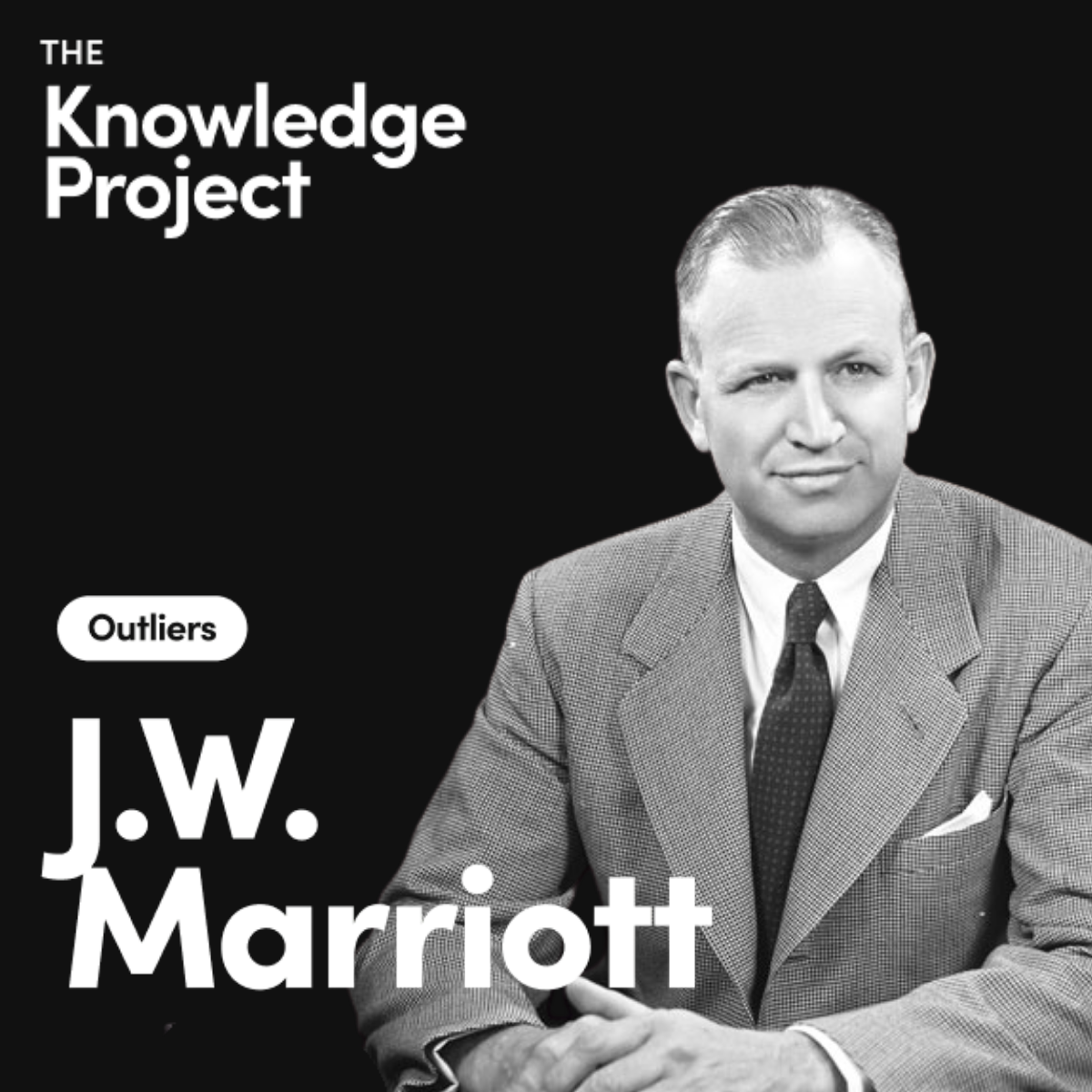
Bill Marriott built the foundation of the world’s largest hotel company.
But he didn’t open his first hotel until he was 55.
Everything starts with a nine-seat root beer stand in Washington, DC, and a simple goal: serve people well and build something that lasts. And of course, he didn’t just go from restaurants to hotels; along the way, he started the airline catering industry.
This episode explores the timeless principles that guided his success, including his obsession with downside risk, his practice of isolating variables, and his expansion during the Great Depression while his competitors folded.
Listen and Learn: YouTube | Spotify | Apple Podcasts | X | Transcript
Tiny Lessons
- “Manage your time. Short conversations to the point. Make every minute count.”
- How you define yourself becomes your prison.
- “Perfection was one notch below the desired result.”
- “Do it and do it now. Err on the side of taking action.”
- “Guard your habits. Bad ones will destroy you.”
- “Make crystal clear what decisions each manager is responsible for. Have all the facts, then decide and stick to it.”
- You can’t expect what you don’t inspect.
- Take care of your people before your customers. People who feel disposable deliver a disposable experience.
- Never give your customers a reason to go to the competition.
- If a job is too big for one person, don’t work harder. Find the right incentive and let others carry it.
- Every major decision should start with your eyes, not your wallet.
- Trust people with something that matters before the world says they’re ready.
- Most companies lose their culture when the founder leaves because the founder was the culture and never put it on paper.
- “A leader should have character, be an example in all things.”
- Predictability builds a brand.
- Don’t accept seasonal thinking. When the crowd disappears, ask what people need now.
- You don’t lose control because you expand. You lose control because of bad debt and bad people.
- “See the good in people and then try to develop those qualities.”
- “As long as we are taking in more than we spent, I knew we were doing all right.”
- Survive first, grow second. You can’t compound what doesn’t exist.
- “Ideas keep the business alive. Know what your competitors are doing. Spend time and money on research and development.”
- The person who wrote the rule might say yes if you actually show up and ask.
- “Discipline is the greatest thing in the world. Where there is no discipline, there is no character.”
- Reward the behavior you want to see spread.
- Obsess over costs that don’t touch the customer.
- Three ideas built the company: friendly service, fair prices, and hard work.
- “People are number one. Their development, loyalty, interest, team, spirit. Develop managers in every area. This is your prime responsibility.”
- “My dad always told me to take time to smell the flowers, but I just don’t have the time.”
- “I’ve felt that dissatisfaction is the basis of progress. When we become satisfied in business, we become obsolete.”
Some Interesting Nuggets
- His last words were a quality complaint. At a family cookout in New Hampshire, moments before dying of a heart attack at 85, J.W. declared: “We’ve got to get some better corn around here.”
- He sought a Mormon prophet’s permission to sell alcohol and felt “unburdened” when the 87-year-old church president told him it was acceptable in hotels.
- He couldn’t praise his own son because his father had never praised him. In a 4 a.m. letter the night before promoting Bill Jr., he wrote: “I don’t ever tell you you’re doing a good job because my father never told me. But you are. I’m happy.”
- His perfectionism was pathological. He threw away 10 hamburgers over salt levels, demanded hash browns be turned only once, ran his finger along his son’s furniture checking for dust, and created 66 separate steps for cleaning a hotel room in under 30 minutes.
His Inner Monologue
J.W. Marriott was not a polished communicator. He was a Utah farm boy who spoke in plain, practical sentences. No fancy words, no inspirational rhetoric, just observations compressed into action.
The most revealing material comes from his diary entries, where he talked to himself.
I sweat terribly and overdo. But I love to work.
Raw self-awareness. He knew his nature was compulsive and excessive, yet embraced it anyway. The tension between “I overdo” and “I love to work” defined his entire life.
The Church and parents taught us to be honest, clean personally, good habits, workaholics. In short, to follow two of the greatest words: work and pray, a sure formula for success.
Faith and relentless labor were inseparable in his mind. He calls himself and his family “workaholics” without apology. To him it’s a virtue.
We sell people what they need, and we keep our prices down. We have good, clean-cut people in positions of responsibility. And we work hard — and long.
Friend, people are after me all the time to sign notes for them, but I never sign a note for anybody. If I wanted to help them, and if I could, I’d sooner give them the money and forget it. Start signing notes and most times, you lose your money, and you lose your friend too.
This is how J.W. actually talked — “Friend” as an opener, folksy wisdom wrapped in hard-earned financial caution. Remember he was a sheep rancher’s son who learned about money by watching his father lose everything.
I’ve felt that dissatisfaction is the basis of progress. When we become satisfied in business, we become obsolete.
Do it and do it now. Err on the side of taking action.
The Obsessive: Perfectionism as Religion
J.W. Marriott’s attention to detail bordered on compulsion. He created systems to replicate his own obsessiveness at scale, and those systems became the DNA of the company.
Oatmeal is not negotiable!
When he discovered a Hot Shoppes location had run out of oatmeal despite it being on the menu. It wasn’t about the oatmeal, it was about his philosophy: if you promise it, you deliver it.
His operational standards descended to the molecular level. Cooks must follow recipe cards for every dish. Hash browns turned only once on the grill. Waitresses must pick up glasses by the sides only — never the rim. Servers’ mustaches couldn’t extend below the corners of their mouths. He once argued with a manager about hamburger seasoning, throwing away ten hamburgers until the salt level met his standard.
He created 66 separate steps for cleaning a hotel room in less than half an hour. His son recalled: “Almost from the start, my parents, especially my father, launched the process of figuring out how to do something right and then writing it down.” This extended from “washing windows to burnishing silverware, to arranging buffet tables.” Without these SOPs, the company couldn’t have scaled.
You can’t expect what you don’t inspect.
When we had six or seven fast food stores, I’d drive to every one of them every day, sometimes twice a day.
This was the origin of Marriott’s management-by-walking-around. He didn’t delegate inspection instead he opted to do it himself. So he’d go to every store, every day, sometimes twice. When the company grew too large, he hired supervisors to replicate exactly what he’d been doing.
The Builder: Business Instincts
J.W.’s strategic genius came from observation, not analysis. He watched customers, listened to employees, and spotted patterns others missed. Every major business he entered — restaurants, airline catering, hotels — started with a ground-level observation.
The Root Beer Stand
In 1927, J.W. and Alice opened an A&W root beer franchise in Washington, D.C. When winter came and customers wanted hot food, he added Mexican dishes. Alice had used her college Spanish to talk the Mexican Embassy chef into sharing recipes for tamales and chili. This was the first Mexican food served in Washington, D.C. The root beer stand became Hot Shoppes.
Why Hot Shoppes Thrived in the Depression
Everybody was living in apartments. Nobody had air conditioning, so in the summer people didn’t want to cook because it was too hot in their kitchens. They wanted to come to Hot Shoppes and eat in their cars.
By 1933, six Hot Shoppes were grossing $1 million annually. Remember this was during the Depression! Hot Shoppes was the first drive-in restaurant east of the Rockies.
The Airline Catering Origin
A waitress at Hot Shoppe No. 8, near Hoover Airport, told Marriott that passengers were buying boxed food to carry onto flights. He immediately saw the opportunity, negotiated contracts with Eastern, American, and Capital Airlines, and within one year was servicing 20 daily flights.
He created the in-flight catering industry — the first company ever to do this. That single observation grew into a division serving 150 airlines through 108 flight kitchens, with revenues reaching $800 million before it was sold for $570 million in 1990.
The Hotel Pivot at 57
Marriott was deeply skeptical of hotels. He’d watched them fail during the Depression and declared: “Nothing good ever happens in a hotel.”
It was his son Bill who pushed him into it. When the company bought land near the Pentagon for a corporate office, an executive VP suggested it would make a perfect hotel site.
Bill, just eight months back in the business, said: “Why don’t you let me run the hotel, and I’ll learn.” J.W. agreed. The family hung pictures together until late the night before the Twin Bridges Motor Hotel opened on the eve of Eisenhower’s second inauguration in January 1957.
The Bridge Location Theory
The Marriotts chose restaurant and hotel locations by personally staking out intersections and counting cars. For hotels, they specifically preferred bridge locations, reasoning that “while highways and intersections might undergo extensive redesign, bridges generally stayed put.”
The Anti-Franchise Decision
Marriott watched his friend Howard Johnson “lose control of his business” through franchising. This made him refuse to franchise, a decision that shaped Marriott’s direct-ownership strategy for decades.
The D.C. Strategy
Washington wasn’t where Marriott happened to be, it was a deliberate strategy. He scored the U.S. Treasury cafeteria contract in 1939. During WWII, he expanded into government building cafeterias and war-production factory food service. Post-war, he added school cafeterias and the Children’s National Medical Center contract (held for 35 years). He built his empire within arm’s reach of the one customer that never goes bankrupt: the U.S. government.
The Mormon: Faith as Operating System
J.W. Marriott’s Mormon faith was the operating system that ran everything else. It shaped who he hired, how he worked, what he feared, and the single most agonizing business decision of his life.
To sell it to them doesn’t mean that we approve of drinking any more than to sell a gun means approval of using that gun to commit a crime.
When planning his Philadelphia hotel in the 1960s, J.W. agonized over serving alcohol because it was prohibited by his faith.
A consultant’s report said the hotel would succeed “primarily because of expected extensive local use of the restaurant and bar facilities.” He personally visited the 87-year-old Church President, who drew the line: alcohol acceptable in hotels and upscale restaurants, but NOT in family-oriented Hot Shoppes.
When J.W. returned to Washington, his son saw “a changed man” — he felt “unburdened.”
J.W. served as president of the Washington D.C. Stake of the LDS Church from 1948 to 1957 — one of the most prominent lay leadership positions in the church. He tithed faithfully throughout his life.
At his funeral, Ezra Taft Benson (future LDS Church President), “in a voice racked by emotion and age, read in final tribute to his friend the poem ‘A Real Man,'” which said: “He was the kind of man I’d like to be.”
The Father: A Generational Chain of Silence
The most psychologically revealing thread in J.W.’s life is the chain of emotional withholding that ran from his father Hyrum through J.W. to Bill Jr. — and arguably to the third generation.
My father gave me the responsibility of a man. He would tell me what he wanted done, but never said much about how to do it. It was up to me to find out for myself.
J.W. on his father Hyrum. Autonomy through being thrown into problems. He replicated this approach — but added relentless inspection on the back end.
The 4 A.M. Letter
On January 20, 1964, unable to sleep the night before announcing Bill’s promotion to executive VP, J.W. got out of bed at 4 a.m. and went to his study to write his son a letter. It contained 15 leadership guideposts, including:
Pray about every difficult problem. Manage your time: Make every minute on the job count. People are number 1 — their development, loyalty, interest, team spirit. Develop managers in every area. This is your prime responsibility.
And then, buried at the end:
I don’t ever tell you you’re doing a good job because my father never told me I did a good job. But you are. I’m happy.
A rare confession.
He could see the pattern he got from his father. Hyrum never praised him, and he replicated it with Bill, but he couldn’t break it but he did acknowledge it.
Bill Jr. later discovered something else. His father wrote in his diary every night. “Every now and then he’d write… that I was doing a good job… maybe once or twice a year.” The praise existed — it just couldn’t survive the journey from page to voice.
The Shoe-Shining Ritual
Bill Jr. shined his father’s shoes every Saturday for church. If the shoes weren’t perfect, Marriott Sr. told him to do it again.
Once, a gummy substance from work took the boy hours to scrub out “so that he might pass his father’s grueling inspection.” Bill described the standard: “Perfection was one notch below the desired result.”
The Dust Inspector
When visiting Bill Jr.’s house, J.W. would run his finger along the furniture checking for dust — treating his son’s home like a Hot Shoppes inspection. Bill’s son Stephen recalled: “Mom went ballistic.” The man who preached “take care of employees” couldn’t turn off the controlling inspector even with his own family.
He was never happy. I got Bs and he wanted As. He challenged everything I did.
I must give her credit for rearing my two sons. I’ve had such a busy life in business and civic work and church affairs that I had little time for our family.
A remarkably candid admission. He’s crediting Alice and confessing he was an absentee father. This is the shadow side of “no one gets rich on 40 hours a week,” the cost was his family time.
The Generational Curse
The pattern J.W. established — demanding patriarch, emotional withholding, punishing deviation — replicated itself.
Bill Jr.’s son John Marriott III sued his father in 2017, alleging Bill “disowned him, cut him off from his trust fund, forced him out of the family business” after John divorced his wife — the Marriotts being devout Mormons who strongly discourage divorce. Three generations of Marriotts, the same controlling dynamic.
The Power Broker: Washington Insider
J.W. didn’t just build a company in Washington, he wove himself into the fabric of power.
He catered Eisenhower’s inaugural ball. Regular customers at Hot Shoppes included Dwight and Mamie Eisenhower, FBI Director J. Edgar Hoover, and Eleanor Roosevelt. He chaired both of Nixon’s inaugural committees (1969 and 1973).
He co-organized “Honor America Day” (July 4, 1970) with Billy Graham and Bob Hope at Nixon’s request — the event descended into tear gas and nude protesters on the National Mall. Nixon called Marriott’s friendship and “wise counsel” a 35-year bond.
He hired Nixon’s brother Donald to scout hotel sites. He scored the U.S. Treasury cafeteria contract. He built his empire on government customers who never go bankrupt.
At his funeral — 2,500 people at the Mormon Stake Center in Kensington — the guest list read like a roll call of American power: President Nixon, Ezra Taft Benson, Reverend Billy Graham, Roy Rogers, Senator Strom Thurmond.
The Final Act
Two quotes that bookend J.W. Marriott’s life philosophy and his death.
A man should keep on being constructive, and do constructive things. He should take part in the things that go on in this wonderful world. He should be someone to be reckoned with. He should live life and make every day count, to the very end. Sometimes it’s tough. But that’s what I’m going to do.
And then, at a family cookout in Wolfeboro, New Hampshire, August 1985. After eating:
We’ve got to get some better corn around here.
Then he died of a heart attack.
His son recalls this as the perfect embodiment of his father’s lifelong insistence on quality. The man literally died mid-quality-complaint. He inspected his way to the very last breath.
President Reagan called him “a living example of the American dream” who “never quite got used to the trappings of status that his hard-earned success brought.” He received the Presidential Medal of Freedom posthumously in 1988. His widow Alice accepted.
The Empty Fieldhouse
In 1964, future BYU president Jeffrey Holland watched Marriott arrive at a campus ceremony where almost no students had shown up. Rather than being insulted, J.W. said:
You are here, and I am here, and these kids in this skit are here. Let’s begin.
He then “spoke as if the whole world were present. And he acted as if this were the greatest compliment and the highest award he could ever be given.” Holland called it “one of the most profound demonstrations of compassion and humility I have ever seen in my life.”
The same man who threw away ten hamburgers over salt content, who couldn’t praise his own son, who ran his finger along furniture checking for dust performed with full grace and generosity for an empty room.
Source Index
- Washingtonian — “Growing Up Marriott” (April 2007)
- Washingtonian — “The Marriott Family’s Civil War” (January 2018)
- Robert O’Brien — Marriott: The J. Willard Marriott Story (1977)
- Selling Power — “The Marriott Miracle” (February 2010)
- Encyclopedia.com — Marriott, J. Willard
- LDS Living — “What a Prophet Told the Marriotts About Serving Alcohol”
- Entrepreneur.com — J. Willard Marriott profile
- BYU Marriott School Magazine — “Becoming Marriott”
- BYU Marriott School — “Building a Family Legacy” speech
- Phi Delta Theta — Famous Phis: J. Willard Marriott
- Northwest Adventists — Famous Tithe-payer profile
- Get The Edge — The Marriott Management Philosophy
- Reagan Library — Statement on the Death of J.W. Marriott (1985)
- American Presidency Project — Medal of Freedom Ceremony (1988)
- Washington Post — “Thousands Attend Last Rites for J. Willard Marriott” (1985)
- Deseret News — Marriott Hotels Go Porn-Free (2011)
- PFBI — Case Study: The McCains
- Boundary Stones (WETA) — 1970 Honor America Day
- Chi Omega 125th Anniversary — Alice Marriott
- A-Z Quotes — J. Willard Marriott
Facts Only
* J. Willard Marriott was the founder of the Marriott Hotels chain.
* He began his business selling hot dogs and hamburgers.
* The company operated under a vertically integrated system.
* Marriott personally inspected properties for quality.
* The chain grew to become a global brand.
* He died of a heart attack in 1985.
* Alice Marriott, his wife, was present at his funeral.
* The article mentions several sources related to Marriott's biography and the company’s history.
* The article references several organizations and institutions, including BYU, the Reagan Library, and various Marriott-related entities.
Executive Summary
Full Take
Patterns detected: ARC-0012 *The Myth of the Self-Made Man* – Marriott's success is presented as largely attributable to inherited resources and connections, softened only by his relentless work ethic and demanding management style. It’s a classic American narrative, but heavily curated to emphasize individual achievement while downplaying systemic advantages. The article’s focus on his meticulous inspections subtly reinforces the idea of a “hands-on” leader, a trope often associated with self-reliance and meritocracy – a potentially misleading simplification of complex business dynamics.
Further, the framing of Marriott as both “demanding” and “compassionate” – referencing his obsessive quality control and his final act of offering constructive criticism at his own death – employs a classic “good man doing good deeds” narrative. This emotional hook aims to foster positive associations and reinforce his image as a virtuous American icon. The repeated emphasis on his “quality” obsession (highlighted through repeated descriptions of inspection) suggests a possible attempt to normalize a highly controlling and potentially exploitative management style under the guise of pursuing excellence. This evokes ARC-0043 *Motte-and-Bailey*— presenting a minor issue (a bad piece of corn) as a significant detail that illustrates a core value, subtly shifting the focus from potential ethical concerns to the demonstrated commitment of the founder.
The relentless focus on detail, culminating in his death with a quality complaint, is a stark and potentially manipulative image designed to inspire admiration and reinforce the importance of dedication and precision. It represents a potential distortion of his broader business philosophy, which while demanding, encompassed a broader vision of hospitality and customer satisfaction. The inclusion of quotes from Reagan and Holland, representing different spheres of influence (politics and academia), serves to broaden the narrative’s appeal and solidify Marriott’s legacy as a significant figure across multiple domains. Finally, the inclusion of dozens of source citations—almost a bibliographic appendix—suggests an attempt to establish credibility and historical context, while simultaneously obscuring the underlying editorial choices and selective presentation of information. This could be construed as a system of *Authority Games* – strategically layering information to appear more comprehensive than it actually is.