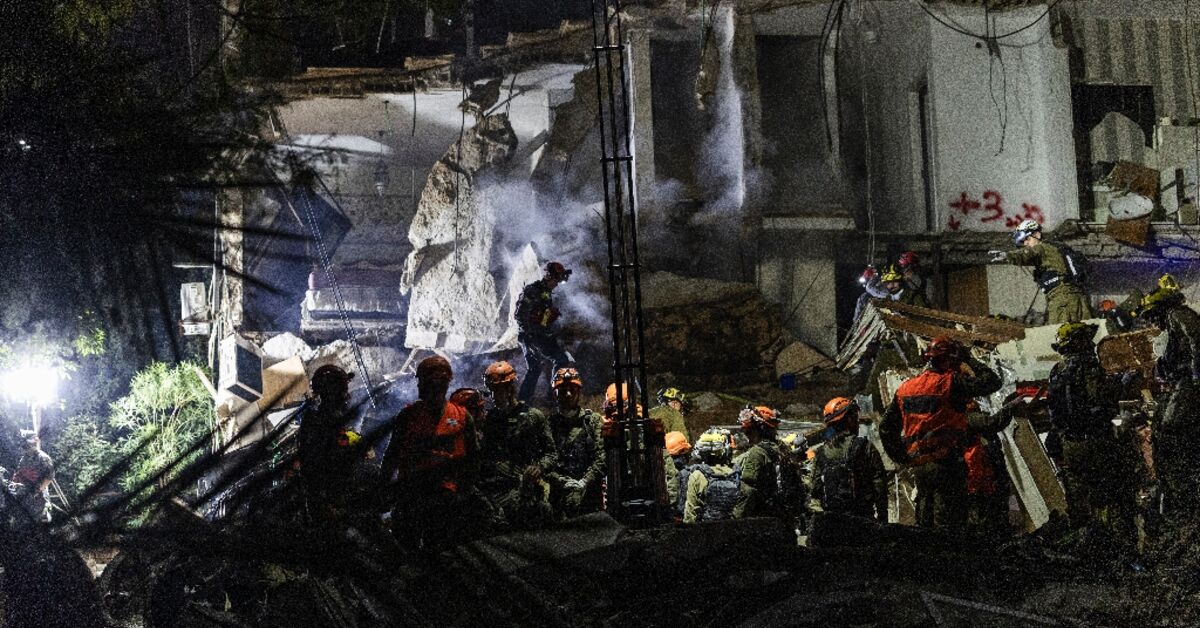
Israeli firefighters were searching for two missing people in the rubble of a residential building in the northern city of Haifa after it was struck by an Iranian missile that killed two others, authorities said Monday.
The direct hit on a seven-storey building tore through sections of the structure which has partially collapsed, the military and rescue services said.
AFP footage showed rescuers using flashlights to search through rubble and scattered concrete blocks.
The strike took place minutes after the military warned it had detected a new round of missiles fired from Iran at around 1500 GMT.
Elad Edri, chief of staff of Israel's Home Front Command, said that four people were missing.
"We have a major destruction site," he said in a video statement.
Israel's Fire and Rescue Services said later that two of the four people trapped under the rubble had been found dead.
The building was hit by a "direct impact of a missile", a military spokesperson told AFP, confirming it was fired from Iran.
- Eldery man, baby wounded -
Israel's emergency service, Magen David Adom, said four people were wounded in the strike, including a 10-month-old baby who suffered a head injury.
An 82-year-old man was also in a "serious condition", MDA said. A hospital later said he was stable.
He was "wounded by a heavy object and the blast", the MDA said, adding that the other three suffered shrapnel and blast injuries.
Dozens of Israeli security and members of rescue forces were deployed at the site of the strike, an AFP correspondent reported.
Images and footage published by MDA show smoke rising from the remains of a flattened building in a densely populated area, and stretchers laid on the road by rescuers for casualties.
MDA paramedic Shevach Rothenshtrych quoted residents saying that there were casualties trapped under the rubble on the lower floors, and the 82-year-old was rescued after first responders "managed to move large pieces of concrete with our hands".
His colleague Tal Shustak said that when emergency calls were received, "we were dispatched in large forces to the scene and saw extensive destruction, including glass, smoke and concrete scattered across the ground".
On Monday, the military detected fresh waves of missiles fired from Iran, and each time it said its "defensive systems are operating to intercept the threat".
Iran has fired missiles daily at Israel since February 28, in retaliation to joint US-Israeli attacks on the country that has killed several top Iranian leaders, including supreme leader Ali Khamenei.
Since the start of the conflict, Israeli and US airstrikes have attacked a number of Iran's missile production sites and also nuclear facilities.
Facts Only
Israeli firefighters are searching for two missing people in a collapsed residential building in Haifa.
The building was struck by an Iranian missile, killing two individuals.
The seven-story structure partially collapsed due to the direct hit.
Four people were initially reported missing, with two later confirmed dead.
Four others were wounded, including a 10-month-old baby with a head injury and an 82-year-old man in serious condition.
The strike occurred minutes after Israel's military detected missiles fired from Iran at around 1500 GMT.
Iran has been launching daily missile attacks on Israel since February 28.
The attacks are in retaliation for joint US-Israeli strikes that killed top Iranian leaders, including Supreme Leader Ali Khamenei.
Israeli and US airstrikes have targeted Iranian missile production sites and nuclear facilities.
Rescue operations are ongoing, with dozens of security and emergency personnel deployed to the site.
The building is located in a densely populated area of Haifa.
Israel's military has been intercepting incoming missiles with defensive systems.
Executive Summary
Full Take
The strongest version of this narrative presents a clear escalation in the Israel-Iran conflict, with direct civilian casualties and infrastructure damage in Haifa. The reporting provides verifiable details about the missile strike, rescue efforts, and casualties, which strengthens its credibility. However, the context of Iran's retaliation for US-Israeli strikes is presented without deeper scrutiny of the initial attacks or the broader geopolitical dynamics. The focus on civilian suffering and rescue operations may evoke emotional responses, but the article avoids overt sensationalism.
Patterns detected: none
The root cause of this narrative is the cycle of retaliation between Israel and Iran, driven by mutual accusations of aggression. The unstated assumption is that the conflict is a binary struggle, with little room for diplomatic resolution or third-party mediation. Historically, this echoes Cold War-era proxy conflicts, where direct and indirect strikes escalate without clear off-ramps.
The implications for human agency and dignity are severe: civilians bear the brunt of the violence, with limited recourse for protection or redress. The second-order consequences include potential regional destabilization, further militarization, and the normalization of civilian casualties in conflict zones.
Bridge questions:
How might this cycle of retaliation be de-escalated, and what role could international actors play?
What perspectives from affected civilians or neutral observers are missing from this narrative?
What evidence would change your assessment of who bears primary responsibility for the escalation?
Counterstrike scan: If this were part of a coordinated influence campaign, the playbook would emphasize civilian casualties to sway public opinion against Iran while downplaying the context of prior strikes. However, the article presents a balanced account of the immediate event without overt manipulation, focusing on facts and rescue efforts rather than partisan framing.
Sentinel — Human
This text appears to be written by a human journalist with some stylistic variation and personal voice, contrary to some AI-generated content patterns.