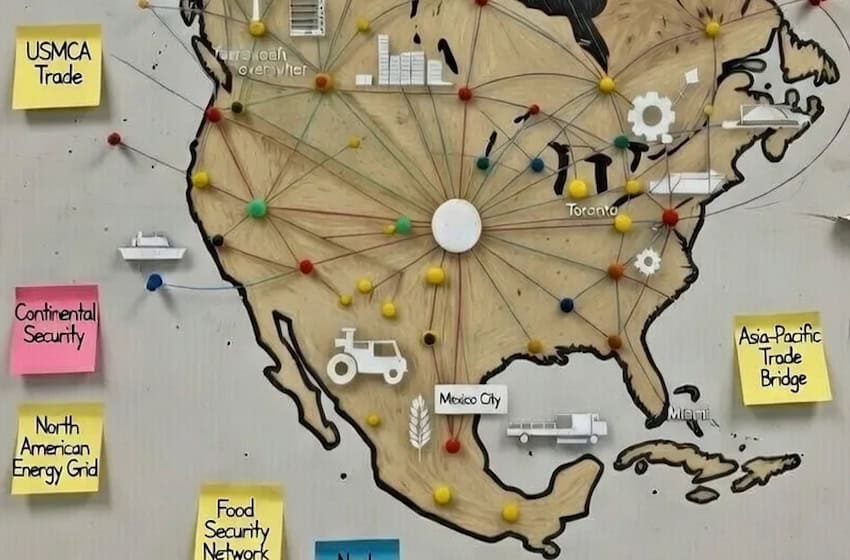
March 16 was the official start of the USMCA review process. It’s the first time the three countries — the United States, Mexico and Canada — will go through this process. Unfortunately, just two are sitting at the table. That’s why this is the perfect timing for the start of a new series: Regional Utopia.
Let’s get started.
By now, it should be clear that trade integration in North America has been, at least in part, a success. Over the past three decades, it has expanded commerce, deepened supply chains and given firms the legal certainty they need to invest and operate across borders. What began as trade has quietly evolved into continental co-production.
Yet this success also exposes its limits. Trade integration was necessary, but never sufficient for sustained, broad-based growth. Perhaps because it was never meant to be.
While North America built one of the world’s most integrated production systems, productivity growth remained modest, industrial expansion uneven and income convergence essentially stalled (you can read more about this in the analysis my co-authors and I wrote for the Inter-American Dialogue). Trade surged, but prosperity did not always keep pace for everyone. The agreement created the platform, but it was not designed to tackle the larger challenge of economic development.
In short, trade integration was only one piece of the puzzle. Many of the most important pieces — infrastructure, talent flows, regulatory alignment, shared industrial strategy — were left undiscussed.
This new series explores those missing pieces: the policies, institutions and strategic choices that could make North America more competitive, more productive and ultimately more prosperous, while spreading the gains more widely.
As the United States, Mexico and Canada approach the practical limits of what trade pacts alone can deliver — and with the USMCA joint review now underway — we face a natural question: what comes next?
My view is that the region must think more holistically about growth. “Fortress North America” makes for a catchy slogan in policy circles, but slogans are not strategy. The real work lies in navigating the political and economic realities that shape cooperation.
First of all, one contradiction stands out. Both the United States and Mexico are navigating sharp political and ideological shifts. Sovereignty, national identity and strategic autonomy have returned to the forefront of debate. At first glance, this resurgence of national priorities seems at odds with deeper regional integration.
How can governments put their own countries first while advancing shared regional prosperity?
The answer is to identify areas where cooperation directly reinforces national interests rather than undermines them. Two objectives tower above the rest: economic prosperity and security. If North America can pursue these goals collectively, the incentives for collaboration will align naturally.
The urgency sharpens in the global context. The competitive arena is no longer national. It is continental.
Competing at that scale demands more than national strategies. No single country in North America can go toe-to-toe with an entire continent alone. An “America First” posture may satisfy domestic politics, but economically it will fall short against a rival bloc. North America must learn to compete as a region.
That requires confronting difficult but unavoidable issues: labor mobility and migration management, regional skills certification, border infrastructure, trade facilitation, regulatory alignment, shared security frameworks, infrastructure corridors, joint energy systems and a coordinated industrial strategy rooted in economic complementarity. In short: building a more robust ecosystem.
For clarity, I group these challenges into three broad categories: people and talent, institutional architecture and industrial co-production.
First, North America must fully leverage its human capital. Our half-billion people must compete with more than two billion across China and its neighbors. Talent needs to move where it is most productive and needed.
This does not mean permanently higher migration flows. Mexico, in particular, needs its young, skilled citizens at home. But more flexible mechanisms — seasonal and circular migration programs, regional professional certifications — could let doctors, engineers, technicians and skilled workers cross borders when needed and source unfilled labor gaps.
Second, our institutional framework must catch up to economic reality. Regulatory coordination can slash friction in trade, investment, and innovation. Mutual recognition agreements — for instance, in pharmaceuticals — could let FDA or COFEPRIS approvals carry weight across borders. Joint border inspections, aligned intellectual property rules and coordinated approaches to emerging technologies like artificial intelligence would further boost productive capacity.
Third, the region must think deliberately about industrial coordination. Fiscal incentives, infrastructure investment, supply-chain strategies, sectoral policies and regional champions should reflect regional complementarities. Policymakers may shy from calling it a customs union, but a deeply integrated production platform will inevitably begin to resemble one.
If managed well, these steps could create a region where opportunity is more evenly distributed, investment and jobs stay within North America, innovation accelerates and economic dynamism helps tackle persistent challenges—from organized crime to irregular migration.
The central argument of this series is straightforward: North America already holds the building blocks of a continental economic system. What it lacks is the political imagination to treat itself as one.
This is not a call for a borderless region, but for strategically managed, efficient circulation of human capital.
It is not reckless outsourcing. It is a complementary, innovative system where the three countries design and build high-value products that sustain well-paid jobs across the continent.
And it is not subordination or diluted sovereignty. It is shared priorities — pursued by confident allies and trusted partners alike, in pursuit of mutually beneficial outcomes.
That is my vision of a regional utopia.
In the essays ahead, I will dig into each of these ideas in detail.
Pedro Casas Alatriste is the Executive Vice President and CEO of the American Chamber of Commerce of Mexico (AmCham). Previously, he has been the Director of Research and Public Policy at the US-Mexico Foundation in Washington, D.C. and the Coordinator of International Affairs at the Business Coordinating Council (CCE). He has also served as a consultant to the Inter-American Development Bank.
Facts Only
The USMCA review process has begun among the United States, Mexico, and Canada.
North America has one of the world's most integrated production systems.
Productivity growth, industrial expansion, and income convergence have been limited despite trade integration.
The US, Mexico, and Canada face political shifts that prioritize sovereignty and national identity.
Key challenges for North America include labor mobility, migration management, regional skills certification, border infrastructure, trade facilitation, regulatory alignment, shared security frameworks, infrastructure corridors, joint energy systems, and a coordinated industrial strategy.
Executive Summary
Full Take
The article presents a vision for a more integrated North America that addresses economic prosperity and security as shared goals. The author suggests that cooperation in these areas would align the incentives for collaboration among the three nations. However, political and ideological shifts in both the United States and Mexico may pose challenges to deeper regional integration. The proposed solutions include leveraging human capital, improving institutional frameworks, and coordinating industrial strategies to create a more robust ecosystem.
Patterns detected: ARC-0024 Ambiguity (the author does not explicitly define what he means by "Fortress North America"), ARC-0043 Motte-and-Bailey (the author proposes a more integrated North America while acknowledging that it may not mean borderless regions or diluted sovereignty).
The author's vision for North America raises questions about the balance between national interests and regional cooperation. It also highlights the potential benefits of deeper integration, such as increased productivity, competitiveness, and shared security. However, it is essential to consider the potential costs and challenges associated with closer ties among these three nations, particularly in light of ongoing political shifts in both the United States and Mexico.
Sentinel — Human
The analysis suggests that the article is likely human-written due to its idiosyncratic emphasis, personal voice, and absence of coordination indicators matching known template patterns. However, a low confidence score is reported as most articles are human-written.