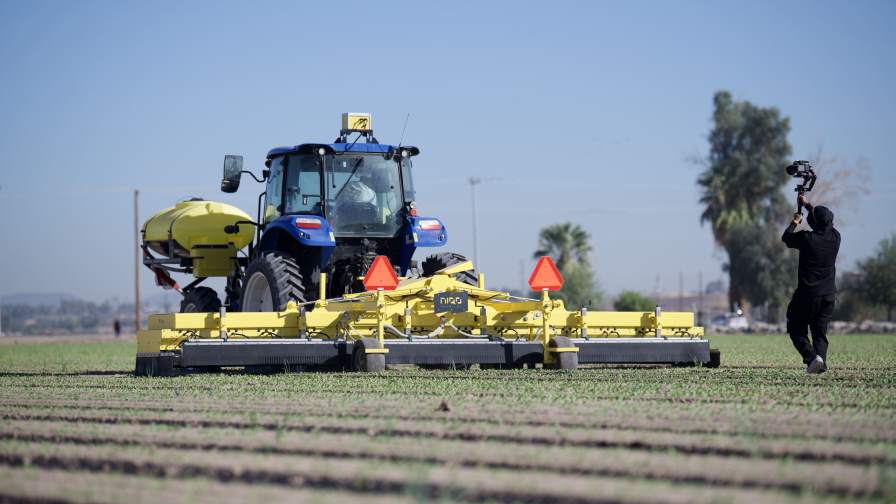
Niqo Robotics, the Physical AI company building intelligent weeding robots for the world’s farms, today announced that its core business is on track for profitability in its first full commercial year, a milestone no agricultural robotics company has publicly achieved. The company simultaneously unveiled plans to expand its AI weeding platform into new crops, new U.S. markets, and an entirely new product form factor, signaling the next phase of growth for the rapidly scaling enterprise.
A First for Agricultural Robotics: Path to Profitability
In an industry where leading players have collectively raised hundreds of millions of dollars without announcing a clear timeline to profitability, Niqo Robotics is charting a different course. The company’s RoboWeeder, an AI-powered precision weeding system that uses proprietary computer vision to identify and eliminate weeds at millimeter accuracy, has achieved strong commercial traction since its market entry, with the core business now approaching self-sustainability.
The company’s capital-efficient model is built on a farmer-first philosophy: a one-time purchase with zero recurring fees, 24/7 service, and locally stocked parts. This approach has resonated with growers across California’s Salinas Valley and Arizona’s Yuma region, Niqo’s established markets.
“We built Niqo to prove that Physical AI can be a real business, not just impressive technology that burns cash indefinitely,” said Jaisimha Rao, Founder and CEO of Niqo Robotics. “Our path to profitability is not about cutting corners. It is the result of building a product that delivers real ROI to growers from day one. No subscriptions, no hidden costs, just a machine that pays for itself.”
Expanding Beyond Lettuce: New Crops, New Markets, New Form Factors
With its core lettuce weeding operations commercially proven, Niqo is now expanding its Physical AI platform across multiple new frontiers.
New Crops: Niqo’s AI weeding technology is expanding rapidly into specialty crops like onions, tomatoes, broccoli, kale, melons, and turf grass. The company will now have 15+ crops as a part of its crop algorithm library.
New Markets: Beyond its established operations in California, Arizona and Georgia, Niqo is entering the Pacific Northwest region targeting the specialty crop market. It also targets expansion into Europe and the Australian specialty crop market in the upcoming year.
New Product line: Niqo announced that a next-generation precision weeding robot is in development for the U.S. market, expected in the second half of 2026. This new product will complement the company’s existing RoboWeeder and dramatically expand the range of crops and field configurations the platform can serve.
Physical AI: From Single Product to Intelligent Farming Platform
At the core of Niqo’s expansion is Niqo Sense, a proprietary AI camera system that can be integrated into multiple form factors and retrofitted onto existing farm equipment. Niqo’s platform combines the power of AI on the edge along with a dual tank twin nozzle architecture system to perform weeding, thinning, and beneficial spraying in a single pass. This eliminates the need for multiple machines and multiple field operations.
The system operates entirely on the edge, processing thousands of plant-level decisions per second in real-time, with zero cloud dependency, delivering over 99% accuracy even in weedy, challenging field conditions. This Physical AI approach, where intelligent software meets purpose-built hardware deployed in the real world, positions Niqo at the forefront of a category attracting significant investor attention globally.
Facts Only
Niqo Robotics is an agricultural robotics company developing AI-powered weeding robots.
The company’s core business is projected to achieve profitability in its first full commercial year.
The RoboWeeder is an AI-powered precision weeding system using proprietary computer vision.
The RoboWeeder has achieved commercial traction in California’s Salinas Valley and Arizona’s Yuma region.
Niqo’s business model includes a one-time purchase with no recurring fees, 24/7 service, and locally stocked parts.
The company is expanding its AI weeding technology to new crops, including onions, tomatoes, broccoli, kale, melons, and turf grass.
Niqo plans to enter new markets, including the Pacific Northwest, Europe, and Australia.
A next-generation precision weeding robot is in development, expected in the second half of 2026.
Niqo Sense is a proprietary AI camera system that operates on the edge, processing plant-level decisions in real-time.
The system claims over 99% accuracy in weeding, thinning, and beneficial spraying in a single pass.
Niqo positions itself as a leader in "Physical AI," combining software and hardware for real-world agricultural applications.
Executive Summary
Niqo Robotics, a company specializing in AI-powered weeding robots for agriculture, is on track to achieve profitability in its first full commercial year, a milestone unmatched by other agricultural robotics firms. Its flagship product, the RoboWeeder, uses proprietary computer vision to precisely identify and eliminate weeds, gaining strong commercial traction in California’s Salinas Valley and Arizona’s Yuma region. The company’s business model emphasizes a one-time purchase with no recurring fees, 24/7 service, and locally stocked parts, which has resonated with growers.
Expanding beyond its initial focus on lettuce, Niqo is now targeting new crops like onions, tomatoes, broccoli, and turf grass, with plans to enter the Pacific Northwest, Europe, and Australia. Additionally, a next-generation weeding robot is in development, expected by late 2026, to broaden the platform’s applicability. Central to Niqo’s technology is Niqo Sense, an AI camera system that operates on the edge, enabling real-time plant-level decisions without cloud dependency. The company positions itself as a leader in "Physical AI," combining intelligent software with purpose-built hardware to streamline farming operations.
Full Take
Niqo Robotics presents a compelling narrative of innovation and profitability in agricultural robotics, a sector often criticized for burning capital without clear returns. The company’s focus on a farmer-first model—no subscriptions, no hidden costs—positions it as a disruptor in an industry where many competitors rely on recurring revenue streams. The expansion into new crops and markets, coupled with the development of a next-generation robot, suggests confidence in its technology’s scalability. The emphasis on "Physical AI" and edge computing aligns with broader trends in autonomous systems, where real-time decision-making without cloud dependency is increasingly valued.
However, the claim of over 99% accuracy in challenging field conditions warrants scrutiny. While impressive, such metrics often depend on controlled testing environments, and real-world variability in soil, lighting, and weed types could affect performance. The article does not address potential limitations or failure cases, which are critical for assessing the technology’s robustness. Additionally, the focus on profitability as a differentiator may overshadow questions about long-term sustainability, such as maintenance costs, adaptability to new farming practices, or competition from established agricultural machinery giants.
The narrative echoes the broader pattern of tech-driven disruption in traditional industries, where startups leverage AI to challenge incumbent practices. Yet, the agricultural sector’s complexity—with its diverse crops, regional variations, and farmer skepticism toward new technologies—poses significant hurdles. Niqo’s success hinges not just on technical prowess but on its ability to build trust and demonstrate consistent value across different farming contexts.
**Patterns detected: none**
**Bridge questions:**
How does Niqo’s one-time purchase model compare to the total cost of ownership for traditional weeding methods or competing robotic systems?
What are the potential risks of over-reliance on AI-driven weeding, such as algorithmic biases or unintended ecological impacts?
How might Niqo’s expansion into Europe and Australia navigate differing regulatory landscapes and farming practices?
**Counterstrike scan:** If this were part of a coordinated influence campaign, the playbook might emphasize Niqo’s profitability and innovation to attract investors while downplaying operational risks or competitive threats. However, the content does not exhibit signs of manipulation, focusing instead on verifiable claims and future plans. The narrative aligns with typical startup messaging rather than a deceptive strategy.