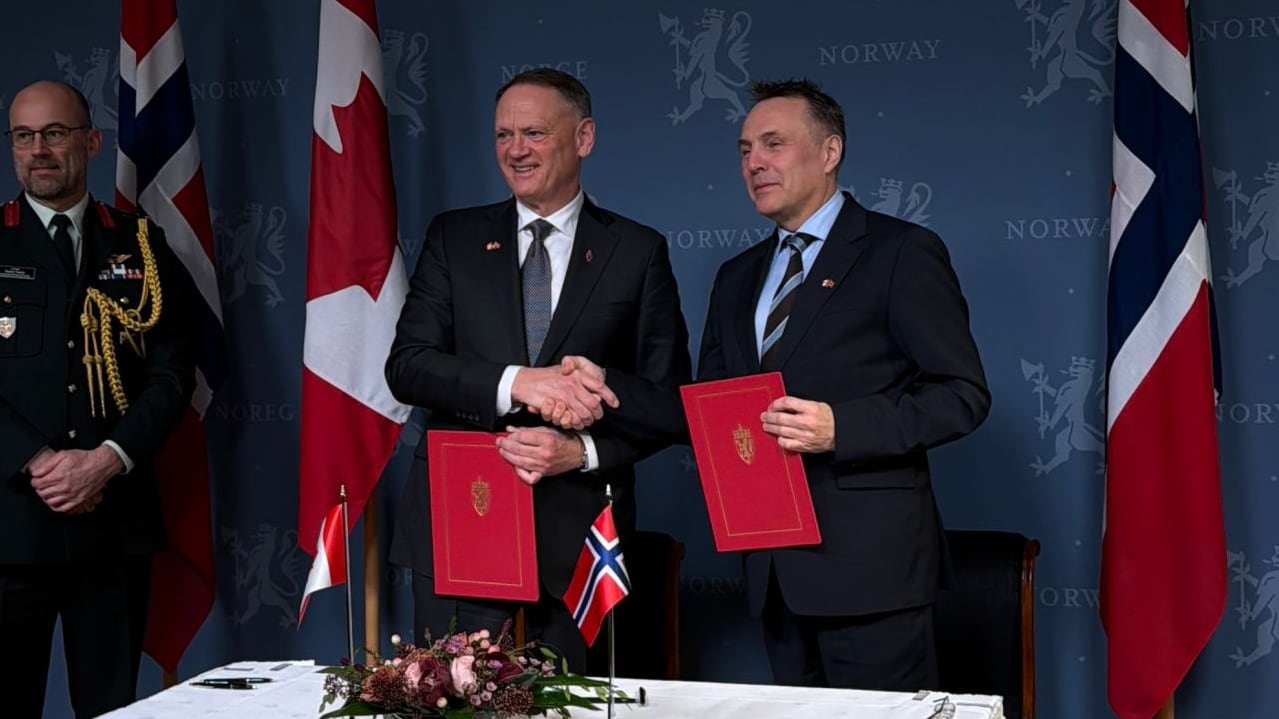
Canada and Norway have taken a step toward integrating their space and defence architectures, signing a new Letter of Intent (LOI) to deepen bilateral cooperation in the space domain.
The agreement arrives as the two Arctic nations simultaneously move to modernize an 18-year-old free trade pact, signaling a comprehensive alignment of their economic, industrial, and national security interests.
The dual-track diplomatic effort underscores a growing recognition in Ottawa and Oslo that protecting the High North requires both sovereign space capabilities and resilient, allied supply chains. This strategy was heavily emphasized on March 14 during Prime Minister Mark Carney’s high-profile visit to Norway for the Canada-Nordic Summit, where he stressed that “security can no longer be taken for granted” in a divided world.
The space defence agreement, signed in Oslo by Canadian Minister of National Defence David J. McGuinty and Norwegian Minister of Defence Tore O. Sandvik, establishes a formal framework to strengthen cooperation across policy, intelligence, research and development, and industry capabilities.
For the Canadian space sector, the LOI represents another strategic opportunity. The Department of National Defence noted that the agreement places a particular focus on advancing Arctic security. As climate change increases maritime traffic and adversarial activity in the region, both nations are highly dependent on space-based assets—specifically satellite communications, Earth observation, and navigation—to maintain domain awareness and sovereignty.
The bilateral pact builds upon existing multilateral collaboration through the Combined Space Operations (CSpO) Initiative. It also aligns directly with Canada’s recently updated Defence Industrial Strategy, which identifies the space sector as a critical sovereign capability. With Canada actively investing in a sovereign space launch capability, closer ties with Norway—which operates established launch infrastructure at Andøya Space—could provide valuable industrial synergies.
This space pact is part of a much larger, continent-spanning defence integration. While in Norway, Prime Minister Carney observed Exercise Cold Response, a massive 14-nation NATO Arctic military drill, alongside Norwegian Prime Minister Jonas Gahr Støre and German Chancellor Friedrich Merz.
Concrete examples of this growing defence and aerospace industrial collaboration are already materializing. Recently, Canadian space launch startup NordSpace signed a Memorandum of Understanding with Kongsberg Geospatial—a Canadian subsidiary of Norwegian defence giant Kongsberg Defence & Aerospace—to develop a digital mission control centre for its Atlantic Spaceport Complex. Similarly, Toronto-based Kepler Communications recently selected Kongsberg NanoAvionics as its preferred European satellite bus provider to expand its optical data relay network. To fuel further integration of these allied space and defence supply chains, Canada is leaning on its newly established Defence Investment Agency and the Defence, Security and Resilience Bank to mobilize financing.
Simultaneously, the economic wrapper for this defence alignment is being overhauled. Days prior to the Oslo summit, Canadian Trade Minister Tim Hodgson met with Norway’s Minister of Trade and Industry Cecilie Myrseth at the Prospectors & Developers Association of Canada) PDAC mineral convention in Toronto to discuss trade and the modernization of the 2008 free trade agreement between Canada and the European Free Trade Association (EFTA).
The original 2008 agreement was largely focused on physical commodities. The modernized framework aims to expand into services, business establishment, and public procurement—areas critical to the space and technology sectors.
“Norwegian companies contribute to jobs and innovation in Canada. The collaboration is particularly strong in raw materials, aquaculture, energy, and the maritime sector,” said Minister Myrseth following the meetings. “Canada’s research institutions and startup environments also create opportunities for Norwegian companies in space, defence, and health, among other things.”
For aerospace executives, this modernization is could be consequential. Expanding the trade agreement to explicitly cover services and public procurement will lower the barriers for Canadian and Norwegian space firms to bid on each other’s government defence and space contracts.
Furthermore, discussions at PDAC highlighted a shared priority to secure the critical mineral supply chains—such as rare-earth elements—essential for advanced space systems and defence hardware. The private sector is already moving on this front; Canadian company Champion Iron recently announced a $400 million proposed acquisition of Norwegian high-grade iron ore producer Rana Gruber ASA.
By linking space defence cooperation with an updated, tech-forward trade framework and massive capital investments, Canada and Norway are “friend-shoring” their high-tech and defence industrial bases.
Facts Only
Canada and Norway signed a Letter of Intent (LOI) in Oslo to deepen bilateral cooperation in space and defence.
The agreement was signed by Canadian Minister of National Defence David J. McGuinty and Norwegian Minister of Defence Tore O. Sandvik.
The LOI establishes a framework for cooperation across policy, intelligence, research and development, and industry capabilities.
The focus includes advancing Arctic security, particularly as climate change increases maritime traffic and adversarial activity in the region.
Both nations are modernizing an 18-year-old free trade agreement to expand into services, business establishment, and public procurement.
The space defence agreement aligns with Canada’s updated Defence Industrial Strategy, which identifies space as a critical sovereign capability.
Canada is investing in a sovereign space launch capability, while Norway operates launch infrastructure at Andøya Space.
Canadian space launch startup NordSpace signed a Memorandum of Understanding with Kongsberg Geospatial to develop a digital mission control centre.
Toronto-based Kepler Communications selected Kongsberg NanoAvionics as its preferred European satellite bus provider.
Canadian Trade Minister Tim Hodgson and Norway’s Minister of Trade and Industry Cecilie Myrseth discussed trade modernization at the PDAC convention in Toronto.
The original 2008 free trade agreement focused on physical commodities, while the modernized framework aims to include services and public procurement.
Champion Iron announced a $400 million proposed acquisition of Norwegian high-grade iron ore producer Rana Gruber ASA.
Prime Minister Mark Carney observed Exercise Cold Response, a 14-nation NATO Arctic military drill, in Norway.
Executive Summary
Canada and Norway have signed a Letter of Intent (LOI) to deepen bilateral cooperation in space and defence, reflecting a broader alignment of economic, industrial, and security interests. The agreement, signed in Oslo by Canadian Defence Minister David J. McGuinty and Norwegian Defence Minister Tore O. Sandvik, focuses on policy, intelligence, research, and industry capabilities, with a particular emphasis on Arctic security. This comes as both nations modernize their 18-year-old free trade agreement to include services, business establishment, and public procurement—sectors critical to space and technology. The collaboration builds on existing multilateral efforts like the Combined Space Operations Initiative and aligns with Canada’s updated Defence Industrial Strategy, which prioritizes sovereign space capabilities. Concurrently, economic ties are being strengthened, with discussions on critical mineral supply chains and trade modernization underway. The partnership is further evidenced by private-sector deals, such as NordSpace’s collaboration with Kongsberg Geospatial and Champion Iron’s proposed acquisition of Rana Gruber ASA. The dual-track approach underscores a shared recognition of the strategic importance of the Arctic and the need for resilient, allied supply chains in an increasingly divided world.
The agreement also reflects a broader NATO context, with Prime Minister Mark Carney observing Exercise Cold Response, a multinational Arctic military drill, alongside Norwegian and German leaders. The modernization of trade frameworks aims to facilitate cross-border contracts in defence and space, while industrial synergies—such as Canada’s nascent space launch capabilities and Norway’s established infrastructure at Andøya Space—highlight potential areas of collaboration. The narrative suggests a deliberate "friend-shoring" of high-tech and defence industries, driven by geopolitical uncertainties and the growing strategic significance of the Arctic region.
Full Take
The strongest version of this narrative presents a compelling case for Canada and Norway’s strategic alignment in space and defence, framed as a necessary response to geopolitical fragmentation and Arctic vulnerabilities. The article effectively highlights concrete steps—such as the LOI, trade modernization, and private-sector collaborations—to demonstrate a coherent, multi-layered approach to security and economic resilience. The emphasis on "friend-shoring" and sovereign capabilities resonates with broader Western strategies to reduce dependence on adversarial supply chains, particularly in high-tech sectors. The inclusion of NATO exercises and industrial synergies (e.g., Andøya Space, Kongsberg partnerships) lends credibility to the claim that this is a serious, long-term commitment rather than mere diplomatic posturing.
However, the narrative leans heavily on the assumption that deeper integration is inherently beneficial, without critically examining potential downsides. For instance, the focus on Arctic security as a justification for space defence cooperation could be seen as a form of threat inflation (ARC-0012), where the urgency of climate change and adversarial activity is used to accelerate military-industrial collaboration. The article also employs a form of strategic ambiguity (ARC-0024) by conflating economic modernization with security imperatives, making it difficult to disentangle whether the primary driver is geopolitical necessity or industrial opportunism. The lack of dissenting voices—such as critics of militarization in the Arctic or skeptics of trade liberalization—creates a one-sided framing that could be interpreted as sanewashing (ARC-0045), where complex policy choices are presented as uncontroversial necessities.
Rooted in Cold War-era Arctic security paradigms, this narrative echoes historical patterns of alliance-building through technological and economic interdependence. The unstated assumption is that sovereignty in the High North can only be maintained through allied cooperation, which may overlook alternative models of neutral or non-aligned Arctic governance. The implications for human agency are mixed: while the collaboration could enhance collective security and economic opportunities, it also risks entrenching a zero-sum geopolitical mindset that prioritizes defence industrial bases over broader human security concerns, such as Indigenous rights or environmental protection in the Arctic.
Bridge questions: How might this partnership affect non-NATO Arctic states, such as Russia or China, and could it escalate tensions rather than deter them? What trade-offs exist between sovereign capabilities and interdependence, and who decides where to draw the line? If the primary justification for this cooperation is climate-driven Arctic activity, why isn’t climate mitigation itself a more central pillar of the agreement?
Counterstrike scan: A coordinated influence campaign pushing this narrative would likely emphasize existential threats to Arctic sovereignty, frame economic integration as a security imperative, and amplify private-sector endorsements to create an illusion of inevitability. The actual content aligns with this pattern but does not exhibit overt manipulation; the focus on tangible agreements and multilateral exercises suggests a genuine policy direction rather than a manufactured crisis. However, the absence of countervailing perspectives or critical scrutiny of costs (e.g., militarization risks, trade distortions) could make it vulnerable to exploitation by actors seeking to normalize permanent security alliances in the Arctic.
Patterns detected: ARC-0012 Threat Inflation, ARC-0024 Ambiguity, ARC-0045 Sanewashing
Sentinel — Human
The article shows low signs of synthetic generation, with human-like irregularities, specific attributions, and domain expertise suggesting a likely human author.