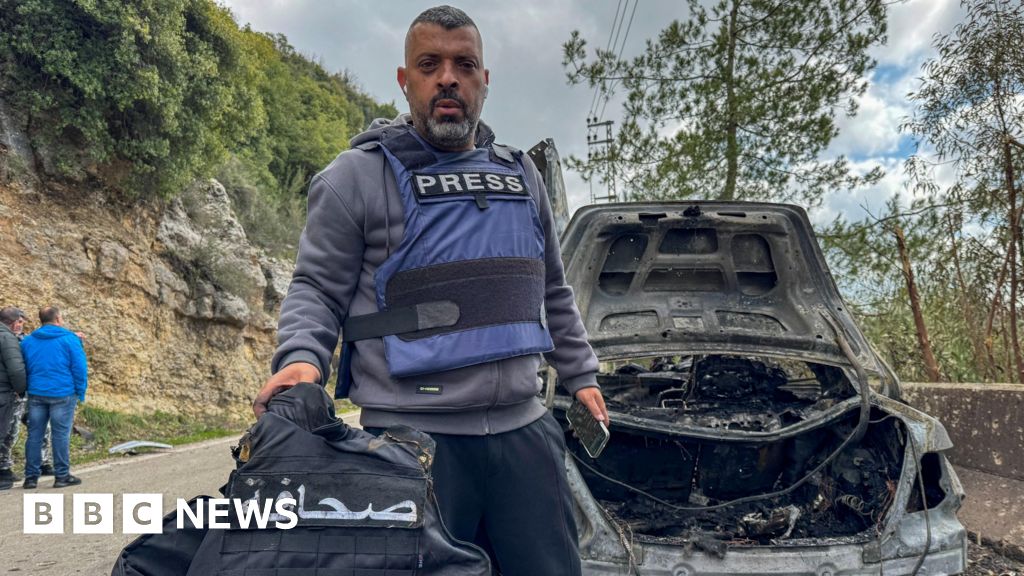
Three Lebanese journalists were killed in a targeted Israeli strike in southern Lebanon on Saturday, their employers have said.
Ali Shoeib, a reporter for the Hezbollah-affiliated Al Manar TV, was killed in the town of Jezzine alongside reporter Fatima Ftouni and cameraman Mohamed Ftouni from the channel Al Mayadeen, according to the stations.
The strike reportedly hit the journalists' car just before noon local time (10:00 GMT).
The Israel Defense Forces (IDF) confirmed it had killed Shoeib, describing him as a "terrorist" from Iranian-backed Hezbollah's elite Radwan Force who had "operated for years under the guise of a journalist".
It said he had worked to "expose the locations of IDF soldiers operating in southern Lebanon and along the border", including during the current fighting, and had used his position "to disseminate Hezbollah propaganda materials".
The IDF did not comment on the deaths of Fatima or Mohamed Ftouni.
Lebanese President Joseph Aoun called the strike a "brazen crime" that broke the "most basic rules" of international law by targeting reporters, "who are ultimately civilians performing a professional duty".
Prime Minister Nawaf Salam likewise condemned the attack in a statement on X, branding it a "flagrant violation of international humanitarian law and a clear breach of the rules that guarantee the protection of journalists in times of war".
This is the second time Israel has been accused of targeting journalists in Lebanon since the US-Israel war against Iran began a month ago.
On 18 March, Al Manar reported its presenter Mohammad Sherri and his wife had been killed in an Israeli strike in Beirut while they were sleeping.
More than 1,100 civilians, including 120 children and 42 paramedics, have been killed in Lebanon during the conflict so far, according to the Lebanese Ministry of Health.
More than a million people have also been displaced, worsening an existing humanitarian crisis in the country.
Many in Lebanon are worried Israel is using similar tactics it has been accused of deploying in Gaza - including the deliberate targeting of civilians, journalists and paramedics, which Israel denies.
Israel and Hezbollah had agreed a ceasefire in November 2024, under which both sides were meant to leave their positions in the south.
Progress was made, but it was partial. Israel maintained several military posts in the south and continued to carry out regular attacks on what it said were Hezbollah targets, accusing the group of trying to rearm and rebuild its presence.
After the killing of Iran's supreme leader at the beginning of the current conflict, Hezbollah fired rockets into northern Israel in retaliation - both for his death and Israeli attacks since the ceasefire.
Israel has since escalated its operations in the region, saying its aim was to protect communities in northern Israel from attacks by Hezbollah militants.
Facts Only
Three Lebanese journalists—Ali Shoeib, Fatima Ftouni, and Mohamed Ftouni—were killed in an Israeli strike in southern Lebanon on Saturday.
Ali Shoeib was a reporter for Al Manar TV, affiliated with Hezbollah.
Fatima Ftouni and Mohamed Ftouni worked for Al Mayadeen.
The strike hit their car around noon local time (10:00 GMT) in the town of Jezzine.
The Israel Defense Forces (IDF) confirmed Shoeib's death, labeling him a "terrorist" from Hezbollah's Radwan Force.
The IDF stated Shoeib used his journalistic role to expose IDF soldier locations and disseminate Hezbollah propaganda.
The IDF did not comment on the deaths of Fatima or Mohamed Ftouni.
Lebanese President Joseph Aoun called the strike a "brazen crime" violating international law.
Lebanese Prime Minister Nawaf Salam condemned the attack as a breach of humanitarian law protecting journalists.
On March 18, an Israeli strike in Beirut killed Al Manar presenter Mohammad Sherri and his wife.
Over 1,100 civilians, including 120 children and 42 paramedics, have been killed in Lebanon during the conflict.
More than one million people have been displaced in Lebanon.
Israel and Hezbollah agreed to a ceasefire in November 2024, though both sides continued limited military activities.
Hezbollah fired rockets into northern Israel after Iran's supreme leader was killed, prompting Israeli escalation.
Executive Summary
Three Lebanese journalists—Ali Shoeib of Al Manar TV and Fatima Ftouni and Mohamed Ftouni of Al Mayadeen—were killed in an Israeli strike in southern Lebanon on Saturday. The Israel Defense Forces (IDF) confirmed Shoeib's death, describing him as a Hezbollah operative who used journalism as cover to gather intelligence and spread propaganda. The IDF did not address the deaths of the other two journalists. Lebanese officials, including President Joseph Aoun and Prime Minister Nawaf Salam, condemned the strike as a violation of international law protecting civilians and journalists. This incident follows a March attack that killed another Al Manar journalist and his wife in Beirut. The conflict has resulted in over 1,100 civilian deaths in Lebanon, including children and paramedics, and displaced more than a million people. Tensions escalated after Iran's supreme leader was killed, prompting Hezbollah retaliation and Israeli military escalation, despite a partial ceasefire agreed in November 2024.
The situation reflects broader concerns about the targeting of civilians and journalists in the conflict, with Lebanon accusing Israel of tactics similar to those used in Gaza. Israel maintains its operations are defensive, aimed at countering Hezbollah threats to northern communities. The ceasefire remains fragile, with both sides accusing the other of violations.
Full Take
The strongest version of this narrative highlights a clear pattern of targeted violence against journalists in conflict zones, framed by competing claims of legitimacy. The IDF's assertion that Shoeib was a Hezbollah operative—rather than a civilian journalist—serves as a legal and moral justification for the strike, while Lebanese officials and media outlets present the killings as deliberate attacks on press freedom. The inclusion of prior incidents, such as the March strike in Beirut, reinforces the narrative of systemic targeting, echoing broader accusations against Israel's conduct in Gaza. The emotional weight of civilian casualties, including children and paramedics, amplifies the moral outrage, while the IDF's selective acknowledgment of Shoeib's death—without addressing the other journalists—creates an asymmetry in accountability.
This dynamic reflects a classic information warfare tactic: the weaponization of ambiguity (ARC-0024). By labeling Shoeib a "terrorist," the IDF shifts the frame from civilian protection to counterterrorism, a motte-and-bailey maneuver (ARC-0043) that allows for plausible deniability while maintaining aggressive posture. Meanwhile, Lebanese officials leverage the journalists' civilian status to rally international condemnation, appealing to humanitarian norms. The broader context—escalating violence post-ceasefire, displacement crises, and regional tensions—suggests a paradigm of perpetual conflict where media narratives become battlegrounds for legitimacy. The root cause lies in the erosion of neutral arbiters: when states and armed groups control information flows, journalism itself becomes a contested domain.
The implications for human agency are stark. Journalists in conflict zones face existential risks, not just from collateral damage but from deliberate targeting justified by opposing narratives. The beneficiaries of this chaos are those who profit from prolonged instability—armed groups, defense industries, and political factions that thrive on polarization. The costs are borne by civilians, displaced populations, and the truth itself. Second-order consequences include the normalization of journalist killings, the weakening of international humanitarian law, and the entrenchment of distrust in media.
Bridge questions: How do we distinguish between legitimate military targets and civilian journalists in hybrid warfare? What mechanisms could restore accountability when both sides exploit legal gray areas? If Hezbollah does embed operatives in media roles, does that justify all strikes on journalists, or does it demand more precise intelligence?
Counterstrike scan: A coordinated influence campaign would amplify emotional outrage (rage bait, ARC-0012) while selectively omitting context (e.g., Hezbollah's use of media for military purposes). It might also employ false equivalence (ARC-0031) to equate all journalist deaths without examining individual cases. This article avoids outright manipulation but leans into the Lebanese narrative of systemic targeting, which could serve a broader delegitimization strategy against Israel. The content does not fully match a hypothetical attack playbook, as it includes IDF justifications and acknowledges uncertainty. However, the framing risks reinforcing preexisting biases without deeper interrogation of Hezbollah's media-military overlap.
Patterns detected: ARC-0024 Ambiguity, ARC-0043 Motte-and-Bailey