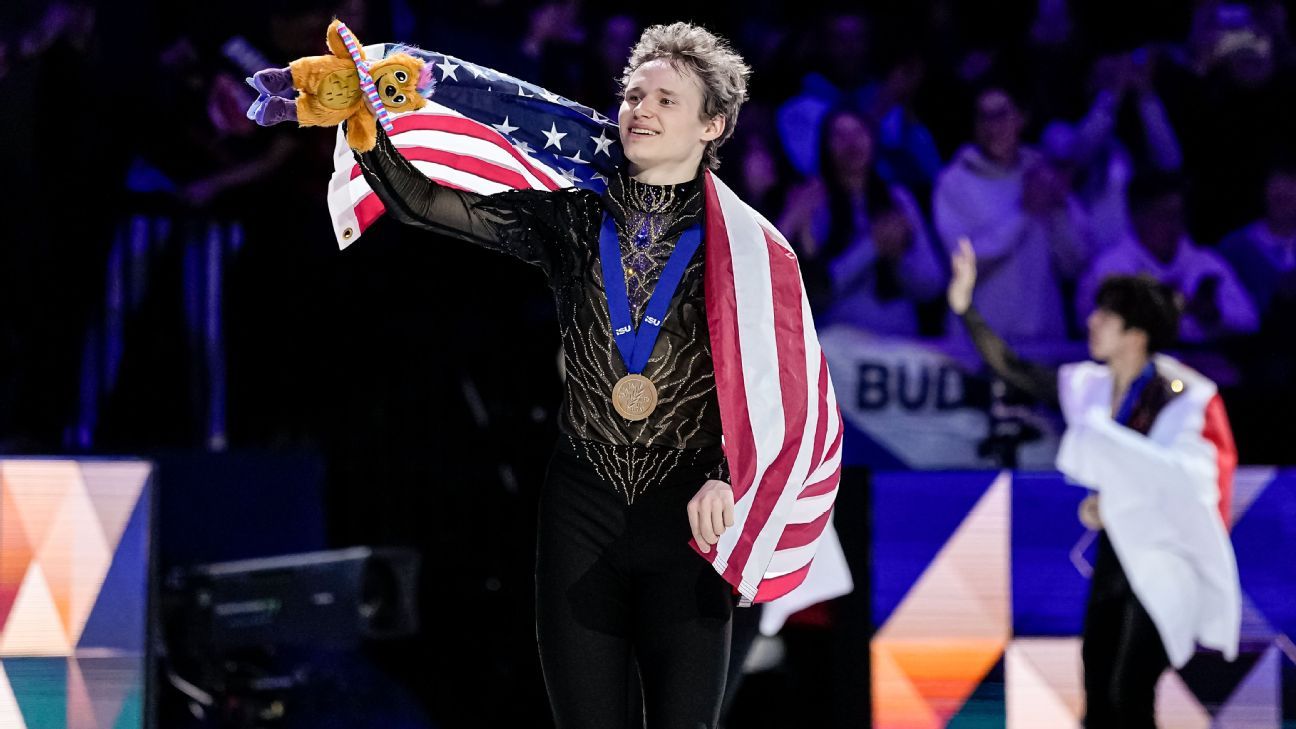
PRAGUE -- Ilia Malinin is back on the top step of the podium.
Six weeks after a disastrous skate knocked the Olympic gold medal favorite off the podium, the "Quad God" reeled off one huge jump after another, and a backflip for good measure, to retain his world championship title for the third year running.
Malinin shouted and punched the air with relief after finishing a skate that showed he had achieved his desire to "move on" from the Olympics following days tormented by his mistakes.
He praised the crowd's support, saying: "It was really challenging, really hard, but with you guys, I was able to make it through." His aim, he added, had simply been to get through the free skate "in one piece."
Skating last after leading the short program, just as he did in Milan, Malinin landed five high-scoring quadruple jumps but not his pioneering quad axel, a jump he didn't attempt at the Olympics.
Malinin scored 218.11 in the free skate for a total 329.40, far ahead of silver medalist Yuma Kagiyama of Japan with 306.67. Another Japanese skater, Shun Sato, was third with 288.54.
Kagiyama beat his personal-best free skate score but still had to make do with a fourth world championship silver in a career that includes four Olympic silvers and five total worlds medals, but no gold from either event. He embraced Malinin after his skate, and they jumped together in celebration.
In a showcase of top-level skating, there was no podium spot for France's Adam Siao Him Fa, who had been in second after the short program but dropped to fifth overall after a fall. Estonia's Aleksandr Selevko also fell and dropped from third to sixth.
Malinin had no rematch with Mikhail Shaidorov, the skater from Kazakhstan who won the Olympic gold, because he opted against competing again this season.
That's relatively common in figure skating for gold medal winners who face a rush of media and commercial opportunities after a grueling four-year Olympic buildup.
Malinin is the first skater to win three consecutive men's world titles since fellow American Nathan Chen, who achieved the feat in 2018, 2019 and 2021 after the 2020 event was canceled because of the COVID-19 pandemic.
The last competition of the championships is the free dance portion of the ice dance event later Saturday. France's Laurence Fournier Beaudry and Guillaume Cizeron are in the lead after Friday's rhythm dance.
Facts Only
Ilia Malinin won his third consecutive world championship title in men's figure skating in Prague.
He scored 218.11 in the free skate and 329.40 overall.
Yuma Kagiyama of Japan placed second with 306.67 points.
Shun Sato of Japan placed third with 288.54 points.
Malinin landed five quadruple jumps but did not attempt a quad axel.
He had previously failed to medal at the Olympics six weeks earlier.
Adam Siao Him Fa of France dropped from second to fifth after a fall.
Aleksandr Selevko of Estonia dropped from third to sixth after a fall.
Mikhail Shaidorov, the Olympic gold medalist, did not compete at the world championships.
Malinin is the first skater since Nathan Chen to win three consecutive men's world titles.
The ice dance free skate, the final event, featured France's Laurence Fournier Beaudry and Guillaume Cizeron in the lead.
Executive Summary
Ilia Malinin, known as the "Quad God," secured his third consecutive world championship title in men's figure skating in Prague, delivering a strong performance with five quadruple jumps and a backflip. His free skate score of 218.11 and total of 329.40 placed him far ahead of Japan's Yuma Kagiyama, who earned silver with 306.67, and Shun Sato, who took bronze with 288.54. Malinin's victory follows a disappointing Olympic performance where he failed to medal, and he expressed relief and gratitude for the crowd's support. Kagiyama, despite setting a personal-best free skate score, has yet to win a world or Olympic gold, settling for his fourth world silver. France's Adam Siao Him Fa and Estonia's Aleksandr Selevko, who were in podium positions after the short program, dropped to fifth and sixth, respectively, due to falls. Olympic gold medalist Mikhail Shaidorov did not compete, a common choice for Olympic champions facing post-victory demands. Malinin joins Nathan Chen as the only American men to win three straight world titles in recent history.
The event also highlighted the competitive depth in men's skating, with multiple skaters executing high-difficulty elements. The championships concluded with the ice dance free skate, where France's Laurence Fournier Beaudry and Guillaume Cizeron led after the rhythm dance. The narrative underscores the pressure of Olympic expectations and the resilience required to rebound from setbacks in elite sports.
Full Take
The strongest version of this narrative highlights Malinin's resilience and technical dominance, framing his victory as a redemption arc after Olympic disappointment. The article credits his performance, the crowd's support, and the competitive field, while acknowledging Kagiyama's consistent but silver-laden career. It avoids overt emotional manipulation but leans into the dramatic contrast between Malinin's Olympic failure and world championship triumph, a classic underdog rebound story.
Pattern scan: The framing subtly elevates Malinin's achievement by contrasting it with Kagiyama's "no gold" record, which could edge into a false binary of success (gold vs. silver). The omission of deeper analysis on why Olympic champions often skip post-Games competitions (e.g., burnout, commercial pressures) leaves room for unexamined assumptions about athlete priorities. However, no overt distortion or bad faith is detected.
Root cause: The narrative reflects the broader paradigm of elite sports as a meritocracy of grit and talent, where setbacks are temporary and redemption is earned through performance. It assumes the primacy of competition results as the ultimate measure of an athlete's worth, sidestepping questions about mental health, systemic pressures, or the subjective nature of judging in figure skating.
Implications: For human agency, Malinin's story reinforces the idea that failure can be overcome through perseverance, which is empowering but may also gloss over the structural support (coaching, resources) required for such comebacks. The cost is borne by athletes like Kagiyama, whose consistent excellence is framed as a "lack" of gold, potentially undermining the value of sustained high performance. Second-order consequences include the normalization of extreme physical risk (e.g., quad jumps) as necessary for success, raising ethical questions about the sport's evolution.
Bridge questions: How might the pressure to attempt ever-more-dangerous jumps affect skaters' long-term health? What role do media narratives play in shaping how athletes perceive their own careers? Would the sport benefit from a broader definition of success beyond medals?
Counterstrike scan: A coordinated influence campaign might amplify the "redemption" angle to sell a simplistic "failure-to-triumph" narrative, ignoring systemic issues like judging biases or athlete exploitation. The actual content does not match this pattern; it presents a straightforward sports story without overt manipulation. The focus on individual achievement over structural context is typical of sports reporting but not inherently malicious.
Patterns detected: none