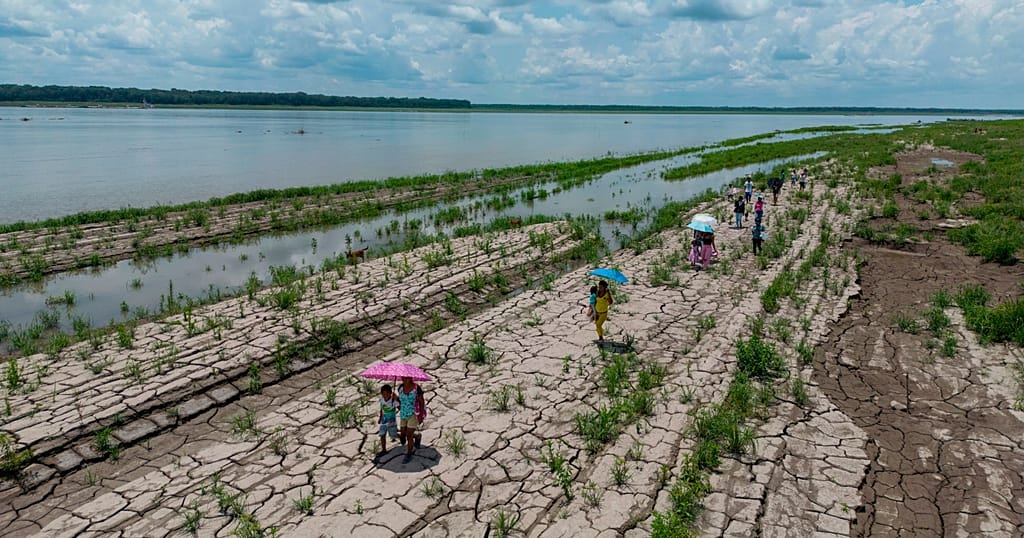
El Niño
Officials from the UN and international aid agencies gathered in Geneva on Monday to discuss increasing threats of heatwaves in Europe, an intense Ebola outbreak in Africa, and an anticipated food crisis driven by weather events such as El Niño.
Mary Friel, the Senior Officer of Climate Policy at International Federation of Red Cross and Red Crescent Societies, advised "people to take this heat wave seriously and to look out for those most at risk to save lives."
"We know the most extreme impacts are felt by the elderly, children, pregnant women, people living with chronic illnesses, outdoor workers, people experiencing homelessness, migrants, and people living in housing prone to overheating without access to cool spaces," she added.
Dr. Abdirahman Mahamud, the Director of Health Emergency Alert and Response Operations at World Health Organization, termed the ongoing Bundibugyo virus outbreak as the fastest growing Ebola outbreak on record as there are currently 1048 confirmed cases, including 267 fatalities.
"It took 78 days to reach 250 deaths during the 2014 and 2016 West Africa outbreak. In the previous outbreak (in) 2018-2019, it took 130 days, but before this outbreak, it only took 37 days, just portraying the scale, the scope, and the intensity of transmission," Mahamud said.
While the world experiences prolonged conflicts and disease outbreaks, extreme weather events are anticipated to worsen hunger and malnutrition in at least 22 countries.
"We are anticipating what could become a strong El Nino event, one that is expected to affect millions of people across multiple regions through droughts, floods, and storms," said Maxwell Sibhensana, the Deputy Director of Food and Agriculture Organization's (FAO) Office of Emergencies and Resilience.
To cope with, FAO and World Food Programme (WFP) are aiming to fundraise 202 million USD to protect 8.8 million people living across vulnerable communities.
"But let me be clear: timing is critical. The window for anticipatory action is narrow and linked to agricultural cycles. In some countries, this window is already open. If we miss it, we lose the opportunity to prevent losses, and both human and financial costs will increase significantly," Sibhensana added while talking about the FAO-WFP Global Anticipatory Action Appeal.
Experts said the El Nino, a natural warming cycle, should further heat a globe already warming from fossil fuel pollution and will likely turbocharge extreme weather across the planet. Meteorologists forecast it will rival — or exceed — a record El Nino that began in 1997 and helped trigger billions of dollars in damage from heat waves, floods, droughts, tornadoes and wildfires.
The U.S. National Oceanic and Atmospheric Administration officially confirmed the existence of the El Nino, which is a warming of the Pacific near the equator that affects weather patterns across the globe.
According to the National Oceanic and Atmospheric Administration’s announcement, there’s a 63% chance that the El Nino will get so intense this late fall and early winter that it “would rank among the largest El Nino events in the historical record going back to 1950.”
01:47
Kenyan health minister halts controversial US-backed Ebola site
Go to video
Uganda conservationists increase efforts to protect mountain gorillas
01:07
Confirmed Ebola cases rise to 1003, including 254 deaths, DRC says
01:35
Top UN official visits refugee inclusion project in Ethiopia
01:23
Africa must invest own funds in Ebola response, says CDC head
01:24
Red Cross in DRC workers bury six-month-old girl who died of Ebola
Facts Only
* Officials from the UN and international aid agencies gathered in Geneva on Monday.
* The discussion focused on increasing threats of heatwaves in Europe, an Ebola outbreak in Africa, and a food crisis driven by weather events such as El Niño.
* Mary Friel advised people to take the heat wave seriously and look out for those most at risk to save lives.
* The most extreme impacts of heatwaves are felt by the elderly, children, pregnant women, people with chronic illnesses, outdoor workers, homeless people, migrants, and those in overheating housing without cool spaces.
* Dr. Abdirahman Mahamud termed the Bundibugyo virus outbreak the fastest-growing Ebola outbreak on record, with 1048 confirmed cases and 267 fatalities.
* The 2014 and 2016 West Africa Ebola outbreaks took 78 and 130 days to reach 250 deaths, respectively.
* Maxwell Sibhensana anticipated a strong El Niño event affecting millions through droughts, floods, and storms.
* FAO and the World Food Programme (WFP) are aiming to fundraise $202 million to protect 8.8 million people in vulnerable communities.
* Timing is critical for anticipatory action, which is linked to agricultural cycles.
* Meteorologists forecast an El Niño that could rival or exceed the record event of 1997.
Executive Summary
Full Take
The narrative links multiple distinct crises—a natural climate cycle (El Niño), a biological catastrophe (Ebola), and chronic food insecurity—under the umbrella of immediate, coordinated international intervention. This framing leverages existential fear to mandate resource mobilization. The discussion of El Niño is presented not merely as a weather pattern but as an imminent, supercharged global threat that demands urgent anticipatory action tied to agricultural cycles. This structure shifts focus from long-term systemic climate change drivers to acute, solvable disaster management requiring immediate funding.
The deployment of appeals for $202 million by organizations like the FAO and WFP taps into a pattern where complex, diffuse threats are simplified into quantifiable loss figures (8.8 million people) that justify immediate financial demands. The emphasis on "timing is critical" creates an artificial scarcity, positioning delay as directly equating to increased human and financial losses, which functions as a powerful mechanism for motivating rapid action rather than deep structural reform. This dynamic forces attention onto the symptoms of global systems—droughts, disease, heatwaves—rather than challenging the underlying socio-economic and political structures that generate vulnerability and exacerbate exposure to these events. The inherent pattern is the rapid institutionalization of crisis response where emergency appeals become central to global economic dialogue.
Sentinel — Human
The text displays highly structured, perfectly coherent reporting characteristic of advanced LLM synthesis drawn from established public data and expert statements.