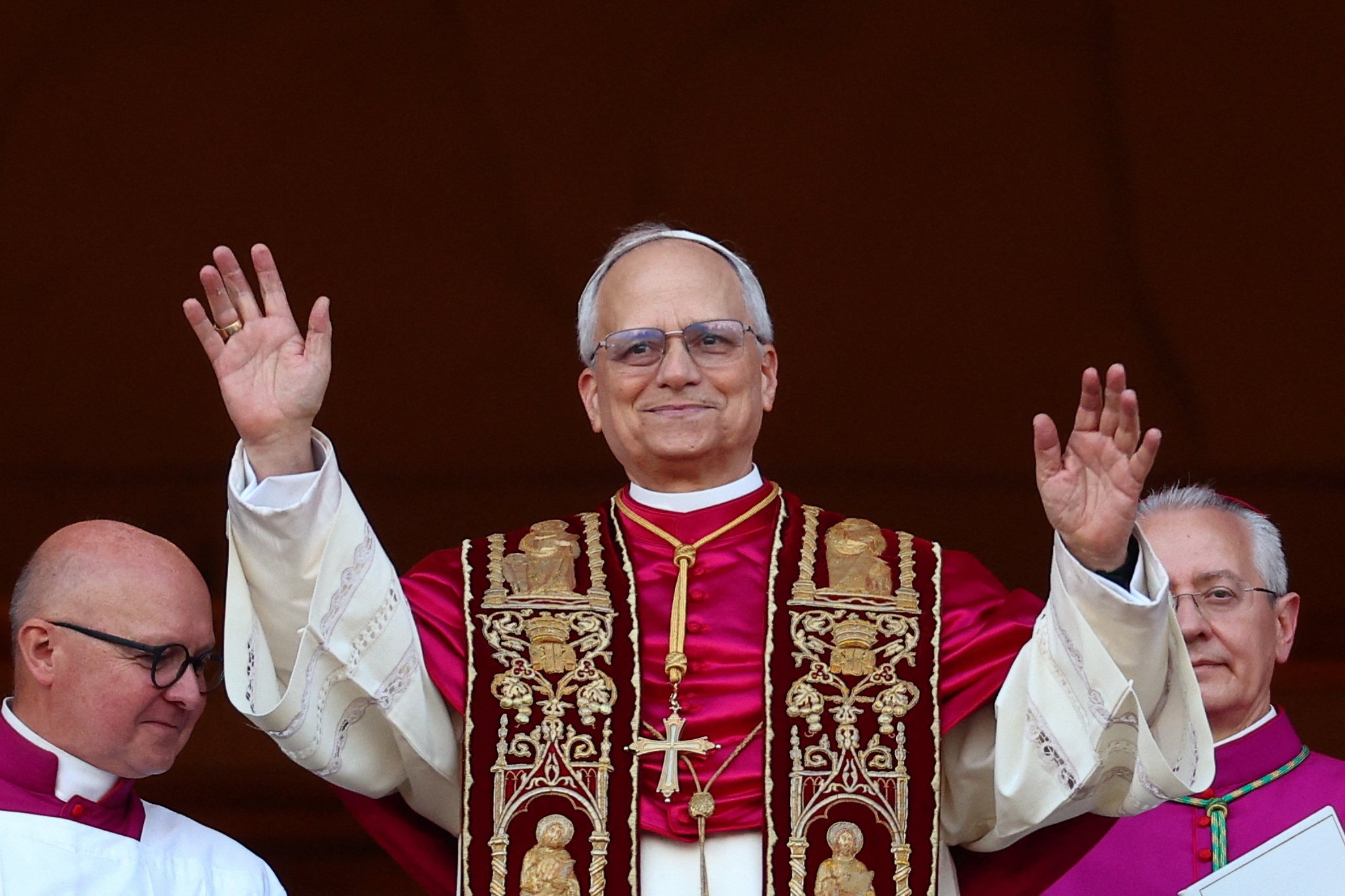
Archdiocese of New York Marks Pope Leo XIV's First Anniversary
By: The Good Newsroom
Clergy, laypeople look back at the American pope’s momentous initial year
One year after the election of the first American pope, the Archdiocese of New York marked the anniversary of Pope Leo XIV’s historic pontificate with reflections from Archbishop Ronald Hicks, Cardinal Timothy Dolan, Auxiliary Bishop Joseph Espaillat, and members of the faithful outside St. Patrick’s Cathedral.
Archbishop Hicks recalled for The Good Newsroom that he was in Omaha, Nebraska, when white smoke rose over St. Peter’s Basilica signaling the election of a new Holy Father. Anticipation turned to astonishment when Pope Leo XIV appeared on the balcony, a man whose childhood home was just 14 blocks from his own.
“This American, this missionary, they said an American would never become pope,” Archbishop Hicks said. “With God all things are possible.”
As Pope Leo’s pontificate reached its first anniversary, Archbishop Hicks described his leadership as both a continuation of his predecessor’s and something distinctly his own, having met then-Cardinal Robert Prevost in August 2024 and come away impressed by his faith, intelligence, and ability to communicate complex ideas clearly.
A Church united in celebration
Cardinal Timothy Dolan, who saw Pope Leo briefly in Rome at the end of April, sent him bagels and peanut butter for the occasion, the archbishop emeritus said in a social media interview on May 8.
Auxiliary Bishop Joseph Espaillat, in a video interview, shared his own experience of witnessing the election from New York and offered a pastoral perspective on the pope’s first year. Speaking in Spanish with Buenas Noticias, the archdiocese’s Spanish-language outlet, Bishop Espaillat described Pope Leo XIV as “a man of deep prayer” with a particular dedication toward migrants.
Catholics outside St. Patrick’s Cathedral shared what the pope’s leadership had meant to them personally in the year since his election, on The Good Newsroom’s social media channels, Facebook, Instagram, and X.
Archbishop Hicks closed with a message to Pope Leo XIV on the anniversary of his election.
“Congratulations. We love you, and may he continue to lead us and guide us. We are right behind him.”
See the full interview with Archbishop Hicks here.
Watch the interview with Bishop Espaillat here.
Follow The Good Newsroom on Facebook.
Follow The Good Newsroom on Instagram.
Follow The Good Newsroom on X.
Facts Only
* The Archdiocese of New York marked the anniversary of Pope Leo XIV’s pontificate.
* Reflections were shared by Archbishop Ronald Hicks, Cardinal Timothy Dolan, Auxiliary Bishop Joseph Espaillat, and members of the faithful.
* Archbishop Hicks recalled witnessing the election of Pope Leo XIV.
* Archbishop Hicks stated that an American would never become pope, adding, "With God all things are possible."
* Archbishop Hicks described his leadership as a continuation of his predecessor’s and something distinctly his own.
* Cardinal Timothy Dolan sent bagels and peanut butter for the occasion.
* Auxiliary Bishop Joseph Espaillat described Pope Leo XIV as "a man of deep prayer" with a dedication toward migrants.
* Catholics outside St. Patrick’s Cathedral shared their personal experiences online.
* Archbishop Hicks offered congratulations to Pope Leo XIV, stating, "We love you, and may he continue to lead us and guide us. We are right behind him."
Executive Summary
Full Take
The narrative functions by unifying religious and social identity around a shared figure, Pope Leo XIV, and reinforcing the idea of divine possibility. The use of personal anecdotes—such as Archbishop Hicks’ personal journey and the shared faith of the faithful—transforms a political event into a communal spiritual experience. The pattern involves invoking religious authority (the pope) to establish moral and spiritual leadership, which is then publicly celebrated across diverse groups (clergy, laypeople, Spanish-language speakers). This framing positions the leadership not merely as political, but as deeply moral and spiritual, mitigating potential political friction by grounding the narrative in faith and personal devotion. The celebration's structure, emphasizing continuity and personal faith, subtly reinforces a specific, unified vision of leadership and community. This operates by appealing to the shared identity of the Catholic community to generate positive, collective sentiment, which acts as a form of social cohesion and resistance to external dissent by prioritizing internal spiritual bonds.
Patterns detected: ARC-0043 Motte-and-Bailey, ARC-0024 Ambiguity, ARC-0031 Emotional Exploitation (In-group appeal)
Sentinel — Human
The text exhibits high internal coherence and specific anecdotal details, strongly suggesting human authorship or rigorous, context-specific human editing, despite its polished journalistic structure.