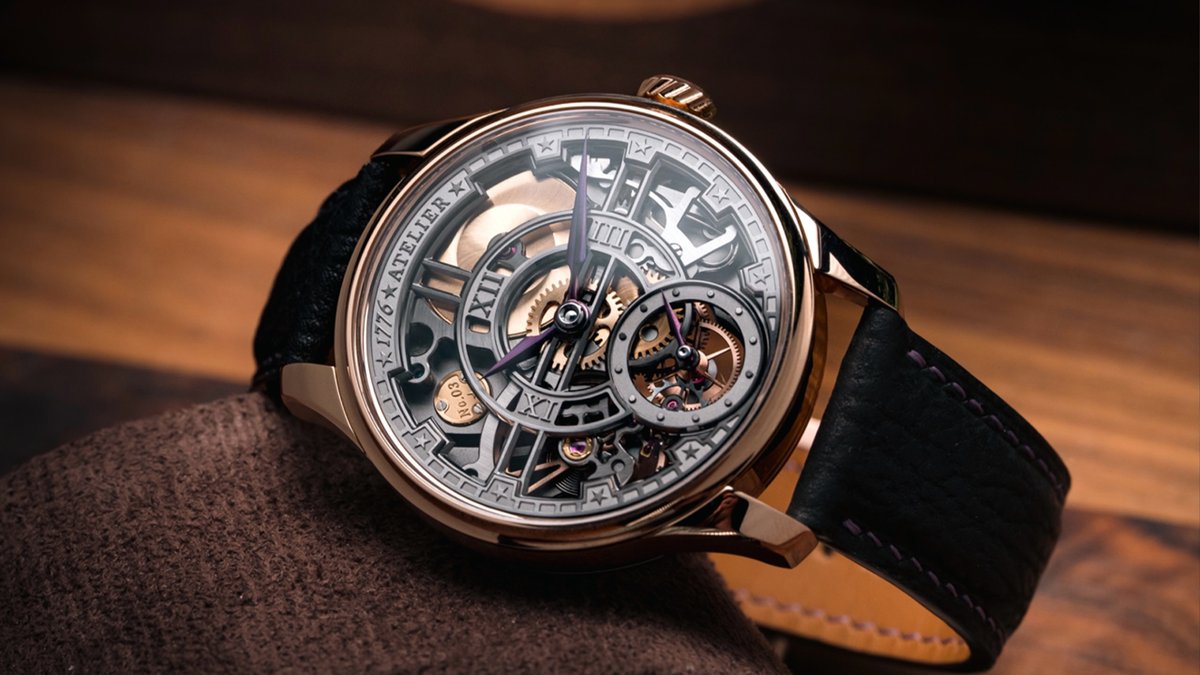
Land of the free-sprung balance.Texas-based independent 1776 Atelier commemorates America’s 250th year with the Liberty 250, a rose gold skeleton watch with sharp anglage on a movement that is overwhelmingly American made, from the main plate to the free-sprung balance.
Initial thoughts
The American watch industry transformed from a cottage industry heavily reliant on European imports to the world’s largest watch manufacturer in just a few decades, concentrated around a handful of massive, and capital intensive, factories. This meant that when Waltham, Elgin, and Hamilton closed their American factories in 1957, 1968, and 1969, respectively, the entire domestic watchmaking disappeared almost overnight.
1776 Atelier is one of a handful of independents trying to rebuild it. Founder Jason Lu is a Texan technology executive turned self-taught watchmaker who cut his teeth restoring pocket watches as a hobby.
He was later mentored by Donat Kornagel of DK Precision — a prolific German movement customiser — and took anglage-guru Philippe Narbel‘s full week masterclass. Co-founder Zach Smith — WOSTEP-trained watchmaker and KERN-whisperer — also founded Hour Precision, one of the few American component suppliers.
Together, their approach is antithetical to the so-called “American system” of industrial watchmaking, which failed in the US but lives on in Switzerland and Asia. Instead, they build watches in small numbers by labour-intensive means, much like the pre-industrial days of American watchmaking.
I believe this is also the future of American watchmaking, as it doesn’t require powerful luxury brands or massive capital expenditure. It just requires making good watches, which this is. It is also reasonably priced for an 18k gold watch with a high-end movement that is, at least in my view, made in America.
That said, the 41 mm sizing — largely dictated by the movement — feels slightly too large by the standards of 2026, a problem many brands have addressed by moving to bespoke platforms. But as the saying goes, “everything is bigger in Texas” and the brand has used the real estate to good effect front and back.
Curiously, the case is made not in the United States, but by RP Uhrgehäuse, a competent German case maker that supplies several small-to-medium watch brands. The quality is evidently high, even if the German origin feels out of place with the mostly American-made movement. As the brand evolves, I’d expect case making to move stateside based on the founders’ shared vision.
A nearly ‘Made in USA’ movement
At its core, the Liberty 250’s manually wound movement is a clone of the Unitas 6498 pocket watch calibre, the engine behind dozens of independent watch brands. It is not, however, a modified Unitas movement, nor made from an ebauche. Rather, it’s a cal. 6498 architecture manufactured from the ground up in the United States.
1776 Atelier buys American brass, grinds it flat and mills it out to form the bridges and plates. Screws are turned from American steel, finished, and heat-treated. The wheels are a similar story, and even the stud holder is fabricated from American materials in the United States.
While the stud carrier is a fairly common design, it resembles the “swan neck” regulator invented and patented by Bostonian watchmaker George P. Reed.
One of the more interesting components is the balance, which is free-sprung with four screws recessed into the balance rim to reduce drag. It beats at a stately and traditional 2.5 Hz — appropriate for its large diameter.
While many independent watchmakers use the Unitas architecture, the extent of 1776 Atelier’s upgrades is unusual. The free-sprung balance is emblematic of these changes, as most makers choose to use the stock Etachron system that was designed for it. The brand’s earlier calibres used the simpler Etachron system as well.
In this context, the free-sprung oscillator signals both the ambition and the capabilities of the brand.
Naturally, the movement is decorated and assembled in the United States too. We have validated the brand’s claim that the movement features 222 hand-finished internal angles using DotDotGoose — open-source software originally developed to help conservationists count birds.
We tallied 70 on the dial side and 16 on the back, for a total of 86 on the plates. Including 144 on the train wheels brings, the total count adds up to 230, which is actually higher than the brand’s official claim.
For reference, previous models with this movement, such as the Montpelier or Mount Vernon, featured less than a handful of sharp interior angles visible through the case back.
Regardless of the number of angles, the openworked dial plate is well crafted. According to the brand, the beveling alone requires 200 hours of labour. And yet, even after all that, this movement is not “Made in USA” by the (almost impossible) standards of the Federal Trade Commission (FTC).
Made in USA?
While the United States of America’s manufacturing output is (by value) second only to that of China, there are two significant barriers to building watches here in meaningful numbers.
The first is the supplier network, or lack thereof. No company makes every part that goes into its watches – not even Swatch Group or the Seiko companies. If a Swiss watch manufacturer needs a part, whether it is an escapement or strap, there are multiple domestic options.
The second is the lofty ‘All or Virtually All’ standard required to describe a product as Made in USA without qualifications. This means that all significant processing and assembly must occur in the United States, and all (or virtually all) components of the product must be made and sourced in the United States.
In contrast, the Swiss Made label has a much lower threshold, requiring a minimum of just 60% of the value to come from Switzerland. Were the US standard to be applied to Swiss brands, even Rolex might not qualify — even though nearly all of its parts are fabricated in Switzerland, the brand’s movements are made from German brass.
The FTC determines whether a product meets this standard on a case-by-case basis, and there is no formal safe harbour. This explains why 1776 Atelier has stopped short of claiming a fully American-made watch and instead describes the Liberty 250 as “More than 90% manufactured in-house from raw American materials.”
The FTC’s requirements are arguably more reasonable given the vastness of the country (compared to a smaller nation like Switzerland) and are achievable in many industries. But when it comes to complicated assemblies like watch movements, the standard all but prevents American companies from offering the same assurances of origin that have buoyed Swiss rivals.
In short, building watches in the United States is a thankless task, being more expensive and less prestigious than manufacturing in Switzerland, without even being able to badge the product as Made in USA.
The presentation box, however, is wholly made in the USA, with inlay made from one of the beams that supported the Independence Hall assembly room where the Second Continental Congress signed the Declaration of Independence in 1776. These beams were removed during the 1898 renovation, and some of the material is still on the market, often used for collectible items like this.
Key facts and price
1776 Atelier Liberty 250
Case diameter: 41 mm
Material: 18k pink gold
Crystal: Sapphire
Water resistance: 50 m
Movement: Cal. 621.1776
Features: Hours, minutes, seconds.
Frequency: 18,000 beats per hour (2.5 Hz)
Winding: Manual winding
Power reserve: 52 hours
Strap: Alligator strap with matching pin buckle
Limited edition: 25 pieces
Availability: Direct from 1776 Atelier and authorised retailers
Price: US$44,000 excluding taxes
For more, visit 1776Atelier.com.
This was brought to you in partnership with 1776 Atelier.
Back to top.
Sentinel — Human
The text exhibits strong, unique voice and sophisticated argumentative structure consistent with high-quality human journalistic or essay writing, focusing on deep contextual analysis rather than synthetic summarization.