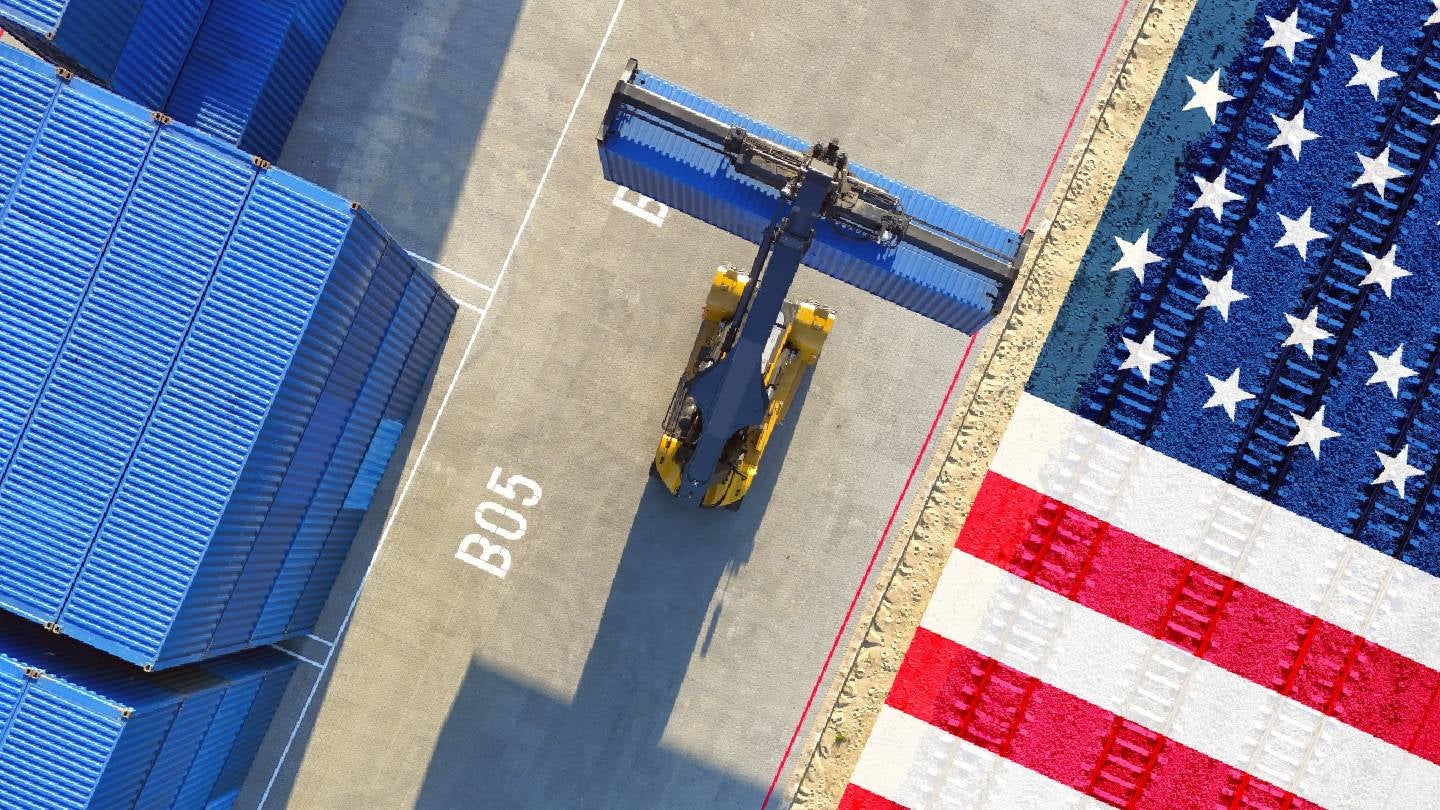
This comes as retailers remain “cautious” about building up inventories amid ongoing economic uncertainty.
“Containerised imports in the first quarter were down year over year, and forward demand is weakening,” said Hackett Associates founder Ben Hackett. “Stalling re-stocking efforts and rising geopolitical tensions are increasingly clouding the outlook.”
Discover B2B Marketing That Performs
Combine business intelligence and editorial excellence to reach engaged professionals across 36 leading media platforms.
The data shows that despite a skewed year-on-year increase projected for May and June, overall volumes are expected to remain below 2025 levels over the next several months.
In March, the Global Port Tracker recorded 2.16 million TEUs moving through major US ports, marking a 0.6% increase on the previous year. This represented a 13.6% rise compared to February, a period impacted by Asian factory closures for Lunar New Year celebrations and adverse weather that led to cargo delays.
Preliminary estimates place April’s throughput at 2.13 million twenty-foot equivalent units (TEUs), registering a projected decline of 3.6% compared to April last year.
The forecast for May points to 2.17 million TEUs, up 11.1% year-over-year, while June is anticipated at 2.13 million TEUs, reflecting an 8.2% increase from the previous year.
Despite these gains, the report expects volumes to fall in the following months. July is forecast at 2.2 million TEUs, down 7.8% from last year, followed by a 5.5% declined to 2.19 million TEUs in August.
In September, import cargo is expected at 2.08 million TEUs, down 1.3%.
For the first half of 2026, the report estimates total imports at 12.59 million TEUs, representing a 0.5% increase from the same period in 2025.
NRF supply chain and customs policy vice president Jonathan Gold said: “The numbers show a year-over-year increase for the next two months, but that’s only because of the sharp fall-off in imports after ‘Liberation Day’ tariffs were announced in April 2025. With inflation rising and consumer confidence falling among global economic uncertainty driven by the conflict in Iran, the overall trend of lower imports is expected to continue after that.”
The Global Port Tracker compiles data and forecasts for key US handling points, including Los Angeles/Long Beach, Oakland, Seattle and Tacoma on the West Coast, New York/New Jersey, Port of Virginia, Charleston, Savannah, Port Everglades, Miami and Jacksonville on the East Coast, and Houston on the Gulf Coast.
Facts Only
* Containerised imports in the first quarter were down year over year.
* Forward demand is weakening.
* The Global Port Tracker recorded 2.16 million TEUs moving through major US ports in March, an increase of 0.6% on the previous year.
* April’s throughput is estimated at 2.13 million TEUs, a projected decline of 3.6% compared to April last year.
* May is forecast at 2.17 million TEUs, up 11.1% year-over-year.
* June is anticipated at 2.13 million TEUs, reflecting an 8.2% increase from the previous year.
* July is forecast at 2.2 million TEUs, down 7.8% from last year.
* August is forecast at 2.19 million TEUs, down 5.5% from last year.
* September is expected at 2.08 million TEUs, down 1.3%.
* The report estimates total imports for the first half of 2026 at 12.59 million TEUs.
* The Global Port Tracker compiles data and forecasts for key US handling points, including Los Angeles/Long Beach, Oakland, Seattle, Tacoma, New York/New Jersey, Port of Virginia, Charleston, Savannah, Port Everglades, Miami, Jacksonville, and Houston.
Executive Summary
Full Take
Sentinel — Human
The text exhibits a highly structured, data-focused style, characteristic of professional reporting, but the integration of specific expert commentary suggests a human journalistic origin.