19th March 2026
The big news this morning: Astral to join OpenAI (on the Astral blog) and OpenAI to acquire Astral (the OpenAI announcement). Astral are the company behind uv, ruff, and ty—three increasingly load-bearing open source projects in the Python ecosystem. I have thoughts!
The official line from OpenAI and Astral
The Astral team will become part of the Codex team at OpenAI.
Charlie Marsh has this to say:
Open source is at the heart of that impact and the heart of that story; it sits at the center of everything we do. In line with our philosophy and OpenAI’s own announcement, OpenAI will continue supporting our open source tools after the deal closes. We’ll keep building in the open, alongside our community -- and for the broader Python ecosystem -- just as we have from the start. [...]
After joining the Codex team, we’ll continue building our open source tools, explore ways they can work more seamlessly with Codex, and expand our reach to think more broadly about the future of software development.
OpenAI’s message has a slightly different focus (highlights mine):
As part of our developer-first philosophy, after closing OpenAI plans to support Astral’s open source products. By bringing Astral’s tooling and engineering expertise to OpenAI, we will accelerate our work on Codex and expand what AI can do across the software development lifecycle.
This is a slightly confusing message. The Codex CLI is a Rust application, and Astral have some of the best Rust engineers in the industry—BurntSushi alone (Rust regex, ripgrep, jiff) may be worth the price of acquisition!
So is this about the talent or about the product? I expect both, but I know from past experience that a product+talent acquisition can turn into a talent-only acquisition later on.
uv is the big one
Of Astral’s projects the most impactful is uv. If you’re not familiar with it, uv
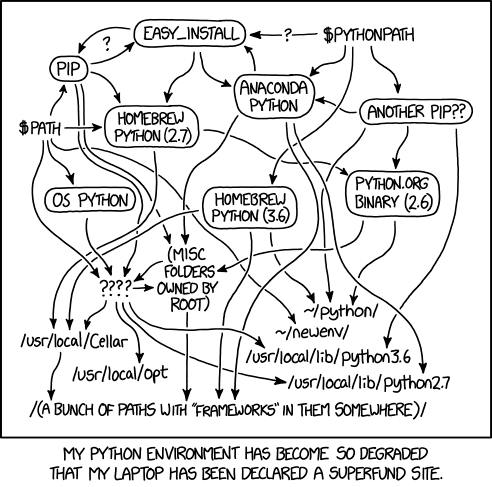
is by far the most convincing solution to Python’s environment management problems, best illustrated by this classic XKCD:
Switch from python
to uv run
and most of these problems go away. I’ve been using it extensively for the past couple of years and it’s become an essential part of my workflow.
I’m not alone in this. According to PyPI Stats uv was downloaded more than 126 million times last month! Since its release in February 2024—just two years ago—it’s become one of the most popular tools for running Python code.
Ruff and ty
Astral’s two other big projects are ruff—a Python linter and formatter—and ty—a fast Python type checker.
These are popular tools that provide a great developer experience but they aren’t load-bearing in the same way that uv
is.
They do however resonate well with coding agent tools like Codex—giving an agent access to fast linting and type checking tools can help improve the quality of the code they generate.
I’m not convinced that integrating them into the coding agent itself as opposed to telling it when to run them will make a meaningful difference, but I may just not be imaginative enough here.
What of pyx?
Ever since uv
started to gain traction the Python community has been worrying about the strategic risk of a single VC-backed company owning a key piece of Python infrastructure. I wrote about one of those conversations in detail back in September 2024.
The conversation back then focused on what Astral’s business plan could be, which started to take form in August 2025 when they announced pyx, their private PyPI-style package registry for organizations.
I’m less convinced that pyx makes sense within OpenAI, and it’s notably absent from both the Astral and OpenAI announcement posts.
Competitive dynamics
An interesting aspect of this deal is how it might impact the competition between Anthropic and OpenAI.
Both companies spent most of 2025 focused on improving the coding ability of their models, resulting in the November 2025 inflection point when coding agents went from often-useful to almost-indispensable tools for software development.
The competition between Anthropic’s Claude Code and OpenAI’s Codex is fierce. Those $200/month subscriptions add up to billions of dollars a year in revenue, for companies that very much need that money.
Anthropic acquired the Bun JavaScript runtime in December 2025, an acquisition that looks somewhat similar in shape to Astral.
Bun was already a core component of Claude Code and that acquisition looked to mainly be about ensuring that a crucial dependency stayed actively maintained. Claude Code’s performance has increased significantly since then thanks to the efforts of Bun’s Jarred Sumner.
One bad version of this deal would be if OpenAI start using their ownership of uv
as leverage in their competition with Anthropic.
Astral’s quiet series A and B
One detail that caught my eye from Astral’s announcement, in the section thanking the team, investors, and community:
Second, to our investors, especially Casey Aylward from Accel, who led our Seed and Series A, and Jennifer Li from Andreessen Horowitz, who led our Series B. As a first-time, technical, solo founder, you showed far more belief in me than I ever showed in myself, and I will never forget that.
As far as I can tell neither the Series A nor the Series B were previously announced—I’ve only been able to find coverage of the original seed round from April 2023.
Those investors presumably now get to exchange their stake in Astral for a piece of OpenAI. I wonder how much influence they had on Astral’s decision to sell.
Forking as a credible exit?
Armin Ronacher built Rye, which was later taken over by Astral and effectively merged with uv. In August 2024 he wrote about the risk involved in a VC-backed company owning a key piece of open source infrastructure and said the following (highlight mine):
However having seen the code and what uv is doing, even in the worst possible future this is a very forkable and maintainable thing. I believe that even in case Astral shuts down or were to do something incredibly dodgy licensing wise, the community would be better off than before uv existed.
Astral’s own Douglas Creager emphasized this angle on Hacker News today:
All I can say is that right now, we’re committed to maintaining our open-source tools with the same level of effort, care, and attention to detail as before. That does not change with this acquisition. No one can guarantee how motives, incentives, and decisions might change years down the line. But that’s why we bake optionality into it with the tools being permissively licensed. That makes the worst-case scenarios have the shape of “fork and move on”, and not “software disappears forever”.
I like and trust the Astral team and I’m optimistic that their projects will be well-maintained in their new home.
OpenAI don’t yet have much of a track record with respect to acquiring and maintaining open source projects. They’ve been on a bit of an acquisition spree over the past three months though, snapping up Promptfoo and OpenClaw (sort-of, they hired creator Peter Steinberger and are spinning OpenClaw off to a foundation), plus closed source LaTeX platform Crixet (now Prism).
If things do go south for uv
and the other Astral projects we’ll get to see how credible the forking exit strategy turns out to be.
More recent articles
- Experimenting with Starlette 1.0 with Claude skills - 22nd March 2026
- Profiling Hacker News users based on their comments - 21st March 2026
Facts Only
OpenAI announced the acquisition of Astral on March 19, 2026.
Astral is the company behind uv, ruff, and ty, three widely used Python tools.
The Astral team will join OpenAI's Codex team.
uv is a Python environment management tool with over 126 million downloads in the past month.
ruff is a Python linter and formatter, and ty is a fast Python type checker.
Astral previously announced pyx, a private PyPI-style package registry, in August 2025.
OpenAI has stated it will continue supporting Astral's open-source tools post-acquisition.
Astral's Series A and B funding rounds were led by Accel and Andreessen Horowitz, respectively.
Anthropic acquired Bun, a JavaScript runtime, in December 2025.
Astral's tools are permissively licensed, allowing for forking if needed.
OpenAI has made multiple acquisitions in recent months, including Promptfoo and OpenClaw.
The acquisition raises questions about competition between OpenAI and Anthropic in coding agent tools.
Executive Summary
Full Take
The strongest version of this narrative highlights OpenAI's strategic move to bolster its coding agent capabilities by acquiring Astral, a company with deep expertise in Python tooling and Rust engineering. The acquisition aligns with OpenAI's developer-first philosophy and could accelerate innovation in AI-assisted software development. However, the narrative also acknowledges legitimate concerns about the long-term stewardship of open-source projects under a corporate umbrella, especially given OpenAI's recent acquisition spree and competitive pressures with Anthropic.
Patterns detected: ARC-0043 Motte-and-Bailey (OpenAI's dual messaging on open-source support vs. strategic acquisition), ARC-0024 Ambiguity (unclear focus on talent vs. product).
The root cause of this narrative is the tension between corporate consolidation and open-source sustainability. The unstated assumption is that OpenAI's ownership will not compromise the open-source nature of Astral's tools, but historical patterns suggest that corporate priorities can shift over time. The implications for human agency and dignity are significant: developers rely on these tools, and any future restrictions or neglect could disrupt workflows and innovation. The second-order consequences include potential fragmentation in the Python ecosystem if forking becomes necessary, as well as the broader impact on trust in corporate stewardship of open-source projects.
Bridge questions: What safeguards can ensure the continued open-source nature of Astral's tools under OpenAI? How might this acquisition affect the competitive landscape between OpenAI and Anthropic in coding agent tools? What would it take for the Python community to trust corporate ownership of critical infrastructure?
Counterstrike scan: A coordinated influence campaign might emphasize the benefits of corporate ownership while downplaying risks to open-source sustainability. The actual content does not fully match this pattern, as it acknowledges both the potential benefits and the concerns, though it could be more explicit about the risks.
Sentinel — Human
The article exhibits strong human stylistic markers, including personal voice, erratic sentence structure, and opinionated analysis, with no significant signs of synthetic generation.