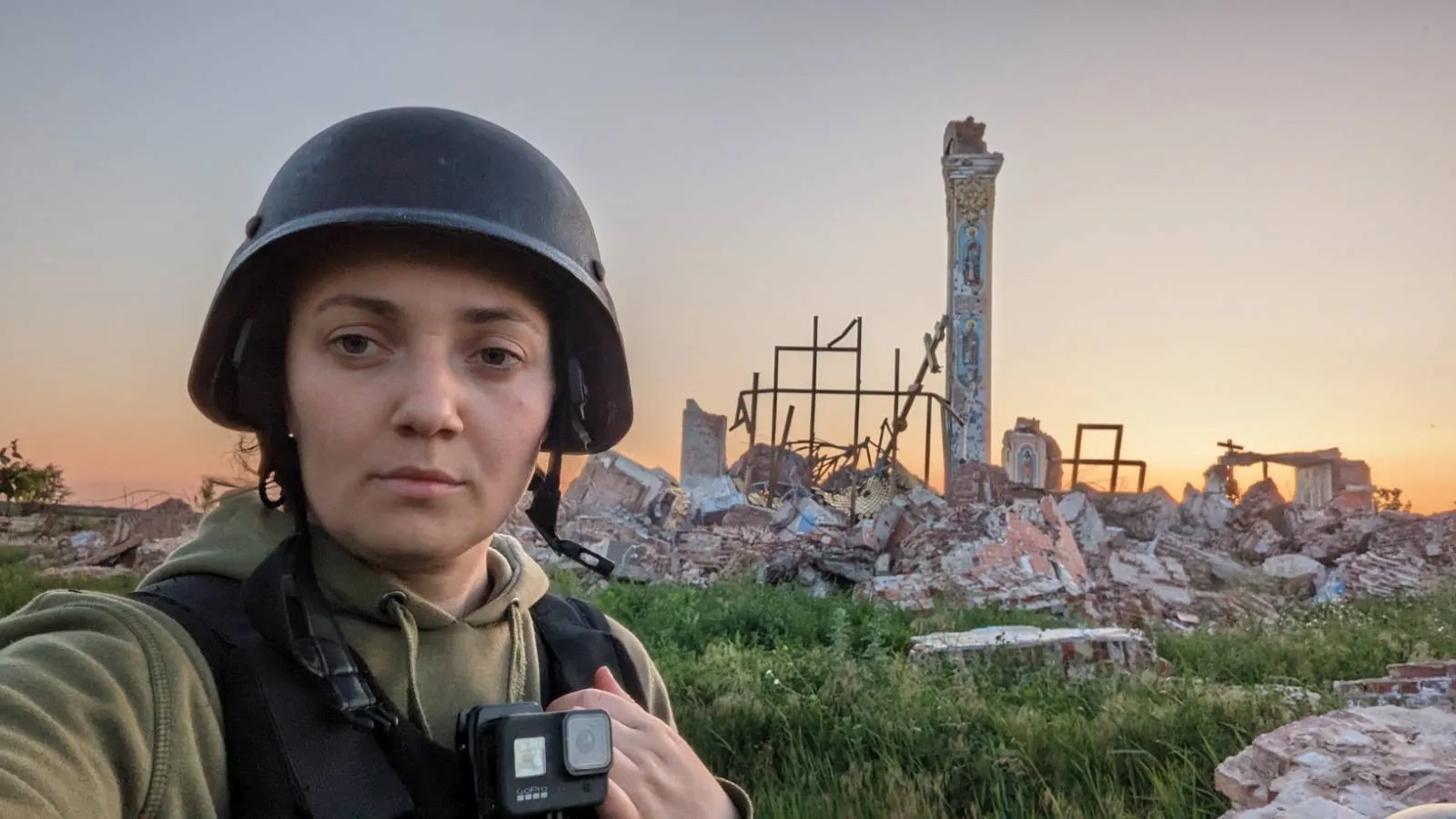
New York, March 27, 2026—Ukrainian authorities must conduct a swift and thorough investigation into recent online harassment against Ukrainian journalist Anna Kalyuzhna and ensure that journalists can work without fear of reprisal, the Committee to Protect Journalists said Friday.
On March 6, Kalyuzhna, a journalist with Ukrainian investigative outlet Slidstvo.Info as well as Novynarnia, which has been covering the war in Ukraine since 2014, reported that she had received more than 150 messages on Facebook containing insults and misogynistic remarks within 24 hours of publishing a Facebook post criticizing the expansion and alleged abuses within Ukrainian Armed Forces’ assault regiments.
On March 17, as she was leaving a store an unnamed man told her “maybe you should just shut your mouth,” and mentioned that he had served time in prison. On the same day, she filed a report with the police, who opened an investigation under Article 129 of Ukraine’s criminal code pertaining to “death threats.”
“Ukrainian authorities must promptly investigate the harassment of Ukrainian journalist Anna Kalyuzhna and ensure her protection,” said Gulnoza Said, CPJ’s Europe and Central Asia program coordinator. “CPJ is very concerned about online harassment against journalists and the seeming lack of political will to investigate these incidents and hold those responsible to account. Journalists provide an important service to the public by covering the war and need to be able to do so safely.”
“I view these incidents as an attempt to obstruct journalistic activity … and a threat against me as a journalist,” Kalyuzhna wrote on Facebook. She told CPJ she is seeking to add a charge for “obstruction of journalistic activity” to the criminal case opened by police.
CPJ emailed Ukraine’s national police for comment but did not immediately receive a reply.
Similarly, Denys Bulavin, a journalist with independent news outlet Hromadske, faced online harassment after his March 16 report on attacks on employees with military enlistment offices. Also, journalist and blogger Olga Khudetska received social media threats, including ones of physical violence, after posting a March 6 thread on X about the alleged lack of public reporting on donations to a battalion of volunteer medics.
Khudetska does not plan on reporting the threats to police, she told the Ukrainian press freedom group Institute of Mass Information. “I don’t know of any successful cases of investigating online threats,” she said.
Several Ukrainian and foreign investigative journalists have faced surveillance, threats, violence, and harassment over their work since Russia’s full-scale invasion of the country.
In a December 2024 letter to Ukraine President Volodymyr Zelensky, CPJ pointed to a pattern of a lack of accountability in such cases. In February, news outlet NGL.media reported that the investigation for “obstructing journalistic activities” into the June 2025 smear campaign against Olena Mudra, an environmental investigative journalist in the Zakarpattia region, in western Ukraine, was stalling.
Facts Only
Ukrainian journalist Anna Kalyuzhna received over 150 harassing and misogynistic messages on Facebook within 24 hours of publishing a post criticizing Ukrainian Armed Forces’ assault regiments on March 6, 2026.
On March 17, 2026, an unnamed man confronted Kalyuzhna in person, telling her to "shut your mouth" and mentioning his prison record.
Kalyuzhna filed a police report on March 17, leading to an investigation under Article 129 of Ukraine’s criminal code for death threats.
The Committee to Protect Journalists (CPJ) called for a prompt investigation and expressed concern over online harassment of journalists in Ukraine.
Kalyuzhna seeks to add a charge for "obstruction of journalistic activity" to the criminal case.
Denys Bulavin, a journalist with Hromadske, faced online harassment after reporting on attacks against military enlistment office employees on March 16, 2026.
Blogger Olga Khudetska received threats of physical violence on social media after posting about alleged lack of transparency in donations to a volunteer medic battalion on March 6, 2026.
Khudetska chose not to report the threats to police, citing a lack of successful investigations into online threats.
CPJ sent a letter to Ukrainian President Volodymyr Zelensky in December 2024 highlighting a pattern of unaccountability in cases of journalist harassment.
In February 2026, NGL.media reported that an investigation into the 2025 smear campaign against journalist Olena Mudra was stalling.
Ukrainian and foreign investigative journalists have faced surveillance, threats, and violence since Russia’s full-scale invasion in 2022.
Executive Summary
Full Take
The strongest version of this narrative underscores a systemic failure to protect journalists in Ukraine, where online harassment and physical intimidation are met with inadequate institutional responses. The CPJ’s call for accountability is well-founded, given the documented pattern of stalled investigations and the chilling effect on press freedom. The inclusion of multiple cases—Kalyuzhna, Bulavin, Khudetska, and Mudra—reinforces the argument that this is not an isolated issue but a broader trend of impunity.
However, the narrative could be vulnerable to distortion if framed as a blanket indictment of Ukrainian authorities without acknowledging the complexities of wartime governance. The article does not explore whether resource constraints, institutional overload, or political pressures contribute to the lack of progress in these cases. Additionally, the focus on misogynistic harassment against Kalyuzhna risks being weaponized in bad-faith debates about gender and nationalism, where critics might dismiss her concerns as politically motivated rather than a legitimate free speech issue.
Root causes likely include the erosion of institutional capacity during war, where law enforcement prioritizes immediate security threats over digital harassment, and a cultural tolerance for intimidation of journalists who challenge official narratives. The implications are dire: if journalists self-censor due to fear, the public loses access to critical reporting on military conduct, corruption, or governance failures—precisely when transparency is most needed.
Bridge questions: How might wartime conditions justify or exacerbate the failure to investigate these cases? What structural reforms could Ukraine implement to protect journalists without compromising national security? Would international pressure or third-party oversight improve accountability, or could it be perceived as external interference?
Counterstrike scan: A coordinated influence campaign exploiting this narrative might amplify cases of harassment to undermine trust in Ukrainian institutions, portraying them as authoritarian or incompetent. The actual content aligns with this pattern only partially—it critiques institutional failures but does not escalate to systemic delegitimization. The focus remains on specific cases and CPJ’s advocacy, not a broader attack on Ukraine’s governance. No evidence suggests this is part of a disinformation playbook.
Patterns detected: none