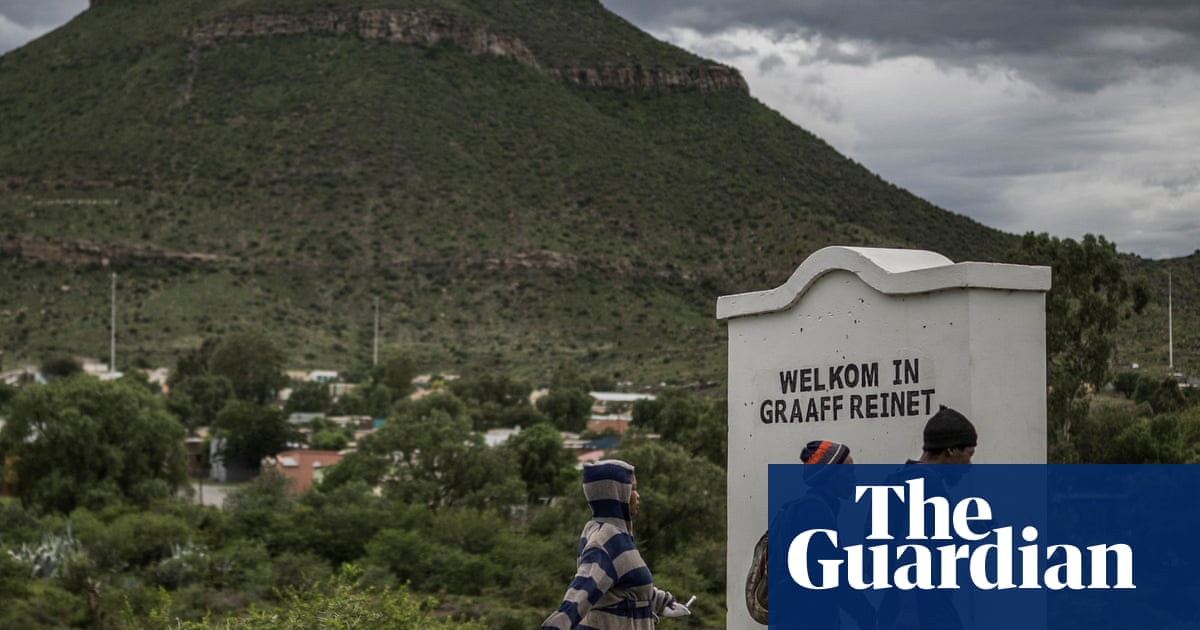
A South African town is divided over changing its name from the colonial-era Graaff-Reinet to Robert Sobukwe, after the anti-apartheid activist, in a debate that has inflamed racial tensions.
Petitions have been signed, rival marches held and a formal letter of complaint sent to the sports, arts and culture minister, Gayton McKenzie, who approved the name change on 6 February.
On one side are people who feel a deep attachment to Graaff-Reinet, many regardless of the fact it was named after Cornelis Jacob van de Graaff, the Dutch governor of the Cape Colony when the town was founded in 1786, and his wife, Hester Cornelia Reynet.
On the other are those who insist that renaming the town after Sobukwe, who was born and buried there, is a necessary part of the “transformation” of South Africa away from colonialism and white-minority apartheid rule.
Sobukwe left the African National Congress (ANC) liberation movement to found the Pan Africanist Congress in 1959, amid disagreements about the ANC allowing white members. On 21 March 1960, Sobukwe led protests against laws requiring Black people to carry pass books. Police opened fire on a march, killing 69 people in what became known as the Sharpeville massacre.
Between 2000 and 2024, more than 1,500 placenames were changed in South Africa, according to an official database. They include more than 400 post offices, 144 rivers and seven airports, while the city of Port Elizabeth became Gqeberha in 2021.
The department of sports, arts and culture said in a statement announcing 21 name changes, including Graaff-Reinet: “The mission … [is] to redress, correct and transform the geographical naming system in order to advance restorative justice, including addressing the colonial and apartheid-era naming legacy.”
A survey carried out in December 2023 found 83.6% of the town’s residents opposed the name change, including 92.9% of Coloured people and 98.5% of white people. A third of Black residents backed the name change. Of the 367 randomly selected representative respondents, 54% were Coloured, 27.2% Black and 18.8% white.
“Many residents felt that changing the name would erase part of their identity as ‘Graaff-Reinetters’,” the Stellenbosch University geography professor Ronnie Donaldson wrote of his findings.
Laughton Hoffman, who runs a non-profit supporting young people, expressed concern about the name change harming tourism in the town, which has a population of about 51,000 and whose centre is filled with elegant, whitewashed Cape Dutch buildings.
“We are not emotional about the Dutch … Out of the grief of the past [the name Graaff-Reinet] became a benefit for the people and for the economy of the town,” said Hoffman, sporting a bright pink “Hands Off Graaff-Reinet” T-shirt.
Hoffman is Coloured and Khoi-San – indigenous South Africans who the apartheid government lumped together as Coloured with mixed-race people and the descendants of enslaved people from other parts of Africa, Indonesia and Malaysia.
Hoffman said his community had been “oppressed” since the end of apartheid by governments led by the black-dominated ANC. “We have been marginalised for 32 years as a cultural group,” he said.
Coloured researchers attribute much of this resentment felt by parts of their community to animosity between Coloured and Black communities fostered by apartheid. Coloured people were allowed slightly better houses and jobs, forcing them to distance themselves from Black people to access those benefits.
Meanwhile, Derek Light, a lawyer who wrote the complaint letter demanding that the culture minister McKenzie reverse his decision, argued that the public consultation on the name change did not follow legal procedure. “It was a faux process,” he said.
Light, who is white, lamented the tensions the name change had caused in the town. “We were living in peace and harmony,” he said. “It’s not without fault; we also have poverty and unemployment and things like that. But we don’t have racial issues amongst our people.”
Black members of the Robert Sobukwe Steering Committee, a group supporting the name change, rejected this. “We have always had racial problems,” said Athe Singeni. “It was very subtle.”
Her mother, Nomandla, said they would not be deterred, even after Sobukwe’s grave was vandalised by unknown people earlier this month. “We as Black people, we have a history that has been erased,” she said. “We’ve got leaders who contributed and laid down their lives for the freedom that we enjoy today. It is time to honour them.”
Further up the hill in uMasizakhe, a former Black township, a group enjoying home-brewed alcohol expressed their support for the name change. “I’m happy to change this name, Graaff-Reinet,” said Mzoxolo Nkhomo, a 59-year-old jobseeker. “Because Sobukwe is our fighter. Sobukwe made us free.”
Across the road, the Robert Mangaliso Sobukwe Museum and Learning Centre was shuttered, a statue of the politician covered up. It had never been officially opened due to family disagreements, said his grandson Mangaliso Tsepo Sobukwe.
Placename changes had been instrumentalised by politicians, Sobukwe said. “It is interesting that the ANC would be seen championing the honouring of Sobukwe, because they … [have been] suppressing his legacy.”
Sobukwe expected the backlash to the renaming, but added: “Going forward, I’m happy that my grandfather’s been honoured, more than anything else.”
Facts Only
Graaff-Reinet, a South African town founded in 1786, is proposed to be renamed Robert Sobukwe after the anti-apartheid activist.
The name change was approved by Sports, Arts, and Culture Minister Gayton McKenzie on February 6, 2024.
Petitions, rival marches, and a formal complaint letter have been submitted in response to the decision.
A December 2023 survey found 83.6% of residents opposed the name change, including 92.9% of Coloured people and 98.5% of white people.
One-third of Black residents supported the name change.
The town has a population of about 51,000 and is known for its Cape Dutch architecture.
Robert Sobukwe, born and buried in Graaff-Reinet, founded the Pan Africanist Congress in 1959 and led protests against pass laws, resulting in the Sharpeville massacre in 1960.
Over 1,500 placenames in South Africa have been changed since 2000, including seven airports and 144 rivers.
The Robert Sobukwe Museum and Learning Centre in Graaff-Reinet remains unopened due to family disagreements.
Sobukwe’s grave was vandalized in early 2024.
The department of sports, arts, and culture stated the name changes aim to address colonial and apartheid-era legacies.
Laughton Hoffman, a Coloured resident, expressed concerns about tourism and economic impact.
Derek Light, a white lawyer, filed a complaint alleging the public consultation process was flawed.
Black residents supporting the change cited Sobukwe’s role in the struggle for freedom.
Executive Summary
Full Take
The strongest version of this narrative highlights a legitimate tension between historical justice and community identity. The push to rename Graaff-Reinet reflects a broader post-apartheid effort to dismantle colonial symbols, while opposition underscores deep attachments to local heritage and economic concerns. The debate is framed as a clash between transformation and preservation, with both sides invoking moral and practical arguments.
Pattern scan: The article avoids overt manipulation but subtly amplifies emotional divides. The framing of "racial tensions" and "marginalization" could risk oversimplifying complex historical grievances (ARC-0024 Ambiguity). The emphasis on survey percentages (83.6% opposition) may create a false sense of unanimity, ignoring nuanced perspectives within racial groups (ARC-0043 Motte-and-Bailey). The vandalism of Sobukwe’s grave is presented as a dramatic escalation, potentially exploiting outrage (ARC-0012 Emotional Exploitation).
Root cause: The paradigm driving this narrative is the unresolved legacy of apartheid and colonialism. The assumption that renaming alone can redress historical injustices is contested, as is the idea that preserving colonial names is neutral. This echoes global debates over monuments and memory, where symbolic changes often outpace material reparations.
Implications: The name change could deepen racial divides if perceived as imposed rather than consensus-driven. Tourism-dependent economies may suffer short-term disruptions, while long-term effects depend on how the transition is managed. The marginalization felt by Coloured communities—caught between Black empowerment and white privilege—reveals the limitations of binary racial frameworks in post-apartheid South Africa.
Bridge questions: How might a participatory process, rather than top-down decrees, reconcile these tensions? What would it mean to honor Sobukwe’s legacy beyond a name change—through education, economic justice, or policy? Could this debate be a microcosm of broader failures to address structural inequality?
Counterstrike scan: A coordinated influence campaign would exploit racial divisions, amplify extremist voices, and frame the debate as a zero-sum game. The actual content, while highlighting tensions, does not match this pattern. It presents multiple perspectives without clear partisan alignment, suggesting a genuine journalistic effort rather than manipulation.