Pierre Huyghe’s brain activity-inspired dreamscapes, Orientalism at The Met, a menagerie of mystical animals, and so much more.
We didn’t need the Knicks to show us that we’re a city of champions, but it sure doesn’t hurt. This has been a major year in New York’s art world — we saw the reopening of the Studio Museum and the expansion of the New Museum, and the stars aligned with marquee exhibitions like the Whitney Biennial and MoMA PS1’s Greater New York landing at the same time. You might even say that The Met’s hard-hitting group show on Orientalism probes the empire state of mind.
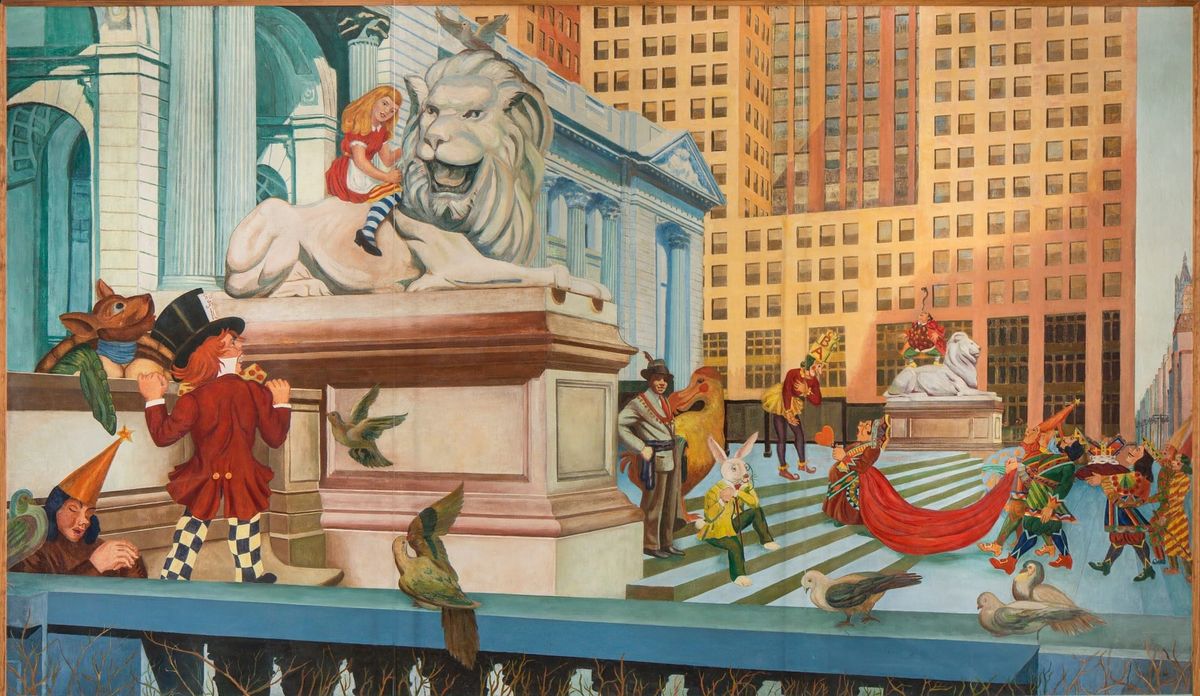
And then, of course, there are the wildcards that make this city such a haven for the weird, the experimental, the magical. Can’t really get freakier than Pierre Huyghe’s brain activity-inspired dreamscapes at MoMA. How about an exhibition at Subtitled NYC — a little artist-run Brooklyn project space — that recasts the internet as a water system? Or an ark-full of animals at Powerhouse Arts, and a menagerie of mythical creatures at the Cloisters? We say chase the unicorn this summer — New York’s a wonderland, as an exhibition of New Deal-era murals of Alice and her crew zooming around NYC at the Museum of the City of New York shows us. You need only open your eyes to it.
— Lisa Yin Zhang, associate editor
Pierre Huyghe: UUmwelt
Museum of Modern Art, 11 West 53rd Street, Midtown, Manhattan
July 1–Nov. 29
Generative artificial intelligence is dependent on human output, but can it interpret our own thoughts before we externalize them? Pierre Huyghe investigates AI’s potential to realize the human imagination in an interactive, multimedia body of work. Born from an artificial neural network’s interpretation of recorded brain activity from a person asked to imagine a series of images, UUmwelt is also activated by visitors whose gazes alter the network’s generative imagery in real time.
Certainly an Act: Works on Paper by Pope.L
The Drawing Center, 35 Wooster Street, Soho, Manhattan
June 26–Sep. 27, 2026
With over 200 rarely-seen works spanning from William Pope.L’s early career to his final years, a survey of the late performance artist’s prolific drawing practice introduces a new urgency to his absurdist distillations of human hierarchy. Works pulled from key series including Failure Drawings and Skin Sets, and a rarely exhibited installation titled “Relational Painting a.k.a If Black Is Beautiful....” underpin this exhibition, functioning as a cross-section of Pope.L’s provocative aesthetics spanning medium, language, and action.
Orientalism: Between Fact and Fantasy
The Metropolitan Museum of Art, 1000 Fifth Avenue, Upper East Side, Manhattan
Through Feb. 28, 2027
By leveling Orientalist and Islamic art and decorative objects from The Met’s collection, this exhibition examines the exchange between Europe, West Asia, and North Africa from the 19th century. It unpacks the westward trade of Ottoman and Persian wares at a time of rapid industrialization, reflecting the porous boundaries between observation and perception, as well as aesthetic influence and cultural appropriation. Central to the exhibition is an exploration into Osman Hamdi Bey, a French-trained Ottoman painter who uniquely infused the Orientalist style with his first-hand cultural insights.
Facts Only
Pierre Huyghe’s exhibition *UUmwelt* runs from July 1 to November 29 at the Museum of Modern Art in Midtown, Manhattan.
The exhibition uses AI to interpret brain activity and generate imagery, with visitor interactions altering the visuals in real time.
*Certainly an Act: Works on Paper by Pope.L* is on view at The Drawing Center in Soho from June 26 to September 27, 2026.
The exhibition features over 200 works from Pope.L’s career, including series like *Failure Drawings* and *Skin Sets*.
*Orientalism: Between Fact and Fantasy* is displayed at The Metropolitan Museum of Art through February 28, 2027.
The show examines 19th-century cultural exchanges between Europe, West Asia, and North Africa, featuring works by Osman Hamdi Bey.
The Studio Museum and New Museum have recently reopened or expanded.
The Whitney Biennial and MoMA PS1’s *Greater New York* are concurrent major exhibitions.
Subtitled NYC, a Brooklyn artist-run space, presents an exhibition framing the internet as a water system.
Powerhouse Arts hosts an exhibition featuring an ark of animals, while the Cloisters displays mythical creatures.
The Museum of the City of New York showcases New Deal-era murals depicting *Alice in Wonderland* characters in NYC.
The article is written by Lisa Yin Zhang, associate editor, and highlights the diversity of New York’s summer art offerings.
Executive Summary
New York City’s summer art scene is vibrant and diverse, featuring major exhibitions across renowned institutions and smaller artist-run spaces. The Museum of Modern Art presents *Pierre Huyghe: UUmwelt*, an interactive AI-driven exhibition where brain activity and visitor engagement shape generative imagery. The Drawing Center showcases *Certainly an Act: Works on Paper by Pope.L*, a comprehensive survey of the late performance artist’s drawings, spanning his career and highlighting his provocative explorations of race and hierarchy. At The Metropolitan Museum of Art, *Orientalism: Between Fact and Fantasy* examines the cultural exchange and appropriation between Europe and the Islamic world through 19th-century art and decorative objects, with a focus on Ottoman painter Osman Hamdi Bey. Other notable exhibitions include a reimagining of the internet as a water system at Subtitled NYC, mythical creatures at the Cloisters, and New Deal-era murals at the Museum of the City of New York. The city’s art world is thriving, with expansions at the Studio Museum and New Museum, alongside marquee shows like the Whitney Biennial and MoMA PS1’s *Greater New York*. The season reflects both institutional gravitas and experimental, boundary-pushing work.
The article highlights a mix of established and emerging voices, underscoring New York’s role as a hub for both critical discourse and avant-garde creativity. While major museums anchor the scene with historically significant exhibitions, smaller spaces like Powerhouse Arts and Subtitled NYC contribute to the city’s reputation for innovation. The thematic range—from AI and neuroscience to colonial legacies and surrealism—demonstrates the breadth of contemporary artistic inquiry. However, the piece does not delve into potential controversies or critiques of the exhibitions, focusing instead on their conceptual and aesthetic merits.
Full Take
This article presents New York’s summer art scene as a microcosm of broader cultural and technological currents, blending institutional authority with experimental edge. The strongest version of this narrative celebrates the city’s role as a dynamic hub where historical critique (*Orientalism*), cutting-edge AI (*UUmwelt*), and radical performance art (*Pope.L*) coexist. The framing leans into New York’s mythos as a "wonderland" of creativity, reinforcing the idea that art here is both a mirror and a catalyst for societal shifts. Yet, the piece avoids deeper interrogation of potential tensions—such as the ethics of AI in art, the commodification of marginalized voices, or the colonial undertones of Orientalist exhibitions—opting instead for an enthusiastic survey.
Pattern scan: The article employs a subtle form of *ARC-0024 Ambiguity* by presenting exhibitions with complex themes (e.g., Orientalism’s colonial legacy) without explicit critique, leaving readers to infer their own judgments. There’s also a hint of *ARC-0043 Motte-and-Bailey* in the way it celebrates "weird, experimental" work while anchoring the narrative in prestigious institutions, allowing the piece to appeal to both avant-garde and mainstream audiences. The lack of dissenting voices or critical perspectives on the exhibitions suggests a possible *ARC-0012 Sanewashing*, where potentially controversial themes are framed as neutral or purely aesthetic.
Root cause: The narrative reflects a paradigm of art as both cultural capital and a site of innovation, where institutions and artists navigate between market demands and creative freedom. The unstated assumption is that New York’s art world is inherently progressive, yet the piece doesn’t grapple with how power structures (e.g., museum funding, AI ethics) shape these exhibitions. Historically, this echoes the city’s long-standing tension between elite cultural gatekeeping and grassroots experimentation.
Implications: For human agency, the article positions art as a space for imagination and critique, but the lack of critical framing may limit readers’ ability to engage with the exhibitions’ deeper societal implications. Who benefits? Institutions gain prestige and attendance; artists gain visibility. Who bears costs? Marginalized voices in *Orientalism* or *Pope.L*’s work may remain tokenized without explicit contextualization. Second-order consequences could include the normalization of AI in art without ethical debate or the perpetuation of Orientalist tropes under the guise of "aesthetic exchange."
Bridge questions: How might the AI in *UUmwelt* reinforce or challenge human creative agency? What perspectives are missing from the *Orientalism* exhibition—particularly from contemporary artists from the regions depicted? Would a more critical lens on these shows change their reception, or is the current framing sufficient for public engagement?
Counterstrike scan: If this were part of a coordinated campaign, the playbook would emphasize New York’s cultural dominance while downplaying controversies, using ambiguity to avoid alienating audiences. The actual content aligns with this to some degree—celebrating without complicating—but stops short of overt propaganda. It’s more a reflection of art-world PR than a manipulative effort.