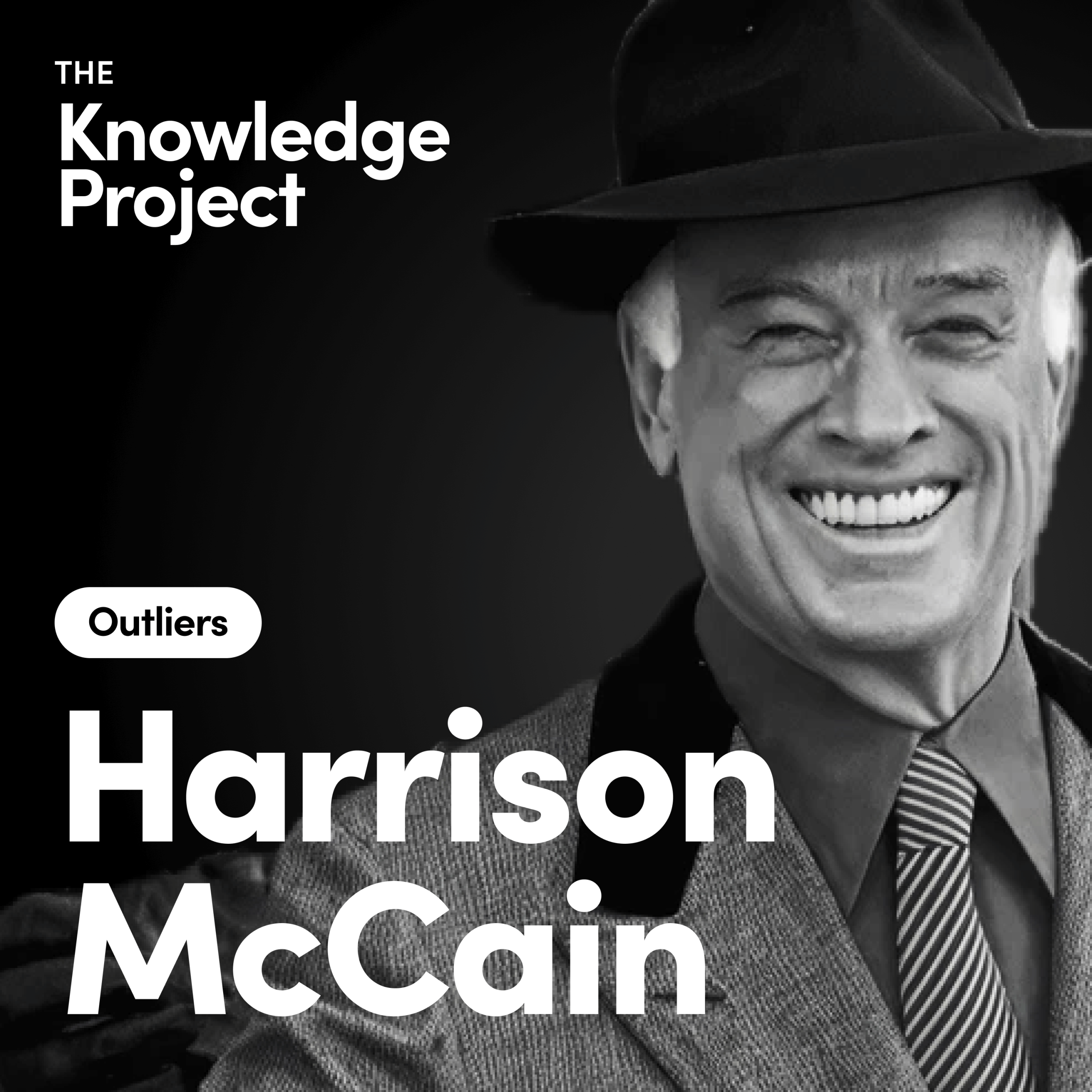
Harrison McCain learned salesmanship by talking his way into a pharmaceutical job at 22, then spent five formative years under K.C. Irving, absorbing lessons in vertical integration, relentless deal-capture, and “management by suggestion.”
Listen and Learn: YouTube | Spotify | Apple Podcasts | Transcript
He quit with no plan, two newborn kids, and no income. His brother Bob noticed that New Brunswick potato farmers were shipping raw potatoes to Maine for processing into frozen fries, then buying the finished product back. The McCains pooled $100,000 in family money, assembled capital from five different sources without giving up equity, and built a plant on a cow pasture in Florenceville.
The company’s core strategy was to avoid competition entirely: enter markets where frozen fries didn’t exist, prove the market by exporting first, hire locals, and only build a factory after the numbers justified it.
The U.S. was the one market that scared Harrison, and he patiently waited 16 years before a $500 million acquisition of Ore-Ida’s foodservice division finally cracked it. Along the way, Harrison nearly destroyed his most important customer relationship with McDonald’s by telling their buyer he didn’t need to tour his plant, a mistake that took years to repair.
By the time he died in 2004, McCain Foods operated 57 factories across six continents, sold in 160 countries, and processed a million pounds of potato products every hour.
Tiny Lessons
- “The main difference between the entrepreneur and the manager is attitude.”
- Reputation is a form of capital.
- When everyone says it can’t be done, and you see why it can, you’ve found an opportunity that won’t last.
- Don’t argue, demonstrate.
- “You bet the bundle every year, year after year. If you’re wrong once, you’re out.”
- “There is no shame in hiring the wrong person. There is, however, shame in keeping him.”
- “He could hold a meeting in his own mind, without need for others to help make a decision.”
- If you’re competing against someone who thinks settling lawsuits is part of the fun, you are at a serious disadvantage.
- “If you do not go after the business, someone else always will.”
- The first time someone says no is rarely the ultimate no. Assume all the risk yourself, and the other side has nothing to lose.
- A hundred percent of the business is better than ninety-six. A successful business owner always looks into the details.
- On saying no: “It is very difficult the first time, not so difficult the third time, and after the fifth time you can say no anytime it needs to be said.”
- “He outperformed everyone’s expectations, except his own.” The only benchmark that matters is internal.
- If you want something, make it happen.
- Making money is the easy part; giving back to your community is a higher bar.
- No job is too small. No task is below you.
- The boldness that gets you into the room is the same boldness that can get you thrown out of it. Know when to dial it back.
- “He seldom had time or inclination for self-doubt.”
- “Harrison was never one to draft a memo when a phone call or a brief visit would do.”
- People follow energy before they follow strategy.
- Learn to say no. “It seems to me the people in business who have the hardest time to get things done are those who can’t bring themselves to say no. They can say maybe, they can say I’ll see, they can say later, but sometimes there is only one answer and it is a simple, straightforward, no.”
- “You will need to work a lot faster if you ever want to be successful.”
- “Harrison would say he was going to be the largest french fry producer in the world. I used to roll my eyes. I didn’t think it was possible ’cause the Americans were so big. But he had great single-mindedness of purpose. He put the blinders on and he was headed right that way.”
- Do everything with enthusiasm.
- Guard your integrity like it’s the whole business. When a marketing employee swiped a trademark from Coca-Cola. Harrison sold it back for $1. “We are not goddamn crooks.” He said, “How could we make money on that?” He didn’t even consider it.
Still curious?
I made ~40 pages of my research notes available here.
Facts Only
Harrison McCain started his career in pharmaceutical sales at age 22.
He worked for K.C. Irving for five years, learning vertical integration and deal-capture strategies.
In 1957, McCain and his brother Bob founded McCain Foods with $100,000 in family money and additional capital from five sources.
The company’s first plant was built on a cow pasture in Florenceville, New Brunswick.
McCain Foods avoided direct competition by entering markets where frozen fries did not yet exist.
The company proved market viability by exporting first, then building local factories.
Harrison McCain waited 16 years before entering the U.S. market, acquiring Ore-Ida’s foodservice division in 1973 for $500 million.
He damaged relations with McDonald’s by refusing a plant tour, requiring years to repair.
By 2004, McCain Foods operated 57 factories across six continents, sold products in 160 countries, and processed a million pounds of potatoes per hour.
McCain emphasized integrity, once selling back a trademark swiped from Coca-Cola for $1 to avoid unethical practices.
He believed in decisive leadership, stating, “You bet the bundle every year, year after year. If you’re wrong once, you’re out.”
McCain prioritized direct communication, preferring phone calls or visits over memos.
Executive Summary
Full Take
This narrative presents Harrison McCain as a visionary entrepreneur whose success stemmed from a combination of boldness, strategic patience, and ethical rigor. The strongest version of this story highlights his ability to identify inefficiencies, take calculated risks, and scale a business globally while maintaining integrity. However, the account also reveals tensions—such as his initial dismissal of McDonald’s, a critical partner—which underscores the fine line between confidence and hubris in leadership.
Pattern-wise, the piece leans into inspirational storytelling, which can risk hagiography. The emphasis on McCain’s "single-mindedness" and rejection of self-doubt, while framed as strengths, could also be read as a cautionary tale about the dangers of overconfidence. The narrative avoids emotional exploitation or distortion, but it does employ a form of *ARC-0024 Ambiguity* by omitting deeper scrutiny of the challenges faced by workers or communities impacted by McCain Foods’ expansion. The focus on his personal principles—like integrity and giving back—serves as a moral anchor, but it’s worth asking whether these values were consistently applied at scale.
Rooted in the paradigm of rugged individualism and entrepreneurial exceptionalism, the story echoes the "great man" theory of history, where success is attributed to personal grit rather than systemic advantages. Yet McCain’s early access to family capital and mentorship under K.C. Irving complicates this narrative, suggesting structural privileges that enabled his risk-taking.
For human agency, the implications are dual: McCain’s story can inspire bold action, but it also risks romanticizing the "bet the bundle" mentality, which may not be replicable or advisable for most. Who benefits? Aspiring entrepreneurs and admirers of self-made success. Who bears costs? The unseen laborers, competitors, or communities displaced by rapid industrialization.
Bridge questions: How might McCain’s strategies have differed if he lacked initial family capital? What trade-offs did his relentless expansion impose on local economies or workers? Would his emphasis on integrity hold up under modern corporate scrutiny?
Counterstrike scan: If this were an influence campaign, the playbook would amplify the "self-made" myth while downplaying systemic advantages, using McCain’s story to justify risk-taking as the sole path to success. The actual content doesn’t fully match this—it acknowledges his early mentorship and capital—but the framing still leans toward individual triumph. No overt manipulation detected, but the narrative’s gaps invite critical reflection.