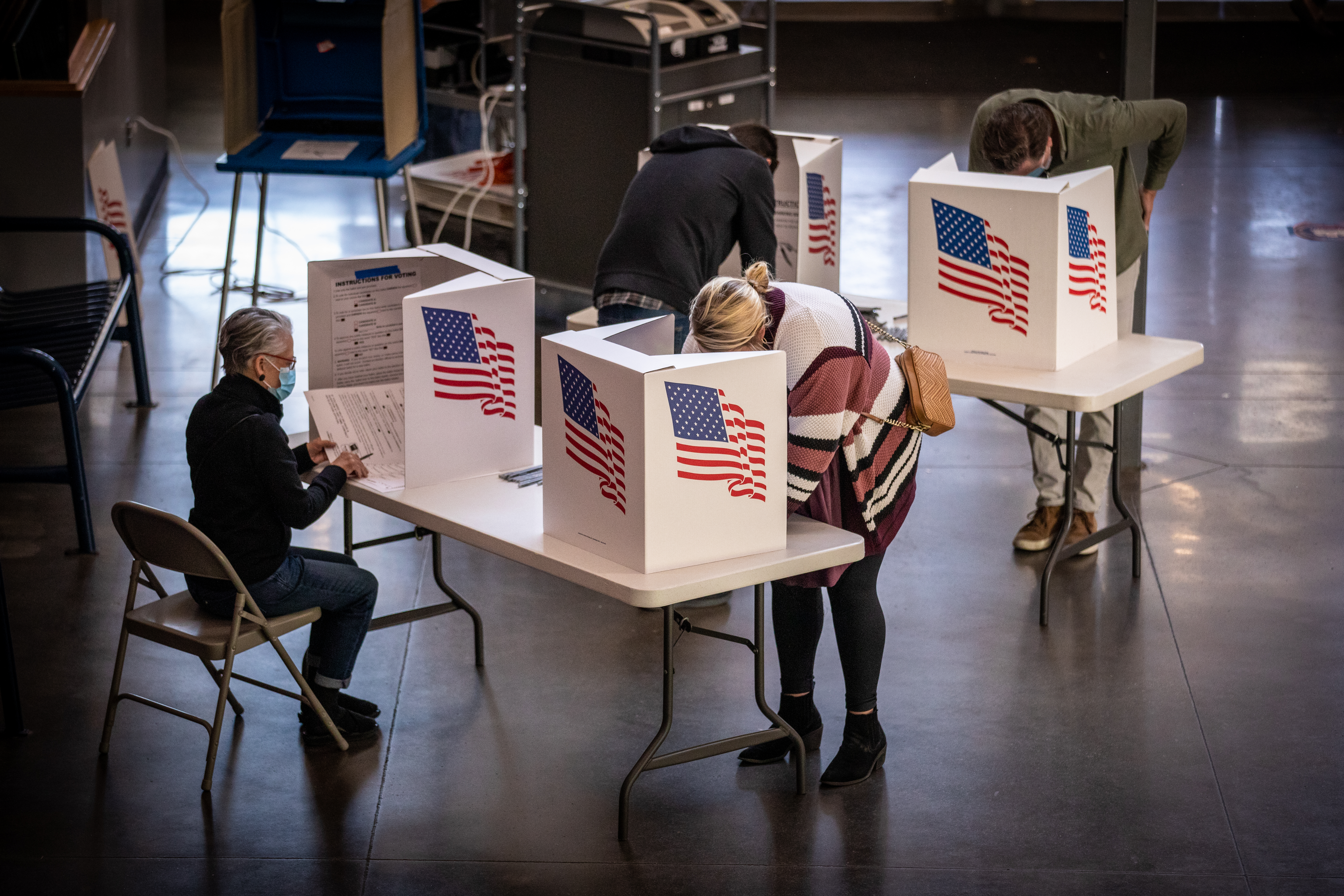
South Dakota Governor Larry Rhoden signed a bill on Thursday that requires new registered voters to prove that they are United States citizens in order to cast a ballot in state elections.
In the press release, Senate Bill 175 was explained to:
only appl[y] to state elections and only impacts new registrants. If a South Dakota resident is already registered to vote, there is nothing for that individual to do to maintain their registration. If a South Dakota resident is already registered to vote and needs to change their name, address, or other information, no proof of citizenship is necessary.
While SB 175 has been compared to the SAVE Act, there are a few differences. The SAVE Act applies to federal elections, whereas SB 175 applies only to South Dakota state elections. Additionally, the federal bill requires a birth certificate to be shown as proof of citizenship whereas a number of documents can be used under SB 175.
The bill provides a list of acceptable documents to prove US citizenship, including certain driver’s licenses or state IDs indicating citizenship verification, Tribal IDs, birth certificates, US passports, naturalization certificates, or similar federal documents. If someone does not provide proof of US citizenship or lists only a mailing address, they may vote only in federal races.
Senate Bill 175 took effect immediately after the governor signed it, due to an emergency clause. According to the press release, the Governor’s Office, the Secretary of State’s Office, and the five state agencies required to assist with voter registration have been working to implement these new legal requirements since the bill passed both legislative chambers.
There have been a few administrative updates in preparation for the bill. County auditors must now verify certain citizenship documents, election ballots are limited for federal voters, and related statutes are updated or repealed to align with the new rules.
Facts Only
South Dakota Governor Larry Rhoden signed Senate Bill 175 on Thursday.
The bill requires new voter registrants to prove U.S. citizenship to vote in state elections.
Existing registered voters are not affected by the new requirement.
Voters updating registration details (name, address, etc.) do not need to provide proof of citizenship.
The bill applies only to South Dakota state elections, not federal elections.
Acceptable proof of citizenship includes driver’s licenses, Tribal IDs, birth certificates, U.S. passports, and naturalization certificates.
Voters who do not provide proof of citizenship or only list a mailing address may vote only in federal elections.
The law took effect immediately upon signing due to an emergency clause.
State agencies, including the Governor’s Office and Secretary of State’s Office, have been preparing for implementation.
County auditors are now required to verify citizenship documents.
Election ballots are limited for voters who can only participate in federal elections.
Related statutes have been updated or repealed to align with the new rules.
Executive Summary
South Dakota Governor Larry Rhoden signed Senate Bill 175 into law on Thursday, requiring new voter registrants to prove U.S. citizenship to vote in state elections. The bill does not affect existing voters or those updating their registration information, such as name or address changes. Unlike the federal SAVE Act, which applies to federal elections and mandates birth certificates as proof, SB 175 accepts a broader range of documents, including driver’s licenses, Tribal IDs, passports, and naturalization certificates. If a voter fails to provide proof of citizenship or only lists a mailing address, they may vote only in federal elections. The law took immediate effect due to an emergency clause, with state agencies already preparing for implementation. Administrative changes include county auditors verifying citizenship documents and limiting ballots for federal-only voters.
The bill has drawn comparisons to broader national debates over voter eligibility and election integrity. Supporters argue it strengthens electoral security, while critics may raise concerns about potential barriers to voter registration, particularly for marginalized groups. The law’s immediate enforcement and the range of acceptable documents suggest an attempt to balance verification with accessibility, though its long-term impact remains uncertain.
Full Take
The strongest version of this narrative frames SB 175 as a measured approach to election integrity, distinguishing it from more restrictive federal proposals like the SAVE Act by allowing multiple forms of citizenship verification. It acknowledges the immediate implementation and administrative preparations, suggesting a coordinated effort to minimize disruption while enforcing new standards. The law’s focus on new registrants rather than existing voters could be seen as a compromise, avoiding retroactive burdens while still addressing concerns about non-citizen voting.
However, the pattern scan reveals potential for **ARC-0024 Ambiguity** in the framing of "proof of citizenship" requirements. While the bill lists acceptable documents, the practical barriers—such as access to birth certificates or passports—could disproportionately affect low-income or marginalized communities, even if unintentionally. The emergency clause and immediate enforcement might also raise questions about the urgency of the perceived problem, inviting scrutiny of whether this is a solution in search of a problem.
Root cause analysis suggests this law reflects a broader paradigm of electoral gatekeeping, where the tension between security and accessibility plays out in state-level policy. The assumption that non-citizen voting is a significant risk—despite limited evidence—drives such measures, echoing historical patterns of voter suppression under the guise of fraud prevention. The implications for human agency are mixed: while the law may reassure those concerned about election integrity, it could deter eligible voters who lack the required documentation, particularly in rural or Indigenous communities where Tribal IDs are accepted but other forms may be harder to obtain.
Bridge questions: How might this law interact with existing voter turnout disparities in South Dakota? What evidence exists of non-citizen voting in the state to justify the emergency clause? Would alternative measures, such as automatic voter registration with citizenship verification, achieve similar goals without potential barriers?
Counterstrike scan: A coordinated influence campaign might exploit fears of election fraud to push for restrictive laws, using ambiguous language about "proof" to obscure practical barriers. The actual content here does not fully match that pattern, as it provides clear documentation options and exempts existing voters. However, the emergency clause and immediate enforcement could be leveraged in bad-faith narratives to amplify urgency without proportional evidence.
Patterns detected: **ARC-0024 Ambiguity** (potential practical barriers obscured by broad documentation options).