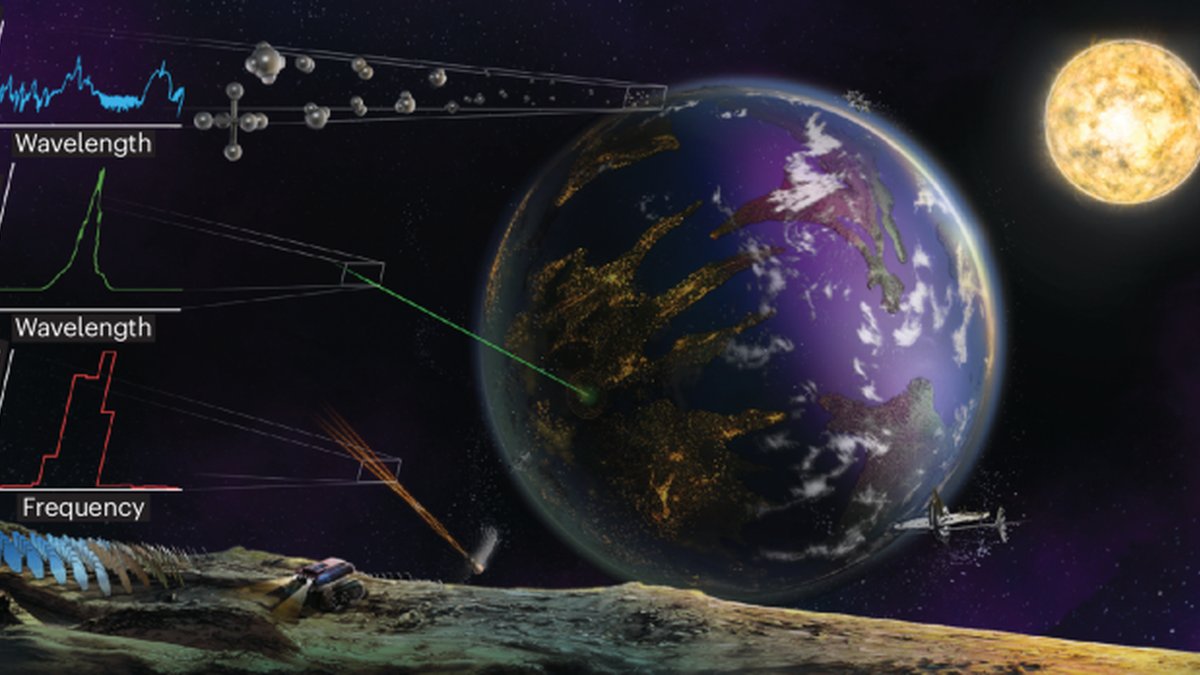
The IAU’s first fully online symposium brought researchers together from around the globe to discuss technosignatures. Upcoming all-sky surveys, exoplanet missions and tools to search data archives offer new directions for the field.
This is a preview of subscription content, access via your institution
Access options
Access Nature and 54 other Nature Portfolio journals
Get Nature+, our best-value online-access subscription
$32.99 / 30 days
cancel any time
Subscribe to this journal
Receive 12 digital issues and online access to articles
$119.00 per year
only $9.92 per issue
Buy this article
- Purchase on SpringerLink
- Instant access to the full article PDF.
USD 39.95
Prices may be subject to local taxes which are calculated during checkout
References
Schwieterman, E. W. et al. Astrobiology 18, 663–708 (2018).
Wright, J. T. et al. Astrophys. J. Lett. 927, L30 (2022).
Haqq-Misra, J., Kopparapu, R. K. & Profitiliotis, G. Astrophys. J. Lett. 995, L22 (2025).
Profitiliotis, G. & Theologou, K. Futures 147, 103117 (2023).
Genevieve, K. et al. Plurality in post detection scenarios. In Proc. 53rd Symposium on the Search for Extraterrestrial Intelligence (SETI) (International Astronautical Federation, 2024).
Nováková, J. N. Nat. Astron. 8, 799–800 (2024).
Papagiannis, M. D. (ed.) The Search for Extraterrestrial Life: Recent Developments. Proceedings of the 112th Symposium of the International Astronomical Union Held at Boston University, Boston, Mass., USA, June 18–21, 1984 (D. Reidel, 1985).
Forgan, D. H. Solving Fermi’s Paradox (Cambridge Univ. Press, 2019).
Haqq-Misra, J. et al. Acta Astronaut. 198, 194–207 (2022).
Author information
Authors and Affiliations
Corresponding author
Ethics declarations
Competing interests
The author declares no competing interests.
Rights and permissions
About this article
Cite this article
Haqq-Misra, J. Advancing the search for technosignatures. Nat Astron (2026). https://doi.org/10.1038/s41550-026-02906-6
Published:
Version of record:
DOI: https://doi.org/10.1038/s41550-026-02906-6
Facts Only
* The IAU held a fully online symposium on technosignatures.
* Upcoming all-sky surveys, exoplanet missions, and data archive tools offer new directions for the field.
* References include work on the search for extraterrestrial life and related astrophysics topics from sources like *Astrobiology*, *Astrophysical Journal Letters*, and other proceedings.
* The article references works by researchers such as Schwieterman et al., Wright et al., Haqq-Misra et al., and others.
Executive Summary
Full Take
Sentinel — Human
This text appears to be standard editorial or promotional material surrounding a peer-reviewed scientific article, exhibiting the formal tone expected from academic publishing rather than argumentative content.