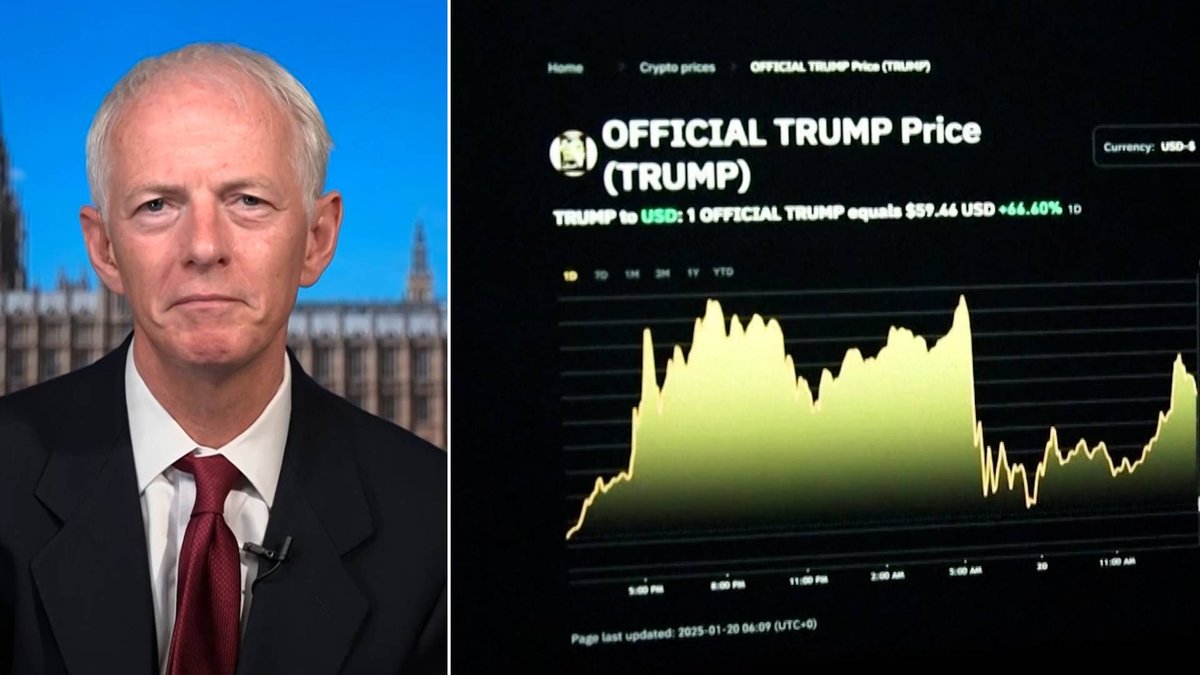
New financial disclosures by President Donald Trump show that he made more than $1.4 billion from his family’s various cryptocurrency ventures last year, reaping a windfall after pulling back on regulation of the industry and promoting the United States as “the crypto capital of the world.” Other Trump businesses, like his resorts and golf courses, have also flourished since his return to the White House, while the Trump Organization has also licensed the family name to properties in countries that are crucial to U.S. foreign policy interests, including Saudi Arabia and Qatar.
“It’s been an incredibly successful period for the Trump family,” says Reuters investigative reporter Tom Bergin.
Transcript
NERMEEN SHAIKH: We begin today’s show with the stunning windfall President Trump has made during his first year back in the White House. New filings show that Trump made more than $2.2 billion last year, most of it fueled by cryptocurrency profits, but with a significant rise in profits across his real estate business and other family investments, and his legal settlements with media giants like ABC News, Paramount and Meta. The mandatory financial disclosure report released Tuesday shows Trump made at least $1.4 billion from his family’s cryptocurrency ventures. That includes $635 million for Trump-branded cryptocurrency meme coins and $590 million from the Trump family’s World Liberty Financial crypto business.
AMY GOODMAN: Meanwhile, roughly two-thirds of investors in the president’s meme coin have reportedly lost money as he made a fortune. As the backlash grows over Trump’s windfall profits, including criticism from The Wall Street Journal, the New York Post and Fox News, specifically Trump’s defenders usually, Trump defended how he’s profited from the presidency, while speaking to reporters Wednesday
REPORTER: To critics who say you’re profiting off the presidency, Mr. President?
PRESIDENT DONALD TRUMP: Well, you know why I’m profiting? Because the stock market is going up. Everybody’s profiting. If you have a — you have a 401(k)? How has your 401(k) done? It’s about up 85%. Thank you, President Trump.
NERMEEN SHAIKH: President Trump was speaking to reporters before boarding the new Air Force One, a Boeing 747 jet donated to him by the Qatari royal family, reportedly at a cost of $400 million. Trump plans to keep the jet after leaving office, saying he’ll donate it to his presidential library. Democrats have accused him of receiving a foreign emolument — or bribe — which is prohibited under the Constitution.
While the bulk of President Trump’s profits in 2025 were driven by cryptocurrency, he also earned another $575 million from his real estate holdings. That includes over $200 million from Trump National Doral and Mar-a-Lago, as well as earnings from licensing deals overseas, including in Saudi Arabia and Qatar, countries vital to U.S. foreign policy interests.
AMY GOODMAN: Growing concerns over the president’s conflicts of interest come as a new report from MS NOW finds the president’s two eldest sons, Eric and Donald Trump Jr., are linked to investments in at least 10 military companies that have drawn about $3.7 billion in federal funds since the start of the second Trump administration. Meanwhile, President Trump’s sons and Commerce Secretary Howard Lutnick stand to see a big windfall after businesses tied to the families helped secure a $1.6 billion mining deal in Kazakhstan, according to a report in The New York Times.
For more on all of this, we’re joined in London by Reuters investigative journalist Tom Bergin. He’s the author of the book Free Lunch Thinking: How Economics Ruins the Economy. His most recent investigative piece is headlined “Parsing the Trumps’ crypto profits, investors’ losses.”
Welcome to Democracy Now!, Tom. Why don’t you parse it out for us? And especially for people who don’t understand the whole crypto issue, explain what it is and how this family, the Trump family, and his allies have profited so much.
TOM BERGIN: Thank you, Amy. It’s good to be on the show.
The first thing I’d say is that the comments from the president aren’t really accurate insofar as that he says that he has made money because the stock market has gone up. None of the gains which we reported upon, as others have, that are contained in these documents refer to gains from selling stocks or bonds. This is all entirely money that is cash that has come into the accounts of his businesses from the operating businesses. And as you mentioned, what has become the most strongly performing new business is the cryptocurrency area. And, of course, this is an entirely new business.
And so, what we’ve seen is that the areas in which Donald Trump has seen an enormous increase in his income — and this is not an increase in his wealth, it’s an increase in cash coming in. We looked at this last year. We analyzed how it had gone up, and it was — you know, even before we saw this huge surge of income, it had gone up dramatically. So, it’s new businesses or businesses that are connected in some way to the presidency, which is to say, when we look at the golf clubs that have performed very well, it seems to be ones like Mar-a-Lago has gone up, 50% increase in revenue, West Palm Beach up 27%. Places where he spends a lot of time as president have done especially well.
But the crypto is really just the blowout one altogether, and in particular this business World Liberty Financial. The business sells digital tokens that have no intrinsic value. They have no real function beyond as a method for speculation. You can buy one in the hope that you can sell it to someone else at a higher price. As such, it’s a zero-sum game. President Trump’s gains from selling these tokens have been mirrored almost identically by the losses on the part of the people who have purchased these coins. So, either if it’s the World Liberty Financial token or the meme coin, people who have bought these, we’ve seen an over 90% drop in the price or 97% drop in the price from the peak there.
So, this is a business that basically you sell tokens that have no cost to manufacture. In the crypto business, when you want to sell tokens, the high cost tends to be in getting people’s attention. That’s why, in the past, when people have launched cryptocurrencies, they’ve hired movie stars and sports stars to get people’s attention. Of course, the Trump family have the ability to get people’s attention in an unheard-of way. They’ve got the best possible marketing tool — namely, the presidency.
So, it’s been an incredibly successful period for the Trump family in this new business. This is important to say. It’s a business that was registered weeks before the 2024 election and which really didn’t start to take much revenue in until the election happened. So, this is something that has really been a 2025 blowout year for the Trump Organization on the back of businesses that have benefited very much from his links, his position as president.
NERMEEN SHAIKH: And also, Tom, just to put it in the context in relative terms, I mean, in orders of magnitude, he declared — I mean, these disclosures show that his income more than tripled what it was in the previous year. So, if we could talk a little bit more about the conflicts of interest this raises? As The New York Times pointed out, Trump is a major crypto industry operator and also its top policymaker. And also, Trump earlier said that — he himself condemned crypto, saying that bitcoin was a scam, and saying cryptocurrency was potentially a disaster waiting to happen.
TOM BERGIN: Yes. I mean, the first thing I’ll just say, just to slightly correct that, it’s far more than a three times increase in his income. Some of the revenues have gone up in some of the businesses maybe three times, but across the piece, it’s far more than a 10 times increase in income for the Trump Organization.
In terms of the regulatory side of things, the White House is very clear: There are no conflicts of interest; President Trump is only concerned about the American public and acts in their interest. Nonetheless, these are businesses that really — well, they didn’t exist before this, and it’s quite difficult to see how they would have existed in their current form in a different situation, under a different president. So, for example, the sale of crypto tokens, like the World Liberty Financial token, or indeed the meme coin, this was treated, from a regulatory perspective, under the Biden regime, as being the sale of securities. Consequently, it was quite difficult to engage in that activity, certainly in the United States. And that’s why we saw, really, the end of the coin-offering boom in the late 2010s, so around by 2019, actually under the first Trump administration. It was the first Trump administration that clamped down on the sale of digital tokens for vast sums of money. So, we’ve — so, yes, so, definitely, the change in regulatory situations definitely benefited him.
NERMEEN SHAIKH: And if we could speak about one of the deals in particular, the deal signed between Eric Trump and the Emirati, Tahnoon bin Zayed? Soon after this deal was signed, the UAE was granted access to U.S. artificial intelligence chips. What is the significance of this particular agreement?
TOM BERGIN: Well, according to World Liberty Financial, there is no significance; this is a entirely commercial transaction unrelated to anything else. I think what we do see is, when Eric Trump or his brother travel around the world, or indeed actually just some of the officials of World Liberty Financial travel around the world, to places in the Middle East, Pakistan, wherever, they do get treated incredibly well by the authorities there. They get — they get meetings with senior people. So, as I say, the company said there’s no connection.
But it is also interesting when we look at that particular deal, and you have to look at what was being bought, $500 million being given for a company that really didn’t have much by way of an income flow. So, it was — it was quite difficult, and that’s because the — what was sold there was not the right to the revenue from selling tokens. It was to a separate business. So, it wasn’t a business that had a lot of intrinsic value. So, it was quite surprising, just for me as somebody who studied the business model of that business in quite a forensic way, just to understand why someone would spend $500 million for that stake. But as I said, there’s a denial on the part of the White House and World Liberty Financial that that’s in any way linked to the decisions with respect to the UAE.
NERMEEN SHAIKH: And what about the fact some have said that this disclosure doesn’t, in fact, reveal other sources? In other words, there are some sources of income that Trump has had that are not included in this document. Is that right?
TOM BERGIN: Well, to be clear, what we’re looking at here is with respect to the cryptocurrency income. Donald Trump has reported cryptocurrency income which he has received into his company’s bank accounts. So, this is not to say — this is not an accrual-type accounting mechanism which is recording everything that he is entitled to. Under the documents governing World Liberty Financial, there are descriptions there of — to the entitlement that the Trump family have with respect to token sales, and they get a significant share of those. And we know that that business continues to hold within it large amounts of funds.
So, we had estimated that Donald Trump and his family had made considerably more from World Liberty Financial than has been reported in this. Just over $500 million in proceeds from token sales by World Liberty Financial is disclosed in this, in this document. We estimated that it was considerably more than twice that number. And the truth is, you know, standing here today, or sitting here today, looking at those documents, I’m not sure that we were wrong, because we don’t know how much else accrued to Donald Trump in 2025 and 2024 from the operations of World Liberty Financial, because we’ve received no accounting for that. So, like most things in crypto, we don’t really see a lot of what’s going on here. We don’t have transparency as to who’s buying these crypto tokens, and we don’t really see where the money is flowing or how much has been paid.
AMY GOODMAN: And, Tom, go beyond crypto and, overall, put this in a global context, the idea of an elected leader of a country making billions of dollars, along with his family and his close allies and their families, like Witkoff and his sons, Lutnick and his sons. I mean, everything from — you have MS NOW, a report that just came out: “Just over a week after U.S. and Israeli forces struck Iran in … February, a publicly traded Florida golf course company announced an unusual plan: a reverse merger to take a barely [one-]year-old drone startup public. Donald Trump [Jr.] and Eric Trump” — the two sons — “were part owners of the golf course company; now, they are backers of the drone startup.”
And then you have, you know, Trump’s legal settlements with companies like ABC, CBS, Meta, YouTube, making $80 million as he sues the media; his Trump National Doral, $121 million; Trump Tower Chicago, $39 million; and the foreign real estate investments; and his sons following in the wake of where the so-called peace envoys go, and people seeing it from the outside. I mean, even you have the conservative Wall Street Journal editorial board, the New York Post editorial board, even Fox raising these issues of the family just raking in a level we have not seen before. Compare it to other countries in history.
TOM BERGIN: Yeah, I mean, it’s difficult to find comparators for anything. I mean, just within the Trump family, it’s difficult to find comparators. What I mean by that is the Trump sons did not face constant — they were not being appointed on a repeated basis to the boards of outside companies in the years before the second Trump presidency, or indeed the first Trump presidency. So, they were not — so far as we could see, they were not, you know, sought-out partners. They don’t have experience in any of these businesses. It’s not entirely clear what they’re bringing to this, apart from their brand.
You mentioned there in terms of precedence. Obviously, in the U.S., there’s no — there’s no precedent of this. But I think that if, you know, you’re looking more broadly, there’s not a precedent, either. So, we’ve seen billionaires before in politics. This has happened in Czech Republic. It’s happened in Ukraine. It’s happened in Italy with Silvio Berlusconi. But what we haven’t seen before is someone coming in, and they’re into a leadership position, and their family starting a new business, which is intimately impacted by the position of the presidency for regulatory and other reasons, and then making over a billion dollars. That’s not something that we’ve seen in the Western world. I’ve looked around, and I couldn’t find any example of that. So, whatever way you look at this, it’s quite unusual, the, you know, precedent geographically or over time. It’s truly quite unusual.
And it does — obviously, as I said, the Trump Organization say there are no conflicts of interest, that the company has always done deals overseas. Well, you know, the truth is that it did do deals overseas, but they’d rather fizzled out come about 2016. And after the second presidency, even after they lifted the self-imposed moratorium on foreign deals, there wasn’t a rush of people to come and do deals in 2021. What we saw was that in 2024, a significant pickup in these deals in the second half of the year as President Trump was nearing the 2024 election, and then we saw a huge explosion in those deals thereafter.
So, we’re seeing a significant increase in income in areas that have some linkage to the presidency, if it just be about his brand being lifted. But also we are seeing, quite interestingly, the places where his brand attracts the most developer interest seems to be in the Middle East, so we see new deals in Qatar and Dubai yielding tens of millions of dollars in the Middle East, so that — that have benefited the president.
NERMEEN SHAIKH: And, Tom, very quickly, before we conclude, what is unquestionably illegal here, and what can Congress do?
TOM BERGIN: Well, you know, nothing’s unquestionably illegal until a judge rules it, and I think, you know, I’ve reported on enough complex regulatory laws in the past. But what’s interesting is there are so few guardrails here with respect to a president. So, you mentioned the Foreign Emoluments Clause. That’s not something that’s been widely tested, so we don’t know about its limits or otherwise. But so many of the rules that would exist with respect to appointed officials or other elected officials do not apply to the president, so it’s quite difficult to — if there was any desire for anyone to hold him to legal account. There isn’t really a legal account. And indeed, that’s something that Elizabeth Warren has drawn some attention to, that maybe there should be some revision of the rules there with respect to the guardrails on a president.
AMY GOODMAN: Tom Bergin, we want to thank you for being with us, investigative journalist with Reuters, author of the book Free Lunch Thinking: How Economics Ruins the Economy. We’ll link to your latest piece and your other investigations, “Parsing the Trumps’ crypto profits, investors’ losses.”
Coming up, the Supreme Court grants President Trump the power to fire and replace independent regulators. In a case focused on the Federal Trade Commission, it could impact dozens of what were believed to be independent agencies. We’ll talk to former FTC Commissioner Alvaro Bedoya. Stay with us.
[break]
AMY GOODMAN: “John Walker’s Blues,” performed by Steve Earle in our Democracy Now! studio.
Media Options