In the 1920s and 1930s, Weimar was rife with contradictions, embracing both utopian modernism and Nazism. This German town’s interwar story, says Katja Hoyer, reveals how democratic dreams can die in the face of economic ills and polarising politics
Adolf Hitler could not have been clearer. “I love Weimar,” he proclaimed at the end of 1925. He wasn’t talking about the Weimar Republic that had emerged from Germany’s defeat at the end of the First World War, but about the town that lent the ill-fated democracy its name.
Weimar lies in the heart of Germany, about halfway between Hamburg and Munich. It is a quaint place, conscious of history and tradition, both of which it has in abundance. Its cobbled streets are lined with timber-framed houses, elegant villas, churches and palaces – all embraced by vast, beautifully landscaped gardens. It’s this combination of cosy charm and cultural importance that made the town so attractive to Hitler. And he was far from the only one drawn to Weimar.
Between the two world wars, Weimar was a place where people dreamed big ideas, ranging from liberal democracy and utopian art to eugenics and a form of tyranny that would plunge Europe into conflict. Weimar was where the architects of the Bauhaus movement first experimented with new ways of living, but also where Buchenwald – the largest concentration camp on German soil – was established in a beech forest nearby. This uncomfortable proximity of idealism and barbarism makes interwar Weimar the perfect place to seek answers to one of the greatest questions of the 20th century: how did a nation that prided itself on its culture and civility enable the catastrophe of Nazism?
Today, few people outside Germany could point to the town on a map. Yet its name widely conjures powerful notions of noble experiments and fallen ideals. That’s because it was the cradle of Germany’s first full democracy. The Weimar Republic burned brightly, but endured for little over 14 years, from 1919 to 1933 – its demise sealed when Hindenburg appointed Hitler as chancellor.
The shock of the new
To understand how Weimar rose to such prominence, we need to look first at 1918, when Germany lost not just the First World War but also its monarchy. Kaiser Wilhelm II was forced to abdicate and the country became a republic, requiring a new constitution. Berlin, which had been the capital of Prussia and the German empire, remained capital of the new Germany, but would not be where its administration was set up. For one thing, Berlin wasn’t safe. At the beginning of 1919, when the country held its first-ever fully democratic elections on a franchise that included all adult Germans – including women – Berlin was the stage for bloody street battles between communist would-be revolutionaries and the war-hardened soldiers deployed to quell their uprising.
As a seat of the dethroned Hohenzollern dynasty, Berlin was also associated with the old, Prussia-led Germany and, therefore, with a brand of militarism that had contributed to the outbreak of war in 1914. Germany needed to convince the world – and itself – that it was open to the idea of reinvention.
Weimar seemed the ideal launchpad for a new national project. As the capital of the small state of Saxe-Weimar-Eisenach, it was neither in Prussia nor in any of the other major German states. It was safe, centrally located and relatively untouched by the political violence that raged in larger cities. Most importantly, it was a powerful symbol that a new Germany could emerge from the ruins of the old.
Weimar was widely regarded as Germany’s cultural capital. Johann Wolfgang von Goethe (1749–1832), the closest thing Germany has to a national poet, had once lived and worked here, as had his friend and fellow writer Friedrich Schiller (1759–1805). Johann Sebastian Bach (1685–1760) resided in Weimar for years, as did composer Franz Liszt (1811–86) and philosopher Friedrich Nietzsche (1844–1900). Weimar’s place in German culture far exceeds its physical size. All in all, it was the ideal setting for an ambitious rebrand.
The Social Democrat Friedrich Ebert, elected as the first president of the republic, knew all this. When he opened the National Assembly in the town’s theatre on 6 February 1919, he proclaimed: “Here in Weimar we must achieve the transformation from imperialism to idealism, from world domination to spiritual greatness… Now the spirit of Weimar, the spirit of great thinkers and poets, must fill our lives again.”
So the first German republic became a “Weimar Republic”. It is telling, however, that the person who coined this term was Hitler. Officially, the postwar state was still called the German Reich (meaning ‘kingdom’ or ‘empire’), as it had been under the kaiser – a hint that regime change is easier than a change in culture. And in 1929, the future dictator and other enemies of the fragile democracy used its 10th anniversary to deploy the term ‘Weimar Republic’ in a derogatory fashion, deriding the system as un-German.
- Read more | Timeline: the rise and fall of the Third Reich
Designs on change
There was much about the new ‘spirit of Weimar’ that riled not just the Nazis but also many conservatives. In the early 1920s, the town drew radically creative minds. A key moment was when Walter Gropius agreed to settle in Weimar and establish the Bauhaus (literally: ‘building house’) art school in 1919. With his arrival, the town had attracted one of the most influential names in world architecture. Many other illustrious figures followed, among them the Russian painter Wassily Kandinsky and Swiss-born artist Paul Klee. In its revolutionary approach, fusing design and craftsmanship with industrial mass production, the Bauhaus had a huge influence on the way we live today, sowing the seed for everything from IKEA flat-packs to clearer typography, prefabricated housing and the cantilever chair.
Sensing the explosive potential of Bauhaus ideas, Weimar’s conservative elites pushed back hard. Their ire was aimed at both the burgeoning Bauhaus movement and those who represented it – students and teachers, an eclectic mix of men and women, many of whom had left-leaning outlooks that ranged from moderate to communist. Scandalously, some students lived in communes and went skinny-dipping in the river Ilm. Many wore distinctive, proto-hippy garments such as sandals and long, loose shirts provocatively referred to as Russen-kittel (Russian smocks), donned in protest against middle-class convention. It all smacked of social decay to conservatives, many of whom existed in a permanent state of moral panic brought on by the dizzying speed of postwar change. They drove Gropius’s art school out of town in 1925, and the Nazis closed the Bauhaus entirely in 1933.
Nursery of Nazism
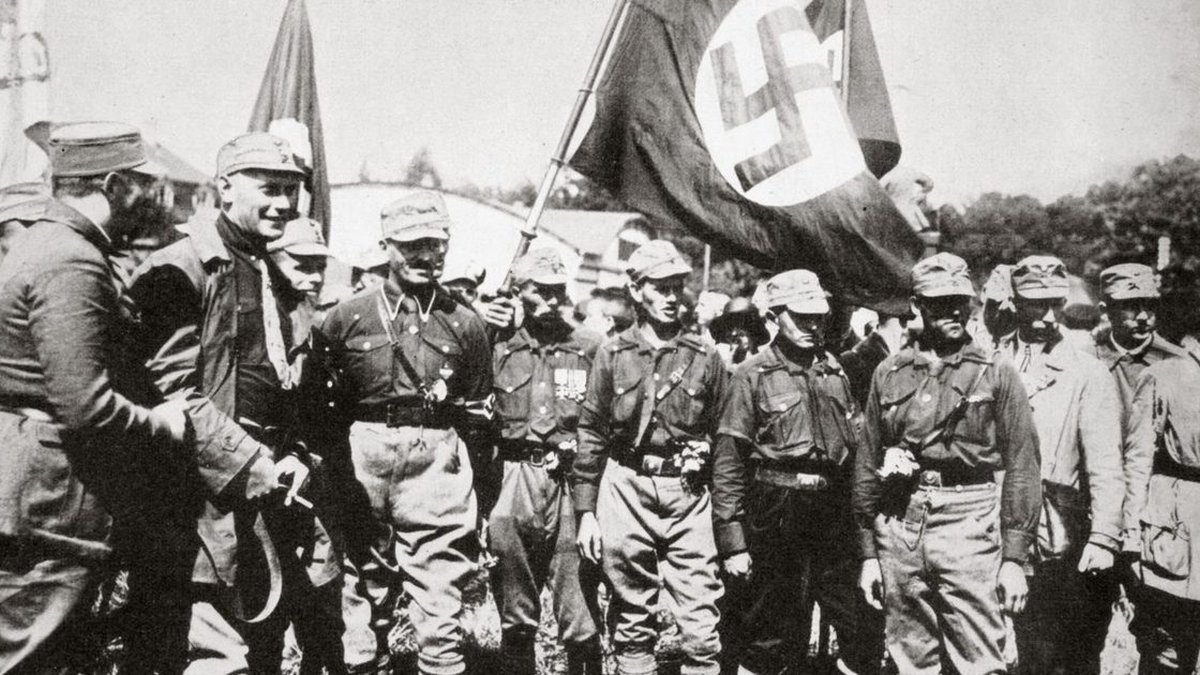
Though Weimar was, in many ways, an epicentre of modernism, it was also an early stronghold of the Nazi movement. The first formal Nazi Party rally was held in Weimar in 1926, before such gatherings were relocated to Nuremberg. Weimar was where the Hitler Youth received its name, and where significant Nazi rituals such as the Hitler salute were first presented to the public. Nazi polling numbers in Weimar usually exceeded their average across Germany, and the town became the seat of the first state government to appoint a Nazi minister, in 1930, three years before Hitler became Germany’s chancellor.
As Weimar became a haven for the movement and a testing ground for Nazi ideas, its people found themselves on the frontline of the culture wars that played out across interwar Germany. With its peculiar combination of small-town life and cultural prestige, the town was home to both ordinary and illustrious people during the 1920s and 1930s, all striving to ride the waves of history – or, at least, to avoid being drowned. Individual stories of Weimar’s residents offer revealing and fascinating case studies of how people behave in times of crisis.
Take Carl Weirich, a stationer and bookbinder. He moved to Weimar from nearby Eisenach in 1914 to take over a well-established stationery shop in the heart of the old town, just a short walk away from the theatre in which the Weimar Republic was founded. He’d arrived with great hopes for the future – only to be faced by the impacts of two world wars and a multitude of crises that hit both his business and his family.
Weirich was fascinated by paper, ink, typewriters and the written word. He meticulously kept a diary that details his story and is often surprisingly frank, providing unique, granular insights into life between the wars. Fundamentally, he was not a political man. His diary records more on the hiking tours he conducted each Sunday – come rain, come shine, come democracy, come dictatorship – than on the minutiae of current affairs. Yet politics touched every aspect of his life. When the National Assembly convened a stone’s throw from his shop in 1919, he attended some of the public sessions to see how “the new people presented themselves who would represent the fatherland headed by Fritz Ebert”.
Running a small shop that offered bookbinding services as well as fountain pens for schoolchildren and postcards for tourists, Weirich wasn’t rich, but he was comparatively comfortable when the economy was stable. During times of crisis, however, it felt as if the rug was being pulled from beneath his feet. In the spring of 1923, when hyperinflation began to hit the young republic hard, he bought a used bicycle for 2 million marks. Had he held on to the money until September, the same amount would have bought him a loaf of bread or an egg.
During the Great Depression that followed the Wall Street crash of 1929, he once again suffered a reversal of fortunes as economic despair threatened to rob him and his young family of house, shop, home and livelihood. One government after another had failed to make things better. At the end of 1932, Weirich – like millions of his fellow Germans – was ready to pin his hopes on one “young man, the Führer of the National Socialist Party A. Hitler”. The war that “young man” would unleash just a few years later would leave Weimar – and, with it, the life Weirich had built for himself – in ash and ruin.
Hosting Hitler
Weimar’s women who found themselves caught up in events also tried to shape their own destinies. Take Rosa Schmidt, a hotelier of Jewish heritage who, together with her husband, Arthur – a decorated war veteran from an old Protestant Weimar family – ran the Hotel Hohenzollern by the train station. The couple struggled to keep their business afloat during the challenging postwar years and hyperinflation. So when Hitler and his supporters booked the hotel repeatedly for early Nazi visits to Weimar, the Schmidts saw welcome opportunities to save their business from catastrophe. Hitler had no idea that his meals were prepared by a Jewish woman, even as he unleashed his antisemitic rants in her hotel. Rosa had no idea that her guest would bring death to the majority of European Jews, and that her family would be no exception.
At the other end of town, Elisabeth Förster-Nietzsche ran an archive that contained the papers of her late brother, Friedrich Nietzsche. After the philosopher suffered a mental breakdown in 1889, his sister became his carer until the time of his death 11 years later, and the self-appointed steward of his legacy thereafter. Permanently cash-strapped, she and the Nietzsche Archive relied on funding from generous donors and the various governments of the interwar era. Though not initially impressed by Hitler, Elisabeth soon embraced Nazism – and Nazism embraced Nietzsche.
Despite her politics, Elisabeth’s oldest friend remained the liberal Harry Graf Kessler, an Anglo-German aristocrat and diplomat who enjoyed the eccentric lifestyle of a cosmopolitan dandy. A gay man at a time when male homosexuality was illegal, he was careful not to draw too much attention to his relationships, but he nonetheless flaunted his bachelordom.
A mythical aura surrounded him almost from birth. Kaiser Wilhelm I had been so smitten with the boy’s beautiful mother that he had fostered the Kesslers’ swift rise, and became godfather to Harry’s younger sister, Wilhelmina. There were even rumours that the emperor was the illegitimate father of either or both of the Kessler children – something the younger man vehemently refuted. Multilingual, widely travelled and well-educated, the count felt as much at ease at court as he did in bars and ballrooms. He promoted art and moved to Weimar at the turn of the century, playing an integral part in its thriving cultural scene. There he befriended Elisabeth and helped to establish her brother’s archive.
Expressing an agony that will be familiar to modern readers, Kessler frequently complained in his diary that, in a deeply polarised society, it had become difficult to maintain friendships across the political divide. As Elisabeth became increasingly nationalistic and eventually outright supportive of Nazism, he remained staunchly liberal and had to flee Germany when Hitler rose to power. In one letter to his old friend Elisabeth, Kessler wrote: “I have strived my whole life to, yes, take politics seriously since it belongs to those things on which our daily life and work depends, but to bar it from entering into my relationships.” The pair agreed to avoid political subjects, but this proved increasingly difficult in an era in which everything was political.
Monstrous ideas
Weimar changed politically and physically in the 1930s. The Nazis intended it to be a model town for their murderous dictatorship, and thus reshaped it architecturally and ideologically. Its inhabitants were forced to respond to what was happening, whether they wanted to do so or not. Teachers had to decide if they were happy to teach ‘racial hygiene’ in their lessons. Jews were dismissed from public sector jobs, no matter what they did. Registrar Heinrich Fleischhauer, a civil servant, was soon expected to sign death certificates for the victims of the Buchenwald concentration camp.
Many of those who spent time in Weimar in the 1920s made remarkably contrasting choices in the 1930s. Take Marlene Dietrich, who was sent to Weimar in her late teens to study violin with the best musicians. Or Walter Gropius, the founder of the Bauhaus school. Neither found life in Nazi Germany bearable, and both chose to live in the US rather than remain in a country run by Hitler. Dietrich renounced her German citizenship in 1939 and became an American. Other inhabitants of Weimar embraced Nazism. Emmy Sonnemann worked as an actress at the Weimar theatre. One day in 1932, she happened to be sitting in the Kaiser Café when an important-looking man in uniform stepped in. It was Hermann Göring. The two married in 1935. Hitler was their best man.
- Read more | Who was Hermann Göring? The truth about Hitler’s drug-fuelled enforcer who met his downfall at Nuremberg
Very few citizens of the town actively resisted Nazism. One of those who did was Kurt Nehrling, a young Social Democrat who returned from serving in the First World War with a debilitating case of tuberculosis. He allowed neither his illness nor personal setbacks to deter him from fighting for his convictions and, in resisting Nazism, he put both himself and his family in grave danger. Nehrling didn’t survive the Second World War. Arrested by the SS, he was executed at Dachau in 1943.
When the Americans occupied Weimar in the spring of 1945, they found that people such as Nehrling represented a tiny minority. To quote the American documentary Death Mills, filmed at liberated concentration camps including Buchenwald, the majority of Weimar’s citizens “had put themselves gladly into the hands of criminals and lunatics”.
A zone of interest
What roles did the people of Weimar play in Germany’s descent into darkness? Were they were culpable for the horrors of Nazism? Weimar’s citizens had, after all, found it possible to go hiking and sledging a stone’s throw from a concentration camp, and sleep soundly in their beds at night. They’d cheered on Hitler and stood by when Jewish neighbours were sent to their deaths. It’s always easier to condemn than it is to explain, but in the latter lies the key to understanding history and, ultimately, to drawing meaningful conclusions from it.
Asking why Germans acted the way they did is not the same as justifying their choices. If we are to avoid the mistakes made by people in the past, the first step is to understand why these mistakes were made. No one is entirely free to act outside the circumstances in which they find themselves. But that doesn’t mean that people lack agency. Interwar Germany has long fascinated scholars and the public precisely because it embodies the tension between the individual and the collective, between inevitability and responsibility – and nowhere was this truer than in Weimar, where many of the contrasting pathways of the interwar era came together.
Weimar – with all of its inherent contradictions, with the hopes and fears of a nation stamped onto its houses and streets – acted as a crucible of German history between the world wars. In Weimar, both good and evil ideas were forged, tried and tested. The townspeople were, variously, observers, participants, perpetrators, bystanders and victims of events that shaped Germany, Europe and the world. Studying their behaviour, both as individuals and as members of society, gets us closer to understanding how Nazism took hold, and how it was able to spread its pernicious influence far beyond its fanatical core.
It is in these dynamics that we may find instructive points to help us safeguard democracy and freedom in our own time. When you piece together the human mosaic of Weimar, one stark lesson stands out: no amount of history, tradition or culture is sufficient on its own to safeguard against takeover by a ruthless totalitarian ideology. Democracy and civilisation are maintained or destroyed by the choices we make as individuals and as societies. There is no better place and time to study this than interwar Weimar, a town where people conjured up dreams of a better world – but woke to find themselves living under tyranny.
This article was first published in the July 2026 issue of HistoryExtra Magazine
Authors
Katja Hoyer is visiting research fellow at King’s College London
Sentinel — Human
The text is a sophisticated historical narrative that successfully uses specific personal accounts to explore the complex contradictions of Weimar life, suggesting human authorship focused on interpretation rather than mere data recitation.