The floodwaters that ravaged southern China this week look set to expand to other provinces with the imminent arrival of Super Typhoon Bavi, with scientists warning extreme weather would only grow more frequent this year.
The expected weather systems will be sure to test the resilience of the country’s densely populated cities and rural communities.
China’s National Climate Center expects up to six typhoons to form in the Northwest Pacific and South China Sea in July, more than the average of 3.8. Of these storms, up to three could make landfall, above the norm of 1.8. The intensity of the cyclones will also be stronger, it said.
Scientists say climate change is increasingly exposing the world’s second-largest economy to destructive weather events, with this year of particular concern due to the expected emergence of the El Nino weather pattern, which could drive up temperatures and fuel more intense typhoons, as hurricanes are known in the Asia-Pacific region.
China is bracing for Super Typhoon Bavi on Saturday, the second tropical cyclone to arrive in a week. Measuring more than 1,000 km (621 miles) in diameter, Bavi briefly made landfall on Monday over the U.S. island of Rota in the Western Pacific with winds in excess of 290 kph (180 mph).
Last week, Typhoon Maysak made landfall on China’s southernmost island province of Hainan and quickly swept into the Chinese region of Guangxi, where the storm wreaked the most havoc. The remnants of Maysak also spawned at least two inland tornadoes in central China.
“The problem with these events is that they’re just increasing,” said Benjamin Horton, dean of the School of Energy and Environment at City University of Hong Kong.
The magnitude of the events is increasing and there is no time to recover and become resilient, warned Horton, who expects more frequent and more intense cyclones later this year to drop unprecedented amounts of rainfall, triggering floods, landslides, crop damage and a loss of lives.
“This is just going to repeat and repeat and repeat,” he said.
Water, Water, Everywhere
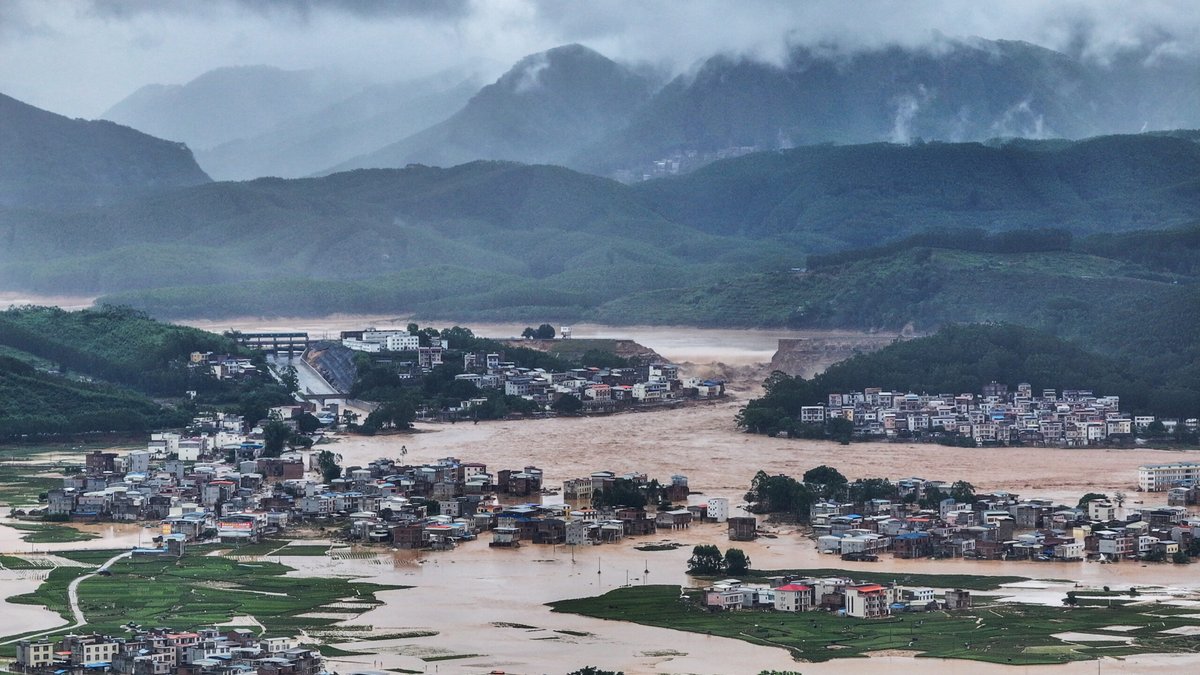
Towns and villages in Hengzhou, the epicenter of the Guangxi floods, were hit by heavy floodwaters on Monday after dams at local reservoirs failed. At least six people have died in Guangxi, officials said, with 375,000 others affected. The death toll is expected to rise.
“At least a thousand people are stranded in the mountains and it’s dark all around and (we need) urgent rescue,” according to a call for help posted on Chinese social media on Tuesday. Reuters has not independently verified the post.
After the failure of a medium-sized reservoir on Monday, floodwaters carrying large amounts of mud and silt have inundated downstream farmland and villages, national broadcaster CCTV said.
In some houses, floodwaters reached the second floor, trapping villagers on rooftops as violent torrents rushed around them, CCTV reported.
The largely rural city of Hengzhou, home to more than 1 million residents, has six medium-sized reservoirs and nearly 200 smaller ones.
It is also the starting point of a 70-billion-yuan ($10.3 billion) canal project that is scheduled to open in September.
“The severe impacts of Maysak and the looming threat of Super Typhoon Bavi indicate that the 2026 season is more intense and damaging than a typical year,” said Hui Su, chair professor of the Department of Civil and Environmental Engineering at the Hong Kong University of Science and Technology.
“El Nino is shifting typhoon tracks westward toward China’s coast and heightening risks, while climate change makes storms wetter and more destructive.”
Last week, the United Nations weather agency raised its forecast for the rapid emergence of a strong El Nino occurrence in the coming months.
El Nino is a periodic warming of sea surface temperatures in the central and eastern Pacific Ocean, potentially ratcheting up global temperatures and raising the risk of extreme weather, according to the World Meteorological Organization.
($1 = 6.7967 Chinese yuan renminbi)
(Reporting by Nicoco Chan in Shanghai, Ethan Wang, Xiuhao Chen and Ryan Woo in Beijing; editing by Thomas Derpinghaus)
Photograph: This photo released by Xinhua News Agency, shows flooded villages after the Liulan Reservoir breached due to heavy rains in Hengzhou, Nanning City, south China’s Guangxi Zhuang Autonomous Region on Monday, July 6, 2026. (Cao Yiming/Xinhua via AP)
Topics Catastrophe Windstorm China
Was this article valuable?
Here are more articles you may enjoy.
Facts Only
* Floodwaters ravaged southern China this week look set to expand to other provinces with Super Typhoon Bavi's arrival.
* Scientists warn that extreme weather will grow more frequent this year.
* China’s National Climate Center expects up to six typhoons to form in the Northwest Pacific and South China Sea in July, exceeding the average of 3.8.
* Up to three of these storms could make landfall, above the norm of 1.8.
* Cyclone Bavi measured more than 1,000 km in diameter and briefly made landfall over the U.S. island of Rota with winds exceeding 290 kph (180 mph).
* Typhoon Maysak made landfall on Hainan and Guangxi last week.
* The remnants of Maysak spawned at least two inland tornadoes in central China.
* Floodwaters inundated downstream farmland and villages following the failure of dams at local reservoirs in Hengzhou.
* At least six people died in Guangxi province following flooding, with 375,000 others affected.
* At least a thousand people were stranded in the mountains in Hengzhou following reservoir failures.
* Experts predict the 2026 season will be more intense and damaging than a typical year due to Maysak and Bavi threats.
Executive Summary
Floodwaters are expected to expand beyond southern China due to the impending arrival of Super Typhoon Bavi, with scientists warning that extreme weather events will increase in frequency this year. The National Climate Center forecasts up to six typhoons forming in the Northwest Pacific and South China Sea in July, which is more than the average of 3.8. These storms have the potential to make landfall in up to three areas, exceeding the norm of 1.8. The emergence of the El Nino weather pattern is expected to drive up temperatures and intensify typhoons, consistent with historical patterns in the Asia-Pacific region.
China is bracing for Super Typhoon Bavi on Saturday, which is the second tropical cyclone to arrive in a week, measuring over 1,000 km in diameter. Last week, Typhoon Maysak made landfall on Hainan and Guangxi, causing significant damage and spawning inland tornadoes. The events of the recent flooding, particularly in Hengzhou, resulted from dam failures at local reservoirs, leading to at least six deaths in Guangxi province, with an expected rise in fatalities. Scientists note that these events are increasing in magnitude, and experts predict the 2026 season will be more intense than average due to the combined effects of El Nino and climate change making storms wetter and more destructive.
Full Take
The narrative describes an escalation of physical risk driven by interconnected climatic forces, positioning existing societal infrastructure against increasingly volatile environmental conditions. The progression moves from acute, localized disaster (floods following reservoir failure) to macro-level climate influence (El Nino fueling stronger typhoons), culminating in a projection of chronic, accelerating vulnerability. The assertion that events are "just increasing" encapsulates a critical failure in the temporal framing: there is no window for recovery or resilience building before the next event strikes, suggesting systemic inertia against necessary adaptive change.
The focus on specific geographical areas and infrastructure—like the reservoirs in Hengzhou—serves to anchor abstract climate change concepts into tangible human cost, illustrating how global meteorological shifts translate directly into loss of life and displacement in densely populated regions. The scientific context regarding El Nino and climate change provides a mechanism for understanding the intensification, but the immediate reporting channels the anxiety toward a fatalistic repetition ("This is just going to repeat and repeat and repeat"), which acts as an emotional accelerant rather than a purely analytical call for policy shifts.
The pattern observed is a reliance on impending meteorological events—typhoons, El Nino cycles—as the primary driver of public discourse, which frames human vulnerability not as a variable to be managed through proactive adaptation, but as a predictable consequence of external forces that relentlessly increase in intensity. The cost borne by rural and densely populated communities contrasts sharply with the scale of the global climate drivers causing these changes, raising questions about the distribution of responsibility for both the destructive outcomes and the lack of preparation mechanisms for future threats.
Bridge Questions: What institutional structures are best equipped to translate long-term climate projections into immediate, localized resilience strategies? How can public discourse shift from reacting to inevitable repetition toward demanding systemic changes in emissions and infrastructure planning? What is the measurable cost—beyond immediate fatalities—of embedding this cycle of escalating environmental impact into economic and social systems?
Sentinel — Human
The article synthesizes scientific forecasts regarding increasing extreme weather risk due to climate patterns and reports on specific, recent flooding events in Southern China, supported by expert commentary.