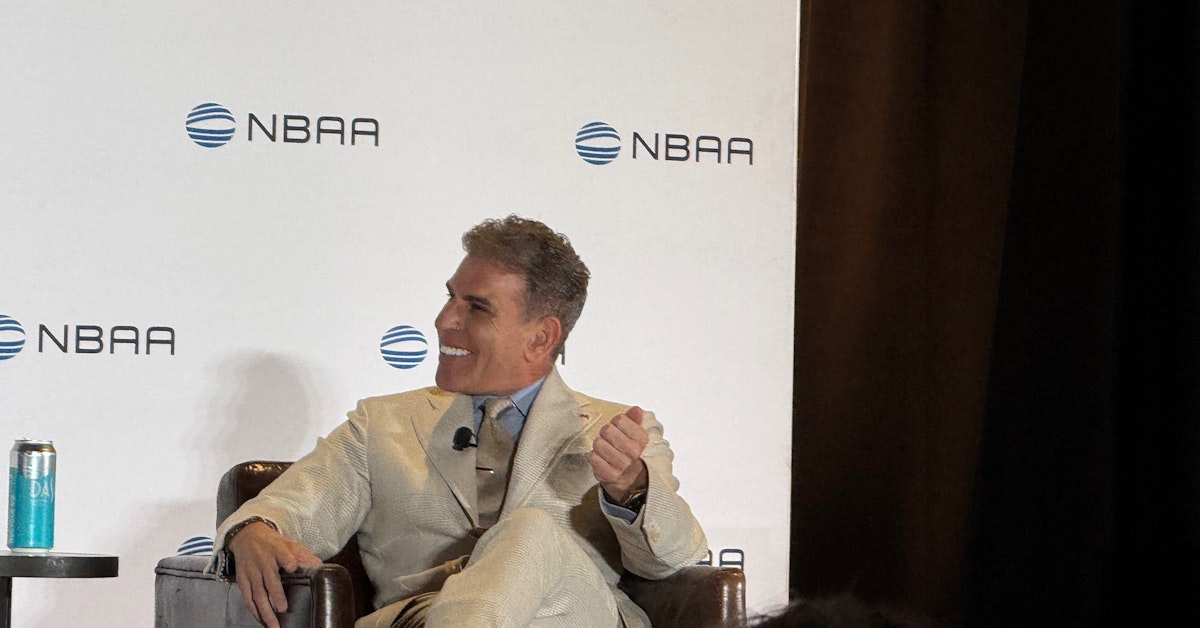
Flexjet’s Ricci on why LVMH was attracted to his company and how Warren Buffett helped get him started in a wide-ranging keynote talk.
During the NBAA Schedulers & Dispatchers Conference in Cleveland, Ohio, yesterday, Flexjet, Inc. Chairman Kenn Ricci spoke in a keynote conversation with NBAA CEO Ed Bolen.
Ricci talked about how he turned his furlough from Northwest Orient Airlines into a multi-billion-dollar private aviation empire, including competing with industry behemoth NetJets, and how Warren Buffett helped him launch his first try at fractional ownership.
Below is an edited and condensed version of the conversation.
Ed Bolen: It’s great to be here in your hometown. Let’s start at the beginning. What did you have in mind with Corporate Wings, and what challenges did you expect—or not expect?
Kenn Ricci: I’d like to say it was visionary, but I was actually unemployed after being laid off as a pilot. I wanted to fly, and that’s how it began. I was doing pilot services for Corporate Wings, which had some aircraft but also some questionable operations tied to a tax-driven structure. When that fell apart, what was left was Corporate Wings. A dispatcher called me and said I should buy it. It was $27,500, and they had $27,000 in the bank. I called my dad and said I could basically buy it with its own money—just needed $500 more. That’s how it started.
Bolen: Walk us through how you built from Corporate Wings to Flexjet.
Ricci: Corporate Wings was a management and charter company. I started thinking about how to make it sticky. I realized that if I owned facilities—FBOs and infrastructure—that would anchor the business. So we began buying facilities in the late ’80s. Then, after the Gulf War recession, I saw the rise of NetJets and the fractional model. What struck me was that they fully costed the asset—something the charter business didn’t really do. That was a big shift.
Bolen: What did it take to enter the fractional space?
Ricci: Scale. You can’t do fractional with one airplane. If two owners want the same aircraft at the same time, you’re stuck. You need a core fleet. We figured about 12 aircraft to get to functionality. And then infrastructure—maintenance, scheduling, crews. If you launch multiple programs, you might need 100+ aircraft to break even. It’s a fixed-cost business, but once you hit the tipping point, it becomes very profitable. We went to different banks to raise capital, and after visiting about 40, we had a very small amount committed—it just wasn’t enough. Then, in June of 1998, Warren Buffett bought NetJets. And it just so happened that our deck was sitting on a lot of banks’ desks, and all of a sudden they said, ‘We’ve got to get in this—we’ve got to be part of it.’ From June of ’98 until we launched in November of ’98, we went from struggling to raise money to having almost $400 million of capital. Boeing and Bombardier gave us money, and checks were coming in very quickly. That’s what allowed us to get the core fleet and really launch the business.
Bolen: Beyond assets, how did you think about culture?
Ricci: Leadership has to align with who you are as a person. If you’re naturally empathetic, you can’t lead with a command-and-control style. That disconnect doesn’t work. I wanted to build a culture that reflected who I am—one where employees actually enjoy the romance of aviation. Historically, people in this industry were underpaid because it was seen as a privilege to work in aviation. I wanted to change that.
Bolen: Culture is harder to maintain as you scale. How do you keep it alive?
Ricci: Communication has to be relentless. You can’t rely on people coming into an office—we have pilots all over the world. So we use constant communication—weekly audio updates, internal platforms, and Instagram. But culture also has to be experienced. If we say we’re empathetic, employees have to feel that every day. And that requires follow-through and constant monitoring.
Bolen: You mentioned a powerful example tied to the recent D.C. accident.
Ricci: Yes. The co-pilot involved was the son of one of our pilots. I was in Europe when it happened. But our team didn’t need direction. They immediately sent aircraft to bring the father and family together, activated support teams, and handled everything. That was culture in action. They knew exactly what to do without being told.
Bolen: You’ve built a strong social media presence. How does that fit into your strategy?
Ricci: Instagram is really for employees and future employees. We want people to understand who we are and what it’s like to work here. It’s about showing the company’s personality. People want to work for someone they know and respect. That’s the primary goal—not customers.
Bolen: You’ve made big bets over time. How do you think about investing?
Ricci: I stay within what I know. I’m not diversified—I know aviation. So we invest in things adjacent to that: training, maintenance, infrastructure. We bought a training company because we train thousands of pilots. It’s not about predicting the future—it’s about understanding your lane.
Bolen: Let’s talk about your operations center in Cleveland. What was the thinking behind it?
Ricci: It had to reflect the culture. It couldn’t just be people at terminals. It had to be a place employees were proud of, and customers could see. We oriented it so customers could walk in and immediately understand the scale and professionalism. It also had to be adaptable for the future—technology will change how we operate.
Bolen: What was the thought process behind bringing in LVMH-backed investment?
Ricci: Their thesis was that luxury is about time. That aligns perfectly with private aviation. They also emphasized two things: control the product and control the distribution. That’s why we’ve invested in maintenance and terminals. You can’t outsource luxury—you have to own it.
Bolen: You’ve had an interesting labor journey, including union decertification at Flexjet. What did that take?
Ricci: When I bought Flexjet back in 2012, the culture had shifted, and pilots were unionized. It took until 2018 to decertify. That’s rare. It required rebuilding trust and showing pilots they could believe in leadership. That doesn’t happen overnight—it’s years of consistency.
Bolen: What trends concern you today?
Ricci: Private equity. It’s driving up costs—maintenance, FBOs, everything. Maintenance cycles are taking longer because efficiency isn’t the priority—profitability is. That’s a real concern.
Bolen: And what gives you optimism?
Ricci: The airlines. They’ve made commercial travel worse. COVID accelerated that. People who would never fly private—what I call the frugal wealthy—tried it and didn’t go back. Our customers are younger now, and they’re using private aviation for both business and personal travel. It’s becoming a necessity, not a luxury.
Bolen: Final thought—what defines the future?
Ricci: Time. That’s the ultimate luxury. If you can give people time, you have a business.
Facts Only
Kenn Ricci is the Chairman of Flexjet, Inc.
Flexjet began as Corporate Wings, a management and charter company, purchased by Ricci in 1986.
NetJets, an industry behemoth, rose after the Gulf War recession.
Warren Buffett bought NetJets in June of 1998.
Flexjet launched its fractional ownership program in November of 1998.
Boeing and Bombardier provided capital for Flexjet's fractional program launch.
Flexjet has invested in maintenance, infrastructure, and training companies.
Flexjet decertified from union representation in 2018.
Executive Summary
Full Take
Ricci's narrative emphasizes the importance of leadership alignment with personal values, relentless communication, and a strong culture for maintaining success as a business scales (ARC-0047 Authentic Leadership). The LVMH investment aligns with their thesis that luxury is about time management, reinforcing Flexjet's focus on efficiency and personal time savings (ARC-0023 Time as Value). However, Ricci's concerns about private equity driving up costs suggest potential tensions between profitability and service quality in the industry (ARC-0157 Financialization vs. Human Values).
Questions for further reflection: What long-term effects will LVMH's investment have on Flexjet's culture and service offerings? How can private equity be reconciled with maintaining high standards of customer service in the aviation industry?
Sentinel — Human
Based on stylometric, coherence, and coordination analysis, the article appears to be written by a human journalist. The text is characterized by varying sentence lengths, a distinctive personal voice, and absence of talking points or argumentative skeletons that could indicate synthetic production.