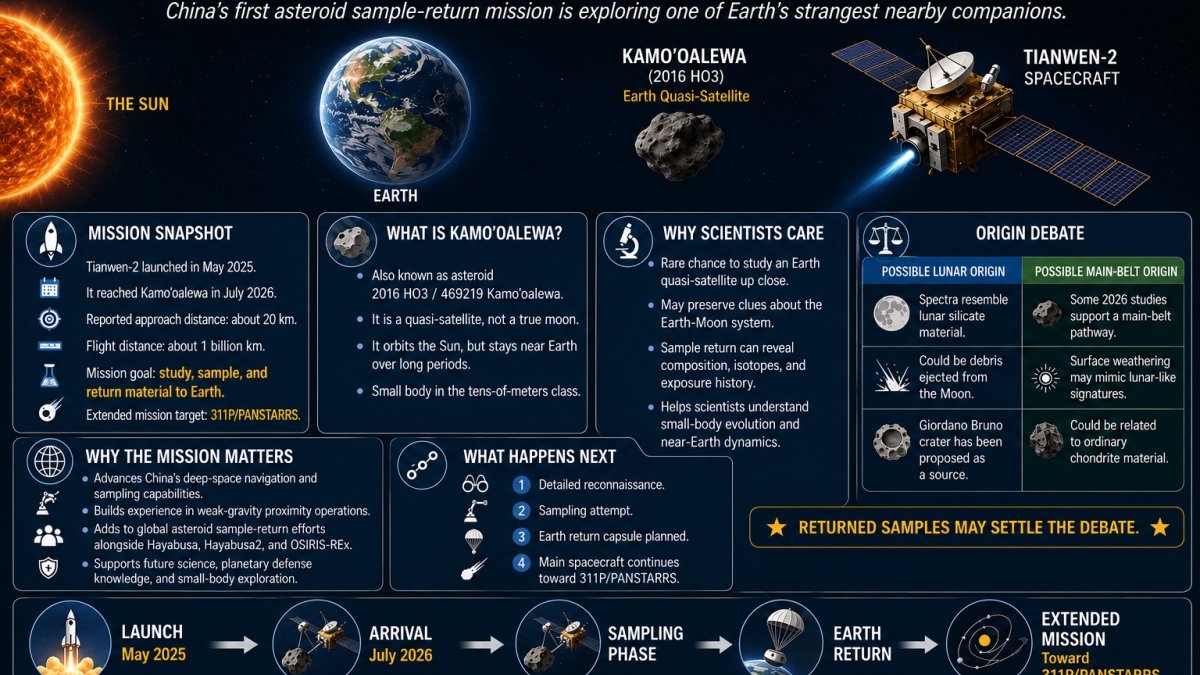
- Key Takeaways
- Why Kamoʻoalewa Became a Spacecraft Target
- What Tianwen-2 Has Reached in July 2026
- Why a Quasi-Moon Is Not a True Moon
- What the First Close Image Changes
- How the Sample Return Could Test the Lunar-Origin Hypothesis
- Why the Mission Matters for the Space Economy
- What Comes After Kamoʻoalewa
- How Kamoʻoalewa Changes the Meaning of Near-Earth Space
- Summary
- Appendix: Useful Books Available on Amazon
- Appendix: Top Questions Answered in This Article
- Appendix: Glossary of Key Terms
Key Takeaways
- Tianwen-2 is turning Kamoʻoalewa from a faint object into a sampled world.
- The asteroid may test competing theories about lunar debris and main-belt origins.
- Sample return gives China strategic experience for deeper space operations.
Why Kamoʻoalewa Became a Spacecraft Target
On July 2, 2026, China’s Tianwen-2 spacecraft imaged asteroid 2016 HO3, better known as Kamoʻoalewa, from about 20 km away after a flight of roughly 400 days and about 1 billion km. The China National Space Administration said the spacecraft had reached a safe distance from the asteroid and begun scientific exploration, making a small object once known mainly through telescopic points of light into a close-range spacecraft target.
Kamoʻoalewa is valuable because it sits in an unusual orbital category. It is not a moon in the ordinary sense. It does not orbit Earth the way the Moon does. Instead, it orbits the Sun in a path that keeps it near Earth for long periods, making it appear from Earth’s moving viewpoint as if it circles the planet. This class of object is known as a quasi-satellite. NASA’s Jet Propulsion Laboratory called 2016 HO3 a small asteroid whose orbit around the Sun keeps it as a constant companion of Earth, with a path stable enough to remain near the planet for centuries.
The target also matters because it may preserve a record of violent events in the Earth-Moon system. Ground-based spectra published in 2021 found that Kamoʻoalewa’s reflected light resembled lunar-like silicate material more than typical near-Earth asteroid material. Nature Communications Earth & Environment presented that lunar-like interpretation, and later modeling connected a possible origin to the Moon’s Giordano Bruno crater. If the returned grains support that idea, Kamoʻoalewa would become a rare physical sample from a fragment that left the Moon and survived in a Sun-centered orbit near Earth.
That possibility makes the mission useful for more than one scientific community. Lunar scientists want to know whether large impacts can send coherent fragments into long-lived Earth-co-orbital paths. Asteroid researchers want to know whether telescope-based classifications can reliably identify composition, surface maturity, and regolith properties on very small bodies. Mission designers want close-proximity experience near an object with weak gravity, rapid rotation, and uncertain surface texture. Space economy analysts see the mission as part of a broader movement in which sample return, deep-space navigation, and small-body operations migrate from rare national prestige projects toward repeatable strategic capabilities. New Space Economy has already treated Tianwen-2 reaches Kamoʻoalewa as a focused case study in China’s asteroid sample-return program.
What Tianwen-2 Has Reached in July 2026
Tianwen-2 launched in late May 2025 on a Long March 3B from the Xichang Satellite Launch Center, then spent about 400 days reaching the vicinity of asteroid 2016 HO3. By early July 2026, China reported that the probe had approached to about 20 km, close enough to begin detailed observations of morphology, material composition, and internal structure before later sample collection attempts. Space Policy Online recorded the launch details in May 2025, and the Chinese Academy of Sciences described the mission as China’s first asteroid sample-return effort.
Tianwen-2 follows China’s Chang’e lunar sample-return achievements and Tianwen-1’s Mars mission, but the engineering environment is different. A small asteroid has far weaker gravity than the Moon or Mars. A spacecraft cannot rely on a stable landing profile in the ordinary planetary sense. Surface material may behave more like dust, gravel, cohesive powder, or bouldery rubble, depending on the asteroid’s history. The spacecraft must approach, map, assess, sample, secure material, depart, and return a capsule to Earth without human repair options.
The mission also carries a second destination. After returning the Kamoʻoalewa sample capsule to Earth, the main spacecraft is planned to continue toward 311P/PANSTARRS, an active asteroid or main-belt comet-like object. That extended architecture gives China one mission with two separate scientific payoffs: a near-Earth object sample return and a later encounter with a body showing comet-like behavior inside the asteroid belt. New Space Economy’s guide to global space missions places missions like Tianwen-2 within a wider campaign of deep-space exploration, where sample return and multi-target mission design test national industrial depth as much as scientific ambition.
The mission’s July 2026 status also shows why small-body exploration is no longer only a matter of telescopes and flybys. The first close image gives mission controllers information about shape, brightness, surface roughness, possible slopes, and local hazards. These observations influence how close the spacecraft can safely operate, where sampling may be attempted, and how engineers judge the difference between modeled expectations and real terrain. Kamoʻoalewa’s small size makes every observation count because a minor mismatch in estimated rotation, surface cohesion, or local topography can affect proximity operations.
The table below summarizes the mission elements that shape the Kamoʻoalewa phase.
| Mission Element | Current Fact | Why It Matters |
|---|---|---|
| Target | 469219 Kamoʻoalewa, Also 2016 HO3 | A rare Earth quasi-satellite with uncertain origin |
| Reported Distance | About 20 km on July 2, 2026 | Close enough for detailed reconnaissance |
| Flight Time | About 400 days after launch | Shows deep-space navigation performance |
| Primary Goal | Sample Return From Kamoʻoalewa | Could test lunar-origin and asteroid-origin theories |
| Later Target | 311P/PANSTARRS | Extends mission value into the main belt |
Why a Quasi-Moon Is Not a True Moon
A true moon is gravitationally bound to a planet in the familiar sense. Earth’s Moon follows an orbit around Earth, even though the full Earth-Moon system also orbits the Sun. Kamoʻoalewa belongs to a different category. It follows a Sun-centered orbit with a period close to Earth’s year. From Earth’s moving reference frame, the asteroid appears to loop near the planet, but the Sun remains the dominant gravitational actor.
This distinction matters because popular descriptions can mislead readers. “Second moon” and “mini-moon” make strong headlines, but they can blur the difference between a temporary capture, a quasi-satellite, and a natural satellite. Kamoʻoalewa is better described as an Earth quasi-satellite or quasi-moon. That wording captures the orbital relationship without suggesting that Earth owns the object in the same way it owns the Moon.
NASA’s 2016 explanation noted that 2016 HO3 spends part of its orbit closer to the Sun than Earth and part farther away, causing its position to drift ahead and behind Earth in a stable-looking dance. Earth’s gravity keeps the asteroid from wandering too far in relative terms, yet the asteroid remains outside the kind of bound orbit expected for a true satellite. That combination makes Kamoʻoalewa scientifically attractive because it samples an orbital pathway close to Earth without being part of the Earth-Moon system in the normal sense.
Kamoʻoalewa is also hard to study from Earth. Small near-Earth objects are faint, fast-moving, and often visible only during favorable observing geometries. Even powerful telescopes can struggle to measure their shape and composition with certainty. Light curves can estimate rotation and elongation. Spectra can suggest surface materials. Thermal observations can constrain size and albedo. None of those techniques equals direct inspection from a spacecraft flying nearby.
That observing difficulty helps explain the scientific value of Tianwen-2. The spacecraft can collect images at many viewing angles, measure brightness changes directly, map surface features, and select candidate sampling sites. If the spacecraft returns material, laboratories can examine mineral grains, isotopes, exposure history, and space-weathering effects in ways telescopes cannot. New Space Economy’s discussion of why asteroid samples matter frames sample return as a shift from remote inference to physical evidence.
A quasi-moon also offers mission-design lessons. Near-Earth quasi-satellites can have relatively accessible trajectories compared with many main-belt objects, yet their small size and rapid spin can make operations difficult. That mix creates a useful test environment for future missions that may involve asteroid resource assessment, planetary-defense reconnaissance, or scientific surveys of small bodies that never become high-profile public names.
What the First Close Image Changes
The image released in July 2026 changes the status of Kamoʻoalewa from a modeled object to a visible world with a recognizable shape. Xinhua described the Tianwen-2 spacecraft as starting scientific exploration after reaching the asteroid, with observation work focused on morphology, composition, and internal structure before sample collection. The picture does not by itself settle the asteroid’s origin, but it marks the start of a phase in which physical detail can replace many assumptions.
For mission operators, shape is not cosmetic. Shape affects gravity distribution, surface slopes, illumination, thermal behavior, and sampling risk. A small elongated object can rotate quickly enough that surface material feels only a tiny effective downward pull. Loose grains may migrate or collect in certain regions. Cohesive material may stay attached in places where ordinary intuition would expect it to drift away. A compact boulder field, a dust layer, and exposed bedrock can all require different sampling tactics.
Scientific papers published before arrival show why the close image was so eagerly awaited. A June 2026 study of the physical characteristics of Kamoʻoalewa estimated a spin period of 28.4517 minutes and suggested a small S-type asteroid with a surface containing grains and small boulders. Another 2026 study modeled a fast-rotating body with dimensions near 68 m by 46 m by 39 m and surface grains smaller than 2 cm stable across much of the asteroid. These estimates may be refined as Tianwen-2 sends back direct observations from close range.
The first image also gives context to public debates over size. Earlier broad estimates often placed Kamoʻoalewa in the tens-of-meters class, with substantial uncertainty because brightness depends on both size and reflectivity. A 2026 James Webb Space Telescope study estimated a mean diameter of about 18 m, with a range near 15 m to 21 m, based on infrared observations. Those estimates suggest Kamoʻoalewa may be smaller than some older broad public ranges implied, but mission teams will refine the physical dimensions through spacecraft imaging.
Small size increases the engineering challenge. A 20 m object is comparable to a house or small building, yet Tianwen-2 must operate around it as a celestial body. The spacecraft has to judge relative motion, avoid collision, manage lighting, and sample without pushing itself into an unsafe path. Each operational step builds skill that can transfer to future missions. For China, that know-how connects civil science, deep-space communications, guidance and navigation, robotics, materials handling, and Earth-return systems.
How the Sample Return Could Test the Lunar-Origin Hypothesis
Kamoʻoalewa’s origin remains unresolved. The lunar-origin hypothesis gained attention because the asteroid’s spectrum looked unusually similar to weathered lunar silicates in 2021 observations. A 2024 Nature Astronomy paper then modeled how material ejected from the Moon’s Giordano Bruno crater could reach Earth’s 1:1 resonance and persist as a Kamoʻoalewa-like object. That work suggested the crater, about 22 km across and geologically young, as a plausible source.
The competing view has strengthened in 2026. Some dynamical studies and spectral reinterpretations support a main-belt pathway. One 2026 paper on Kamoʻoalewa’s possible origin estimated that main-belt models can account for Kamoʻoalewa-like objects more readily than Giordano Bruno ejecta. Another study proposed that Kamoʻoalewa may have an Itokawa-like, LL-chondrite composition with an ultra-weathered surface, possibly tied to the Flora family rather than the Moon. A James Webb Space Telescope analysis added another layer by finding colors less red than earlier observations and a spectrum compatible with several silicate-rich compositions.
That scientific disagreement makes Tianwen-2 more valuable. A returned sample could reveal oxygen isotopes, mineral chemistry, noble gas exposure ages, shock features, and space-weathering products. Lunar material, ordinary chondrite material, and other silicate-rich asteroid material can overlap in telescopic spectra, but laboratory work can separate many of those histories. The exact answer may still be complicated. A sample can reveal surface material, not necessarily the full body, and a tiny asteroid can have a surface changed by radiation, micrometeoroid impacts, thermal cycling, and dust loss.
The evidence categories can be grouped clearly.
| Evidence Type | Lunar-Origin Test | Main-Belt-Origin Test |
|---|---|---|
| Mineralogy | Matches lunar silicate signatures | Matches ordinary chondrite materials |
| Isotopes | Aligns with Earth-Moon chemistry | Aligns with meteorite groups |
| Shock History | Supports high-speed lunar ejection | Supports asteroid collision history |
| Exposure Age | Fits young lunar crater timing | Fits near-Earth transfer timing |
| Surface Weathering | Explains lunar-like spectral reddening | Explains altered chondrite spectra |
The result will matter even if the sample rejects the lunar-origin idea. A main-belt origin would still teach scientists how small objects migrate into Earth-like co-orbital states. It would also warn against overreading spectral similarity when surfaces are highly weathered. A lunar origin would support a more dramatic story: Earth’s neighborhood may contain fragments of the Moon that left during impacts and now occupy unusual Sun-centered paths. Either answer deepens the connection between lunar science, asteroid science, and near-Earth object surveys.
Why the Mission Matters for the Space Economy
Asteroid sample return is a science mission, but it also exercises technologies that sit inside the space economy. The same mission family needs launch services, spacecraft manufacturing, deep-space communications, autonomous navigation, thermal control, propulsion, robotics, ground operations, tracking networks, recovery teams, laboratory analysis, data systems, and international scientific distribution. Those layers make Kamoʻoalewa a small object with a large industrial footprint.
China’s model differs from the commercial-led space narratives common in the United States. Tianwen-2 is a state-led mission linked to national scientific and strategic capacity. It depends on institutions that combine government direction, state-owned aerospace prime contractors, universities, academies, and ground infrastructure. New Space Economy’s profile of China’s space program and its article on China Aerospace Science and Technology Corporation describe the institutional setting that makes missions like Tianwen-2 possible.
Deep-space communications deserve separate attention. A spacecraft operating near a tiny asteroid cannot function without precise tracking, command, telemetry, and data return. The farther the spacecraft travels, the more valuable large antennas, scheduling discipline, signal processing, and navigation expertise become. New Space Economy’s explanation of the Chinese Deep Space Network fits directly into Tianwen-2 because sample collection and later comet operations require sustained communications across large distances.
Commercial implications do not mean immediate asteroid mining. No responsible assessment should jump from a scientific sample of Kamoʻoalewa to near-term extraction markets. Small-body missions still build capabilities that could support later resource assessment, prospecting, and in-space operations. Companies interested in future space resources will watch how national missions characterize surface cohesion, regolith behavior, anchoring methods, and sampling reliability. New Space Economy’s overview of asteroid mining companies provides related market context, though Tianwen-2 itself remains a government scientific mission.
The mission also affects prestige and procurement. When a country demonstrates sample return from the Moon, Mars planning, asteroid operations, and long-duration comet exploration, it shows suppliers and research institutions that deep-space work is a repeatable program line. That can support workforce development, university programs, instrumentation teams, and domestic aerospace manufacturing. The payoff may emerge as capability accumulation rather than immediate revenue.
For global space activity, Tianwen-2 adds another national player to a field previously led by Japan and the United States. Japan’s Hayabusa returned asteroid Itokawa material in 2010, Hayabusa2 returned Ryugu material in 2020, and NASA’s OSIRIS-REx returned Bennu material in 2023. A 2026 review of asteroid sample-return science identified those delivered samples as central to studying planetary formation, organics, water delivery, and hazardous asteroid properties. Tianwen-2 would add a different target type to that record if the sample reaches Earth.
What Comes After Kamoʻoalewa
The Kamoʻoalewa phase is only part of Tianwen-2’s planned mission. The spacecraft is expected to study the asteroid, collect material, send a capsule back to Earth, and then continue toward 311P/PANSTARRS. That later object is often discussed because it shows comet-like activity despite occupying the main asteroid belt. A successful extended mission would let China compare a near-Earth quasi-satellite and a more distant active small body with one spacecraft architecture.
The near-term schedule remains dependent on mission operations. As of July 8, 2026, China has reported arrival at about 20 km and the start of scientific exploration. The sampling attempt, departure timing, Earth-return capsule delivery, and onward trajectory will depend on spacecraft health, surface reconnaissance, risk decisions, and operational success. Public sources have reported different projected dates for sample return, with many accounts pointing to 2027. Since mission dates can shift after close reconnaissance, precise future milestones should remain labeled as planned or expected rather than completed.
The scientific sequence after sample return may take years. Returned material must be recovered, documented, protected from contamination, curated, distributed, and examined by laboratories. Early announcements may identify broad composition, but deeper work can take longer. Researchers will likely compare Kamoʻoalewa material with Apollo and Luna lunar samples, Chang’e lunar samples, meteorite collections, Hayabusa and Hayabusa2 grains, and OSIRIS-REx Bennu material. Each comparison can refine the origin story.
The mission may also influence future mission selection. If Kamoʻoalewa proves lunar, survey teams may search more aggressively for Moon-derived near-Earth objects. If it proves main-belt in origin, researchers may refine models for how small asteroids enter Earth’s co-orbital region. Either result can guide future target lists for sample return, reconnaissance, and planetary-defense characterization. New Space Economy’s article on planned exploration missions places Tianwen-2 beside other sample-return efforts that could reshape how governments choose deep-space targets.
Kamoʻoalewa’s public value may also grow because it gives readers a concrete example of how space science works. A single image is dramatic, but the deeper story involves hypothesis, measurement, uncertainty, mission risk, and laboratory testing. The asteroid can be described in simple terms as a tiny companion of Earth, yet the science behind it touches orbital mechanics, impact physics, mineralogy, thermal modeling, and international mission strategy. That balance makes it one of the most useful small bodies for explaining the next phase of planetary exploration.
How Kamoʻoalewa Changes the Meaning of Near-Earth Space
Near-Earth space is often described through satellites, space stations, launch vehicles, and lunar missions. Kamoʻoalewa adds a different dimension: natural objects that share Earth’s orbital neighborhood without being part of the satellite economy. These objects matter because they can reveal how material moves between the Moon, Earth, the asteroid belt, and the inner Solar System. They also create practical targets for testing navigation and sampling in weak gravity.
The asteroid’s possible lunar connection is a reminder that the Earth-Moon system is not closed. Impacts can excavate material, accelerate it beyond escape velocity, and place fragments into heliocentric paths. Some fragments may later become meteorites. Others may become small near-Earth objects with unusual resonant behavior. A sample from Kamoʻoalewa could help show whether a piece of the Moon can spend millions of years as a companion-like asteroid before a spacecraft retrieves it.
Near-Earth object discovery will also change as survey systems improve. The Vera C. Rubin Observatory’s Legacy Survey of Space and Time is expected to strengthen discovery of small moving objects, including some that pass close to Earth. A 2026 study on imminent impactors estimated that the survey could discover about one to two meter-size or larger imminent impactors per year under simulated conditions. That work concerns impactors rather than quasi-satellites, but it shows how survey capacity can expand the known population of small near-Earth objects.
For policymakers, Kamoʻoalewa sits at the boundary between science and capability. It does not pose a threat to Earth in ordinary public-risk terms, and the mission is not a planetary-defense operation. Yet knowledge gained from small-body reconnaissance can support safer future interactions with asteroids. Surface behavior, rotation, shape, composition, and internal structure all matter when a spacecraft must approach or alter course near a small object. The knowledge base grows mission by mission.
For the space economy, the lesson is subtler. Markets often move slower than technology demonstrations, and technology demonstrations often depend on government investment before commercial demand appears. Tianwen-2 does not prove a resource market. It does show that another major space power is investing in the operational chain needed for small-body access. That chain can later feed science, prestige, security planning, industrial policy, and commercial experiments.
Summary
Kamoʻoalewa matters because it is small enough to be difficult, close enough to be reachable, and strange enough to test more than one theory. Tianwen-2’s July 2026 close-range image marks the start of a mission phase that can replace years of inference with spacecraft data. If sample return succeeds, laboratory analysis could show whether the asteroid is lunar debris, main-belt material, or a more complicated mixture shaped by space weathering and orbital transport.
China’s mission also shows how deep-space competence is built. The target may measure only tens of meters, but the operational system behind it spans launch, robotics, communications, recovery, curation, and science. That makes Kamoʻoalewa a scientific target and a capability test. Its value lies in what it can reveal about the Earth-Moon system, the movement of small bodies, and the growing number of nations able to conduct ambitious sample-return missions.
Appendix: Useful Books Available on Amazon
- Asteroids: Relics of Ancient Time
- Asteroids IV
- Asteroids and Dwarf Planets and How to Observe Them
- Near-Earth Objects: Finding Them Before They Find Us
- Asteroids, Meteorites, and Comets, Revised Edition
Appendix: Top Questions Answered in This Article
What Is Kamoʻoalewa?
Kamoʻoalewa is asteroid 469219, also known as 2016 HO3. It is a small near-Earth object that orbits the Sun in a path closely matched with Earth’s orbit. From Earth’s moving viewpoint, it appears to remain near the planet for long periods, which is why it is called a quasi-satellite.
Is Kamoʻoalewa Really a Moon of Earth?
Kamoʻoalewa is not a true moon. It does not orbit Earth the way the Moon does. It orbits the Sun, but its orbital period and geometry keep it near Earth. “Quasi-moon” is a useful shorthand, but “Earth quasi-satellite” is more accurate.
What Did Tianwen-2 Do in July 2026?
Tianwen-2 approached Kamoʻoalewa to about 20 km and began scientific exploration after a flight of about 400 days and about 1 billion km. China released imagery taken from close range, giving scientists and the public the first detailed look at the target asteroid.
Why Does China Want a Sample From Kamoʻoalewa?
A sample could reveal whether Kamoʻoalewa came from the Moon, the main asteroid belt, or another source. Laboratory analysis can test mineral composition, isotopes, exposure history, and surface alteration more precisely than telescopic observations can.
Could Kamoʻoalewa Be a Piece of the Moon?
Several studies support the possibility that Kamoʻoalewa may be lunar material ejected by an ancient impact. Other studies support a main-belt asteroid origin. The returned sample, if recovered successfully, may give the strongest test of those competing explanations.
How Big Is Kamoʻoalewa?
Public estimates have varied because small asteroids are hard to measure from Earth. Some recent analyses place the object in the tens-of-meters class, and the July 2026 close image suggests a small, irregular body. Spacecraft observations should refine the measurement.
Why Is Sampling a Tiny Asteroid Hard?
A tiny asteroid has extremely weak gravity. Its surface may include dust, gravel, boulders, or cohesive grains. Rapid rotation can further complicate operations. The spacecraft must approach carefully, assess terrain, collect material, and depart without creating unsafe motion.
How Does Tianwen-2 Compare With Hayabusa and OSIRIS-REx?
Japan’s Hayabusa and Hayabusa2 missions returned samples from Itokawa and Ryugu. NASA’s OSIRIS-REx returned samples from Bennu. Tianwen-2 would add China to the group of nations that have returned asteroid material if its sample capsule reaches Earth successfully.
What Happens After Tianwen-2 Samples Kamoʻoalewa?
The mission plan calls for a sample capsule to return to Earth, followed by the main spacecraft continuing toward 311P/PANSTARRS. That later target shows comet-like activity in the asteroid belt, giving Tianwen-2 a second scientific destination.
Why Does Kamoʻoalewa Matter for the Space Economy?
Kamoʻoalewa matters because the mission tests technologies needed for deep-space operations. Navigation, robotics, sample handling, communications, recovery, and curation all support broader space capabilities. The mission does not create an asteroid-resource market by itself, but it expands operational knowledge.
Appendix: Glossary of Key Terms
Kamoʻoalewa
Kamoʻoalewa is the named near-Earth asteroid 469219, also known by its provisional designation 2016 HO3. It is a small object in a Sun-centered orbit that keeps it near Earth for long periods, making it a target for China’s Tianwen-2 sample-return mission.
Quasi-Satellite
A quasi-satellite is an object that orbits the Sun with a period similar to a planet’s orbit and appears to loop near that planet from the planet’s viewpoint. It is not a true moon because the planet does not gravitationally bind it in the usual satellite sense.
Tianwen-2
Tianwen-2 is China’s asteroid sample-return and comet-exploration mission launched in 2025. Its first target is Kamoʻoalewa, where it is expected to study the asteroid closely and attempt sample collection before sending material back to Earth.
Sample Return
Sample return means collecting physical material from another celestial body and bringing it to Earth for laboratory analysis. It gives scientists access to instruments, methods, and repeatable tests that cannot be placed fully on a spacecraft.
Near-Earth Object
A near-Earth object is an asteroid or comet whose orbit brings it into Earth’s broader orbital neighborhood. These objects vary widely in size, composition, origin, and risk, and most known near-Earth objects do not pose any immediate danger to Earth.
Regolith
Regolith is loose surface material made of dust, grains, pebbles, and broken rock. On asteroids, regolith behavior can differ from familiar soil because gravity is weak, surfaces are exposed to radiation, and impacts continually modify the material.
Space Weathering
Space weathering refers to changes in surface material caused by radiation, solar wind, micrometeoroid impacts, and thermal cycling. It can alter color, reflectivity, and spectral signatures, making remote identification of asteroid or lunar materials more difficult.
Giordano Bruno Crater
Giordano Bruno crater is a young crater on the Moon’s far side. Some researchers have proposed it as a possible source of Kamoʻoalewa if a past impact ejected lunar material into a path that later became an Earth quasi-satellite orbit.
311P/PANSTARRS
311P/PANSTARRS is the planned later target for Tianwen-2 after the Kamoʻoalewa sample-return phase. It is often discussed as an active asteroid or main-belt comet-like object because it has shown dust activity despite being located in the asteroid belt.
Deep-Space Network
A deep-space network is a system of large antennas, communication facilities, and tracking systems used to contact spacecraft far from Earth. Missions like Tianwen-2 require such networks for navigation, command, telemetry, and scientific data return.