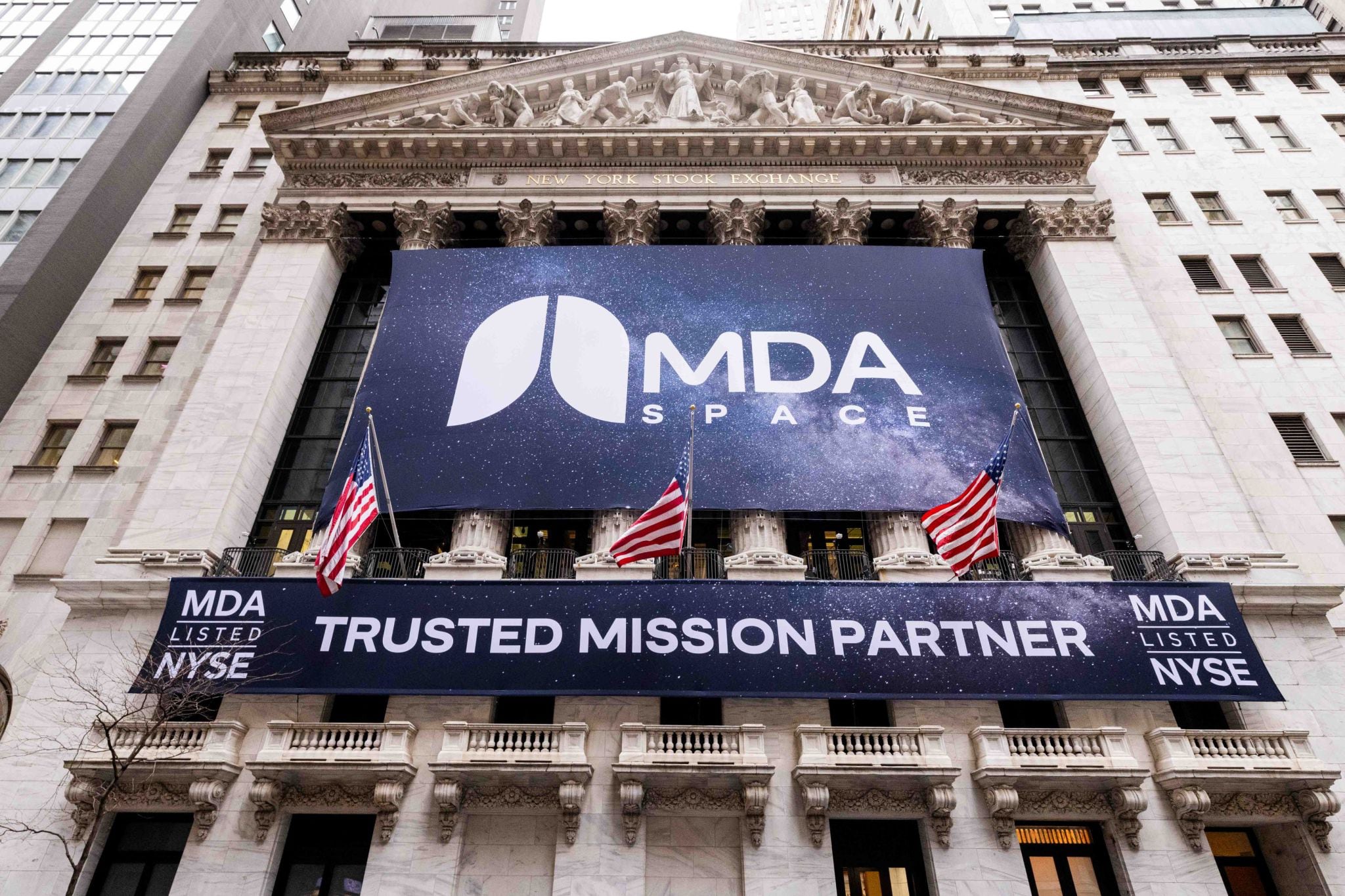
MDA Space is now trading on the New York Stock Exchange (TSX:MDA, NYSE:MDA) after making a total of 9,836,065 Common Shares available at US$30.50 raising US$300 (CAD$410) million in its Initial Public Offering (IPO). The new U.S. listing joins its previous listing on the Toronto Stock Exchange.
The company reports that the IPO was “led by J.P. Morgan and RBC Capital Markets, as joint lead active bookrunners, and BMO Capital Markets, Deutsche Bank Securities, Jefferies, Scotiabank, and Canaccord Genuity, as joint active bookrunners.”
MDA Space said it “intends to use the net proceeds of the Offering to allow the Company to pursue its growth strategies, including expanding its customer base and solutions, supporting the growth of existing customers, and pursuing other strategic opportunities, which may include acquisitions or investments. MDA Space may also use a portion of the net proceeds of the Offering for general corporate purposes, including the repayment of a portion of amounts outstanding under the Company’s existing credit facilities.”
Facts Only
MDA Space completed an Initial Public Offering (IPO) on the New York Stock Exchange (NYSE: MDA).
The company issued 9,836,065 common shares at US$30.50 per share.
The IPO raised US$300 million (CAD$410 million).
MDA Space is also listed on the Toronto Stock Exchange (TSX: MDA).
The IPO was led by J.P. Morgan and RBC Capital Markets as joint lead active bookrunners.
Additional joint active bookrunners included BMO Capital Markets, Deutsche Bank Securities, Jefferies, Scotiabank, and Canaccord Genuity.
Net proceeds from the offering will be used for growth strategies, including expanding the customer base and pursuing acquisitions or investments.
A portion of the proceeds may be used for general corporate purposes, including repaying existing credit facilities.
The company has not specified a timeline for the use of the funds.
The IPO follows MDA Space’s existing listing on the Toronto Stock Exchange.
Executive Summary
MDA Space has successfully completed its Initial Public Offering (IPO), raising US$300 million (CAD$410 million) by issuing 9,836,065 common shares at US$30.50 per share. The company is now dual-listed on both the New York Stock Exchange (NYSE: MDA) and the Toronto Stock Exchange (TSX: MDA). The IPO was underwritten by a consortium of financial institutions, including J.P. Morgan and RBC Capital Markets as joint lead bookrunners, alongside BMO Capital Markets, Deutsche Bank Securities, Jefferies, Scotiabank, and Canaccord Genuity. MDA Space plans to allocate the net proceeds toward growth initiatives, such as expanding its customer base, supporting existing clients, and pursuing strategic opportunities like acquisitions or investments. A portion of the funds may also be used for general corporate purposes, including repaying outstanding debt under existing credit facilities.
The move reflects MDA Space’s strategic effort to strengthen its market position and access broader capital markets. While the company has outlined clear objectives for the raised capital, the long-term impact of these investments remains uncertain. The involvement of multiple high-profile underwriters suggests confidence in MDA Space’s prospects, though market conditions and execution risks will ultimately determine success.
Full Take
The strongest version of this narrative presents MDA Space’s IPO as a strategic milestone, signaling confidence from major financial institutions and positioning the company for expansion in the competitive space sector. The dual listing on NYSE and TSX broadens its investor base, while the stated use of proceeds—growth, acquisitions, and debt repayment—aligns with typical corporate objectives. The involvement of high-profile underwriters lends credibility, suggesting market validation of MDA Space’s business model.
However, the narrative leans on authority games (ARC-0012 Appeal to Authority) by emphasizing the prestige of the underwriters without addressing potential risks or alternative interpretations. The lack of specificity about how the funds will be deployed—beyond broad categories like "growth strategies"—could be seen as ambiguity (ARC-0024 Ambiguity), leaving room for unchecked assumptions about execution. The framing also subtly reinforces a pro-growth paradigm, where expansion and acquisitions are presented as inherently positive without critiquing the long-term sustainability or ethical implications of such strategies.
Root cause: This narrative reflects the dominant financialization paradigm, where public listings and capital raises are framed as unqualified successes, often overlooking the pressures they impose on companies to prioritize shareholder returns over other stakeholders. The unstated assumption is that growth—via acquisitions or market expansion—is the primary path to value creation, echoing historical patterns of corporate consolidation in aerospace and defense sectors.
Implications: For human agency, this IPO could empower MDA Space to innovate and compete globally, potentially advancing space technology. However, the focus on financial metrics may sideline broader societal impacts, such as labor practices or the militarization of space. Shareholders and executives stand to benefit from increased valuation, while employees, taxpayers (if government contracts are involved), and communities near operations may bear unmentioned costs.
Bridge questions: What specific technologies or markets will MDA Space target with these funds, and how might these choices affect geopolitical dynamics in space? How does the company’s dual listing strategy mitigate risks, and what vulnerabilities might it introduce? If MDA Space pursues acquisitions, how will it balance integration challenges with innovation?
Counterstrike scan: A coordinated influence campaign might amplify the IPO as a "vote of confidence" in the space industry, using underwriter prestige to suppress skepticism about MDA Space’s long-term viability. The actual content aligns partially with this pattern but lacks overt manipulation, focusing instead on factual reporting. No structural red flags detected.
Patterns detected: ARC-0012 Appeal to Authority, ARC-0024 Ambiguity
Sentinel — Human
The article shows strong signs of human origin, with natural sentence structure and specific, verifiable details typical of financial reporting.