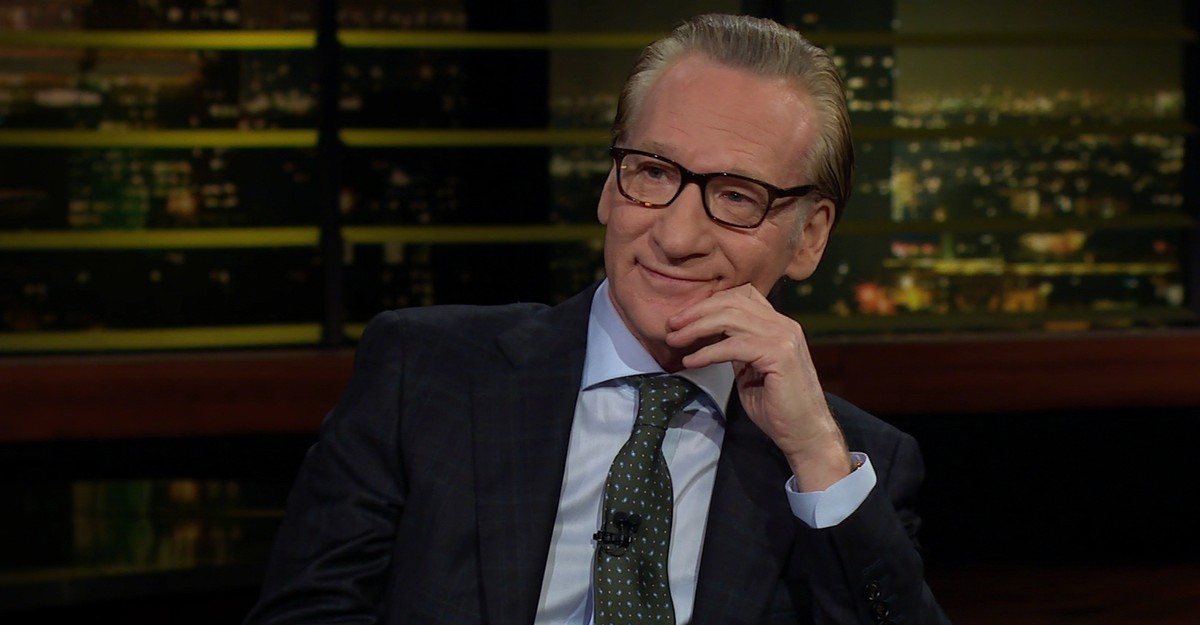
For the past year, Donald Trump has made the Kennedy Center all about him. Last night, the comedian revealed the limits of that approach.
For 13 months, President Trump has been the chairman, muse, occasional programmer, and featured artist at the John F. Kennedy Center for the Performing Arts. His centrality—perhaps even more than his name on the building—helps explain why so many acts have abandoned the Washington, D.C., arts complex. (The most recent, the New York City Ballet, didn’t need to explain itself when it dropped a six-show run this week.)
Trump is undoubtedly on his way to remaking the Kennedy Center in his image. But his stewardship also imposes constraints on him, as became clear during the recent back-and-forth between the White House and the comedian Bill Maher, who the center said will receive this year’s Mark Twain Prize for American Humor. Occasionally, someone else gets to be the main character—in this case, a person from that prickliest of artistic mediums, comedy.
My colleague Ashley Parker and I reported last week that Maher was the choice for this year’s prize, one of comedy’s highest honors, according to several people familiar with the selection. But within a few hours, White House Press Secretary Karoline Leavitt said in a statement: “This is fake news. Bill Maher will NOT be getting this award.” White House Communications Director Steven Cheung posted on X that the story was “literally FAKE NEWS.” As Ashley and I wrote, after our article was published, the White House called the Kennedy Center to make clear that Maher would not receive the award. One Kennedy Center staffer described a sudden change of plans.
On Thursday, the Kennedy Center announced that Maher is, indeed, this year’s Twain recipient. Maher addressed the reversal last night on his HBO show, Real Time: “So, I was gonna get it and then Friday, Trump’s—both his spokespeople—come out and say, Fake news; Bill Maher’s never getting it.” He went on: “We have reached a compromise, okay? And the compromise is, I am going to get it, and then I am going to give it to him. Everybody’s happy.”
Is everybody happy? It was a revealing monologue, suggesting why the White House may have been reluctant to let a punchy comic—one without much reverence for the president—receive this prize in a venue that lately would seem to have room for only one name on the marble facade.
In some ways, the activity at the Kennedy Center has been business as usual since Trump took over in February 2025: orchestra concerts, Broadway tours, free concerts for families. But it has also been the setting for a sustained work of performance by Trump.
It began last March with some storytelling, when the president convened his loyalist board at the center. In audio that leaked to reporters, he imagined reshaping the annual Kennedy Center Honors ceremony to suit his preferences, and floated names such as Sylvester Stallone and Paul Anka. At past awards shows, “these are radical-left lunatics that have been chosen,” he said. “I didn’t like it. I couldn’t watch it. And the host was always terrible.” Most years, the Kennedy Center announced the winners of its most prestigious prize in newspaper exclusives and a press release. But by August, Trump had returned to the center to reveal not only the recipients (including Stallone), but also that he had personally approved the choices and would serve as the event’s emcee.
Trump’s taste became an even louder presence at the Kennedy Center as the year went on. He held a high-dollar fundraiser during the opening night of Les Misérables, a musical in keeping with the Trumpian aesthetic: big, populist, and a product of the ’80s. He televised Kennedy Center board meetings as though they were episodes of The Apprentice, and even invoked his catchphrase at the most recent one: “I think he’d do a good job,” Trump said of the center’s newly installed top executive, Matt Floca. “But if I don’t think he will do a good job, I’ll say, Matt, you’re fired.” He weighed in personally on Kennedy Center–renovation decisions, posting potential design choices (such as marble armrests) on Truth Social and ordering the gold-hued exterior columns to be repainted white. At the Kennedy Center, Trump was a mogul, impresario, and master builder all at once.
The president conducted his politics and extended his personal brand at the center. He insisted on moving FIFA’s World Cup draw to the Kennedy Center; at the December event, the federation’s president bestowed Trump with a made-up award, the FIFA Peace Prize. He rallied the troops at a Republican congressional retreat there in January. Melania, a critical dud of a vanity documentary about the first lady, had its world premiere at the venue. No amount of squinting could let the public pretend that this was still a normal arts center known for drawing bipartisan crowds.
At the Kennedy Center Honors in December, Trump held court on the red carpet and during the ceremony; it was another opportunity to assert his dominance over the institution. Speaking to reporters, he joked that he might nominate himself in 2027. Onstage, he abandoned the host’s creed of putting an audience at ease. “So many people I know in this audience—some good, some bad,” Trump said. “Some I really love and respect. Some I truly hate. But they’re having a good time.”
For the Honors, the Kennedy Center managed to program an evening compatible with Trump’s ongoing cultural project: The talents were by varying degrees Trumpy, but none of them felt too dissonant with the event’s actual star attraction. A comedy show—almost any comedy show—is a different creature. To make a more subservient pick such as, say, the Fox News late-night host Greg Gutfeld (whose name was reportedly floated) would be almost too heavy-handed. It would suggest that this most personalist of presidential administrations doesn’t just demand obeisance, but also that it can’t take a joke.
The question of whether the president can take a joke has driven a surprising number of his controversies. Trump has a lengthy and mostly venomous history with Maher, but the two broke bread last year, only to engage in an insult war last month. The former Politically Incorrect host makes some sense for a Trump-era Twain Prize, the ceremony of which will be streamed on Netflix later this year. The comedian is as well known for critiquing liberal pieties and “woke” culture as he is for poking fun at those in power, and he’ll give the president credit on certain issues.
“I’m not mad that he did this,” Maher said of the temporary rescinding of his prize. “Me and the president, we have a complicated relationship,” he noted. “Him trying to block me from getting it? I respect the move. Keep the game going, baby, okay?” Addressing Trump directly, he added: “You can thank me in person for being one of the few people on the ‘lunatic left’ who’s glad you hit Iran and is hoping we win that one.”
Maher’s selection illustrates that Trump’s Kennedy Center has never quite been as censorious as some critics assumed. Most of the high-profile cancellations, after all, have come from artists trying to dissociate from Trump’s self-branded marble shoebox on the Potomac. (At the same time, the center has shed staffers tasked with diversifying programming, and even sued one jazz artist for canceling a concert.)
In his way, Trump respects comedians. It’s why he insults Jimmy Kimmel and Stephen Colbert, and perhaps even why his Federal Communications Commission has gotten into scraps with networks over their late-night programming. An anti-elitist elite, Trump may simply crave their approbation and respect. Maher is willing to dispense the rare drop of it. But I doubt that will keep Trump safe on Maher’s big night.
Facts Only
Donald Trump has served as chairman of the John F. Kennedy Center for the Performing Arts since February 2025.
The New York City Ballet canceled a six-show run at the Kennedy Center this week.
The Kennedy Center announced Bill Maher as the recipient of the 2025 Mark Twain Prize for American Humor.
White House Press Secretary Karoline Leavitt and Communications Director Steven Cheung denied Maher’s selection, calling reports "fake news."
The Kennedy Center later confirmed Maher as the award recipient.
Trump has influenced Kennedy Center programming, including selecting honorees like Sylvester Stallone and hosting events such as a Republican congressional retreat.
Trump held a fundraiser during the opening night of *Les Misérables* and televised Kennedy Center board meetings.
The Kennedy Center Honors ceremony in December 2024 featured Trump as host and included figures aligned with his cultural preferences.
Trump has made design decisions for the Kennedy Center, such as repainting exterior columns white.
The Kennedy Center has faced staff reductions, including those tasked with diversifying programming.
Bill Maher and Trump have a history of public disputes but have also engaged in dialogue.
The Mark Twain Prize ceremony will be streamed on Netflix later in 2025.
Executive Summary
Since February 2025, President Donald Trump has taken an active role in reshaping the John F. Kennedy Center for the Performing Arts, serving as its chairman and influencing programming, design, and events. His involvement has led to high-profile cancellations, including the New York City Ballet, and a shift toward Trump-aligned cultural figures, such as Sylvester Stallone and Paul Anka, for the Kennedy Center Honors. The center has also hosted political events, fundraisers, and even a vanity documentary premiere, blurring its traditional bipartisan arts mission.
The recent controversy over the Mark Twain Prize for American Humor highlights tensions between Trump’s influence and the center’s independence. After reports that comedian Bill Maher would receive the award, the White House denied it, only for the Kennedy Center to later confirm Maher as the recipient. Maher, known for critiquing both liberal and conservative figures, acknowledged the back-and-forth as a "compromise," suggesting he would accept the award and humorously offer it to Trump. The episode underscores the limits of Trump’s control over the institution, even as he continues to reshape it in his image.
Full Take
The strongest version of this narrative highlights the tension between institutional autonomy and political influence, with Trump’s stewardship of the Kennedy Center serving as a microcosm of broader cultural polarization. The article effectively documents how Trump’s personal brand and political agenda have reshaped a traditionally bipartisan arts institution, leading to cancellations, staff changes, and programming shifts. The back-and-forth over Bill Maher’s award underscores the limits of Trump’s control, even as he dominates the center’s public image. The piece deserves credit for presenting multiple perspectives—acknowledging Trump’s respect for comedians while noting the center’s erosion of diversity initiatives.
Pattern scan: The narrative leans into a framing of Trump as an overbearing figure, which could risk caricature, but the inclusion of Maher’s own words and the center’s eventual confirmation of his award adds nuance. The focus on "fake news" denials from the White House may trigger emotional responses from readers already polarized on Trump, but the article avoids outright distortion by presenting the sequence of events clearly. No clear manipulation patterns are detected beyond the inherent tension in covering a polarizing figure.
Root cause: The paradigm here is the collision of institutional legacy and personalist leadership. The Kennedy Center, historically a symbol of bipartisan cultural prestige, is being recast as an extension of Trump’s brand, reflecting a broader trend of politicizing neutral spaces. The unstated assumption is that arts institutions must either resist or submit to such influence, with little middle ground.
Implications: The erosion of the Kennedy Center’s bipartisan identity could further fragment cultural spaces, leaving fewer neutral grounds for artistic expression. Artists and audiences may increasingly self-censor or disengage, while those who align with Trump’s vision gain prominence. The second-order consequence is a potential chilling effect on satire and dissent, even as figures like Maher navigate the space with ironic detachment.
Bridge questions: How might other cultural institutions navigate similar pressures without losing their independence? What role should satire play in an era where political figures openly attempt to control narrative spaces? Would the Kennedy Center’s trajectory differ under a leader with a less polarizing brand?
Counterstrike scan: If this were a coordinated influence campaign, the playbook would involve amplifying Trump’s dominance over the Kennedy Center while framing resistance as partisan obstruction. The actual content does not match this pattern; it presents a balanced account of institutional shifts and pushback, avoiding overt propaganda. The focus on Maher’s award controversy serves as a case study rather than a weaponized narrative.
Patterns detected: none