Brendan Bell is COO and co-founder of Aligned Climate Capital.
Leaders across technology, politics and climate finance are all converging on the same conclusion: The U.S. lacks sufficient electricity supply to meet emerging demand. OpenAI has warned that AI-driven load growth could exceed available capacity, and hyperscale data centers are increasingly expected to supply their own power. Leaders at major utilities have echoed this concern, warning that grids are already strained as they brace for looming supply shortfalls.
The current administration has emphasized the need for a significant expansion of U.S. power infrastructure, even as some projects face delays or cancellation. Energy transition and infrastructure investors voice similar concerns, emphasizing the need for clean electricity to maintain economic competitiveness.
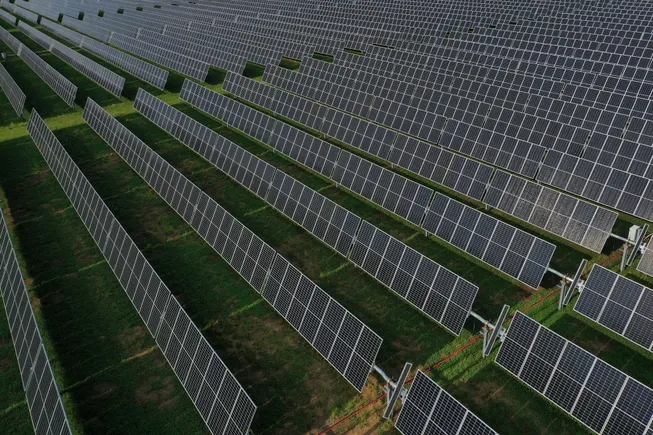
For institutional investors, the central question is which resources will realistically be built in the near term. Recent data provides a clear signal: More than 40 GW of solar was installed across the U.S in 2025, which was 54% of all new electricity-generating capacity added last year, according to the Solar Energy Industries Association. Combined, solar and storage made up 79% of new capacity over the same period, it said.
Despite a slowdown in the fourth quarter due to policy changes, these figures highlight the continued role of solar and storage as the primary sources of incremental capacity.
From emerging technology to essential capacity
The U.S. reached its first gigawatt of installed solar capacity just over a decade ago. Since then, solar has moved from an emerging technology to the fastest-growing source of new power generation, driven in part by an approximately 90% decline in the levelized cost of electricity. What began as an emerging technology is now a mature, standardized infrastructure sector.
Yet discussion continues about whether the U.S. is seeing a “clean energy slowdown,” based on interest rates, permitting bottlenecks and supply chain volatility. While these factors affect project timelines, they do not alter the industry's underlying trajectory. Almost 70 GW of new solar projects are scheduled to come online by 2027, according to the Energy Information Administration, while utility-scale energy storage projects are poised to more than double to reach 65 GW in the next two years.
Economic fundamentals continue to support this growth. In addition to being the fastest-growing source of electricity, solar remains the least expensive form of new generation in the U.S. Even amid macroeconomic volatility, the long-term cost trend appears to remain favorable for solar relative to fossil generation and emerging clean energy technologies. Energy storage costs are also on a downward trajectory, with the capital cost for a 4-hour battery system projected to fall to $245/kW-hour by 2030 and $159/kW-hour by 2050.
Global markets show a similar pattern. Solar installations globally reached 380 GW in the first half of 2025, rising 64% year over year. These results point to continued expansion, even as developers navigate short-term variability.
Demand growth
While supply is increasing, electricity demand is rising even faster. The U.S. is entering a period of structural load growth driven by data centers, advanced computing, industrial reshoring and transportation electrification. Forecasts show that U.S. data center load alone could reach more than 100 GW by 2035.
Utilities across multiple regions report that requests for new service from data center operators and industrial facilities are arriving earlier and in greater volume than expected. These trends are putting additional pressure on a grid operating near capacity and under reliability pressures. The central challenge is securing reliable power on accelerated timelines.
Meeting accelerated load growth requires technologies that can be financed, permitted, and deployed on short timelines at scale. The U.S. will certainly build new combined-cycle natural gas plants, but supply chains for new gas turbines are limited, and many turbines ordered today will not be delivered until 2032. Likewise, newer technologies like advanced nuclear, geothermal and long-duration storage still face commercialization hurdles and construction timelines that make it unlikely they will contribute significantly to U.S. electricity needs before 2030.
Solar and existing storage technology can meet those needs. These technologies are modular, proven and supported by well-established financing structures. And while interconnection and transmission remain challenges, solar and storage projects generally maintain shorter, more reliable construction timelines than other power generation sources, allowing them to meet demand as it accelerates. These characteristics, along with predictable performance, make these resources attractive to investors.
The investor perspective
Infrastructure investors evaluate opportunities based on risk, return and credible deployment pathways. Solar and storage measure up to their scrutiny on those factors. Long-term revenue contracts, declining technology cost and robust supply chains support stable portfolio performance, while storage enhances system dispatchability and enables additional revenue streams.
Investor behavior reflects this assessment. Global investment in the energy transition totaled $2.3 trillion in 2025, with about $1.2 trillion allocated to renewable energy and power grids. Capital is flowing toward technologies that can scale quickly, deliver predictable cash flows and align with load growth, all conditions that favor solar and storage.
These technologies also generate benefits that extend beyond electricity supply. Distributed solar and storage improve local resilience, support employment and provide communities with more stable energy costs. Recent data from Aligned Climate Capital’s inaugural impact report provides an example: The firm’s investments produced more than 1 million megawatt-hours of clean electricity and avoided hundreds of thousands of tons of carbon emissions.
Taken together, these signals show why solar and storage have become established components of today’s infrastructure investment landscape.
A clear market signal
The U.S. power system is entering a decade in which speed to market and reliability matter as much as the type of generation built. Rising electricity demand has created a market where near-term, scalable capacity is at a premium. The question is no longer whether additional generation is needed, but which technologies can be deployed fast enough to supply it.
Solar and storage have become the practical answer. Their development timelines, financing structures and operational performance position them to deliver the capacity the grid requires at the pace the economy demands. Across the technology, policy, and investment communities, incentives are now aligned. Each depends on a power system capable of supporting rapid growth, and each stands to benefit from efforts that accelerate the availability of dependable capacity. Today, no resources are better positioned to meet that need than solar and storage.
Facts Only
Brendan Bell is COO and co-founder of Aligned Climate Capital.
OpenAI has warned that AI-driven electricity demand could exceed available U.S. grid capacity.
Hyperscale data centers are increasingly expected to supply their own power.
U.S. utilities report grids are strained, with looming supply shortfalls anticipated.
In 2025, over 40 GW of solar was installed in the U.S., representing 54% of all new electricity-generating capacity.
Solar and storage combined made up 79% of new U.S. capacity in 2025.
The U.S. installed its first gigawatt of solar capacity just over a decade ago.
Solar costs have declined approximately 90% over the past decade.
The Energy Information Administration projects nearly 70 GW of new solar capacity by 2027.
Utility-scale energy storage is expected to more than double to 65 GW in the next two years.
Global solar installations reached 380 GW in the first half of 2025, a 64% year-over-year increase.
U.S. data center load could exceed 100 GW by 2035.
New combined-cycle natural gas plants face supply chain constraints, with turbines ordered today not arriving until 2032.
Advanced nuclear, geothermal, and long-duration storage are unlikely to contribute significantly before 2030.
Global investment in the energy transition totaled $2.3 trillion in 2025, with $1.2 trillion allocated to renewables and power grids.
Executive Summary
Full Take
**STEELMAN:** The narrative presents a compelling case for solar and storage as the most viable near-term solutions to the U.S. electricity crisis. It grounds its claims in hard data—solar’s dominance in new capacity, cost declines, and investor confidence—while acknowledging real constraints like permitting delays and supply chain issues. The argument avoids hyperbole, instead framing solar and storage as pragmatic choices given the urgency of demand growth and the slow deployment timelines of alternatives like gas and nuclear. The piece also highlights broader benefits, such as job creation and grid resilience, which appeal to both economic and environmental priorities.
**PATTERN SCAN:** The analysis avoids overt manipulation, but a few subtle framing choices warrant attention. The emphasis on solar and storage as the *only* scalable solutions could be seen as a false binary, downplaying the role of other technologies (e.g., gas, nuclear) that may still be necessary for grid stability. The repeated citation of industry projections (e.g., 100 GW data center load by 2035) leans on authority without interrogating the assumptions behind those forecasts. Additionally, the focus on investor behavior as validation risks conflating market trends with optimal policy outcomes—a classic appeal to popularity (ARC-0012 Bandwagon Fallacy). That said, the piece avoids emotional exploitation or bad-faith tactics, presenting its case with data-driven restraint.
**ROOT CAUSE:** The underlying paradigm is one of technological pragmatism: the belief that market-ready solutions should dictate energy policy, even if they’re imperfect. This reflects a broader shift in climate discourse, where urgency trumps ideological purity. The unstated assumption is that solar and storage can single-handedly bridge the gap between demand and supply—a claim that may underestimate the complexity of grid reliability and the need for dispatchable power.
**IMPLICATIONS:** For human agency, this narrative empowers investors and developers to act quickly but risks sidelining communities affected by rapid deployment (e.g., land-use conflicts, local opposition). The beneficiaries are clear: solar/storage industries, tech companies needing power, and investors seeking stable returns. The costs—potential grid instability, over-reliance on intermittent sources, or stranded assets if better tech emerges—are less discussed. Second-order consequences include accelerated industrial reshoring (if power is secured) or economic slowdowns if deployment lags.
**BRIDGE QUESTIONS:**
If solar and storage are the fastest solutions, what safeguards ensure they don’t lock in inefficiencies or crowd out breakthroughs in nuclear/geothermal?
How do we reconcile the urgency of deployment with the need for community consent and equitable distribution of benefits?
What would it take for gas or nuclear to become viable complements rather than competitors in this timeline?
**COUNTERSTRIKE SCAN:** A coordinated influence campaign pushing this narrative would likely amplify the "only viable solution" framing while suppressing discussion of trade-offs (e.g., land use, grid stability). It might also exaggerate the risks of alternatives (e.g., nuclear safety, gas emissions) to create a sense of inevitability around solar/storage. The actual content doesn’t match this pattern—it acknowledges constraints and avoids demonizing other technologies. The tone is pragmatic, not propagandistic.
Patterns detected: ARC-0012 Bandwagon Fallacy (appeal to investor trends as validation)
Sentinel — Human
The article shows strong signs of human authorship, with a clear perspective, nuanced arguments, and specific sourcing, though some forward-looking claims warrant verification.