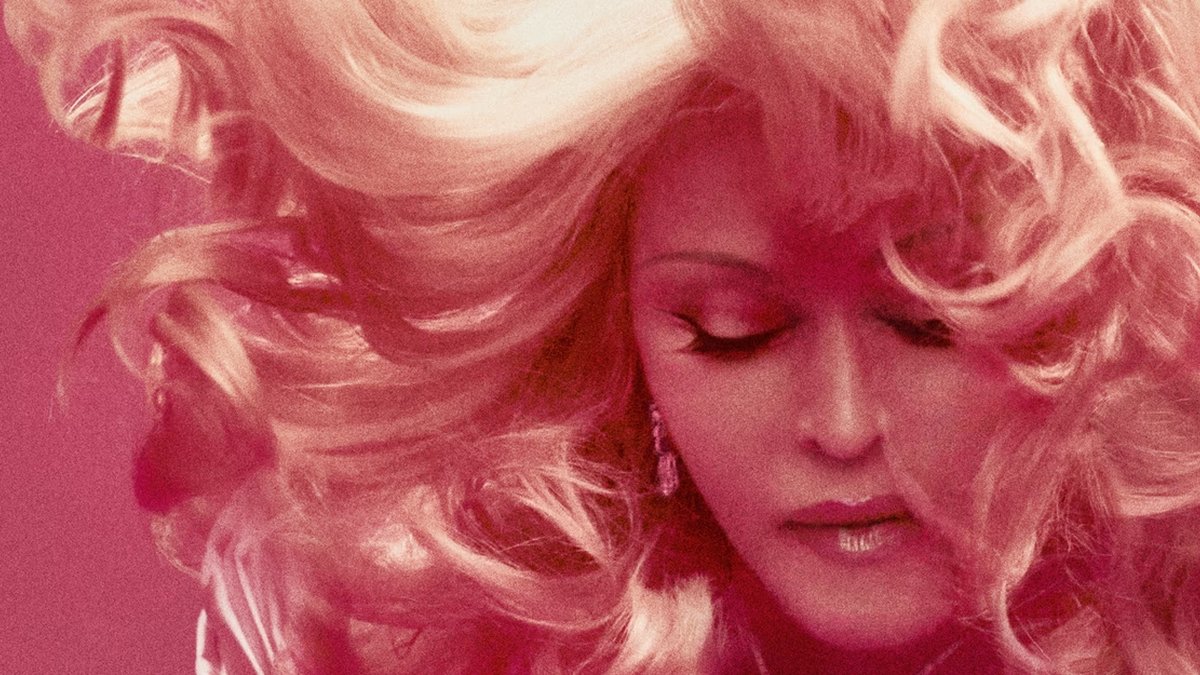
The singer is known for pushing pop forward, but her most acclaimed album in years is playing it safe.
Madonna looks like she’s hiding something on the cover of her 15th album, Confessions II. She’s seated atop a speaker box with her leotard and legs peeking out from beneath a rippling veil of rich purple. The effect is regal, holy, sexual, and funereal—a chic update of her trademark sacred-profane flavor combo. But there’s one twist: She’s covering herself up.
Mystery isn’t usually Madonna’s thing. From the start, she’s been determined to make the world look at her, all of her—in her bed, on a cross, cone-bra’d, bare. As a young woman conquering MTV, she found power in visibility; more recently, her insistence on staying in the frame has served as a dare. In 2023, my colleague Sophie Gilbert described Madonna’s social-media presence—her surgically sculpted, sexagenarian face bobbing around on TikTok—as breaking the pact between the public and its female stars: “If you age in private, the deal goes, you can reemerge triumphantly as royalty in your silver era. But Madonna never signed up for dignified placating.”
Confessions II is, at last, Madonna’s turn to dignified placating. That may sound like a strange description for a club-friendly album marketed with a “Grindr Exxxclusive Picture Disc,” but then again, hedonism has been her home base since “Like a Virgin.” A sequel to her last great album, 2005’s Confessions on a Dance Floor, Confessions II bounces along steadily and nostalgically, like the officially sanctioned biopic she’s recently had to put on ice. Really the most interesting thing about the record is the acclaim it’s generated (trust the New York Post to crudely clarify the cultural narrative: “Taylor Swift has a tacky MSG wedding and Madonna releases an amazing album—it’s bizarro world”). Fans are raving that Madonna has tapped back into her essence—but unfortunately, a lot of her is missing.
As on the first Confessions album, which he helped create, the producer Stuart Price tours through a menagerie of dance styles: swinging house, rushing big beat, meditative drum and bass. Many of these subgenres were commercialized into hokum long ago—the jazzy breakbeats of “Betrayal” would kill over appetizers at Tao—but Price’s touches are impressively refined. The songs develop in overlapping surges of sound, making listeners feel like they’re surfing the curl of an endless wave.
But whereas the first Confessions had a molten brightness to its mood—recall the irrepressible, ABBA-sampling hit “Hung Up”—this one is frosty. The lead track, “I Feel So Free,” opens with a synth pulsing like a lost satellite and Madonna whisper-rasping almost meekly. She feels like she can’t trust people, and her antidote is the “safety in numbers” of the dance floor. She starts cooing in the manner of Donna Summers’s “I Feel Love”—but the expected blastoff into ecstasy doesn’t quite arrive. The track is about freedom, but it’s making a statement about restraint.
One reason for that restraint is to highlight her words. Last year on the wellness influencer Jay Shetty’s podcast, Madonna expressed her desire to spread the wisdom she’s learned from Kabbalah; many of the ideas she conveyed in that conversation are now translated into songs, near verbatim. She commands listeners to focus on their intentions and to believe in love—beautiful notions that are also utterly hackneyed in pop music and rendered artlessly here. “Everything begins with consciousness,” she says flatly on “Good for the Soul.” Later, over drippy strings on “Everything,” she paraphrases Saint John of the Cross and Harvey Dent: “Wherever there’s the greatest amount of darkness / That’s where you’ll find the greatest light.”
Real transcendence approaches only when she quits preaching and Price risks interrupting the breathing exercise. “Everything” and “Bring Your Love” emphasize propulsion and sonic surprise while Madonna plays a campy character, raging at modern phone culture in the former and giggling girlishly with Sabrina Carpenter in the latter. Even better, “Danceteria” reconstructs the titular nightclub where Madonna came up in the ’80s. As she raps about rubbing shoulders with Jean-Michel Basquiat and hiding cocaine from the DJ, the arrangement shape-shifts: a hip-hop break here, an acid-house strobe there. Some listeners will call the track corny; others will love it as theater. The edge of taste—that’s where she belongs.
Later on the album, the tempo slows and she delivers personal revelations—with circumspection. “Bizarre” is a catchy cut apparently about holding a torch for Sean Penn; “Betrayal” dresses down her late mother-in-law. At this point in her life, Madonna’s clearly wrenched by scores unsettled and closures denied, but one gets the sense that she’s holding back her rawest feelings to avoid upsetting the flow. “Fragile” is the most effective ballad on the album because Madonna, movingly if gauzily, transmutes the 2024 death of her brother Christopher, into her own self-actualization tale. Another highlight, “The Test,” features her daughter Lola Leon singing with idiosyncratic cadences and word choices that demonstrate how generic her mother’s have been.
The problem here isn’t all the woo-woo. Madonna has been trying to enlighten us since 1998’s Ray of Light, but back then—and for most of her career—her personal quest was tied to an artistic one. With her ear to the underground and her eye on the mainstream, Madonna has kept trying to push the sound of pop forward. Once, that entailed trip-hop and yoga mantras. What would it mean to make a modern Madonna album right now? Sort through forgotten efforts like the EDM-fried MDNA (2012) and the trap-tastic Rebel Heart (2015), and you’ll find many botched answers to that question—but also, here and there, tracks so crazed with ambition that they make Confessions II sound like AI.
Trading her restless spark for pleasurable consistency theoretically could have at least won her some top-tier bangers, but one revisit to the first Confessions drives home how middling the songwriting is here. Nothing screams for another greatest-hits collection; nothing is likely to inspire the next wave of pop. Instead, she’s given fans a perfectly okay summer soundtrack. Overrating that gift risks sending a sad message: that what the world ultimately wants from Madonna, and any bold performer in her vein, is the safest version of herself. Behind the veil, I suspect she’s hiding her boredom.
Facts Only
Executive Summary
Full Take
Sentinel — Human
The text presents a complex, subjective analysis of an album, skillfully blending factual observations with deep, layered interpretation on themes of public persona and creative restraint, strongly suggesting human critical engagement.