Abstract
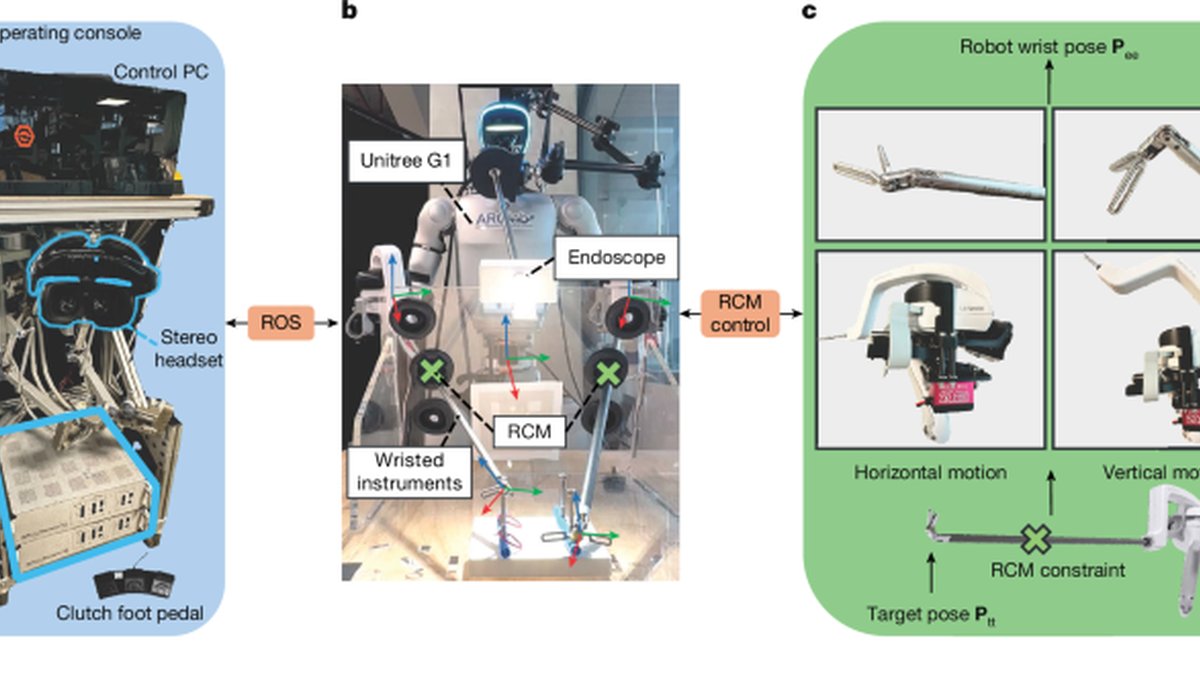
Recent advances in actuation, control and learning have rapidly pushed humanoid robots from a distant vision towards near-term real-world deployment1,2,3,4,5,6,7,8,9,10,11,12,13,14,15,16,17,18. Healthcare is a particularly pressing domain, in which staffing shortages and increasing care demand are widening the gap between clinical workload and available skilled labour19,20,21. Although current automation has largely focused on digital and logistical tasks22, much hospital work remains embodied, requiring mobility, manipulation and safe interaction in human-designed environments. Humanoid form factors offer unique potential, particularly for assisting with surgical tasks. Traditionally, robotic systems for surgery are purpose-built platforms such as Intuitive Surgical’s da Vinci Surgical System23,24, and it remains unclear how close current humanoid systems are to meeting the precision, control and safety requirements of minimally invasive surgery. Here we present a systematic evaluation of contemporary humanoid technology for laparoscopic surgical tasks. We develop a humanoid-based laparoscopic teleoperation framework using general-purpose instruments and assess its abilities through benchtop characterization, dry-laboratory user studies spanning diverse surgical experience levels and in vivo porcine studies. Across these evaluations, we quantify technical feasibility, task performance and clinical readiness relative to established surgical platforms. Together, our study provides an evidence-based assessment of current humanoid abilities and limitations for surgical applications, highlighting both their promise and key technical challenges that must be addressed before clinical deployment.
This is a preview of subscription content, access via your institution
Access options
Access Nature and 54 other Nature Portfolio journals
Get Nature+, our best-value online-access subscription
$32.99 / 30 days
cancel any time
Subscribe to this journal
Receive 52 print issues and online access
$199.00 per year
only $3.83 per issue
Buy this article
- Purchase on SpringerLink
- Instant access to the full article PDF.
USD 39.95
Prices may be subject to local taxes which are calculated during checkout
Data availability
The numerical source data and analysis code underlying the dry-laboratory study are publicly available at Zenodo61 (https://doi.org/10.5281/zenodo.20434260 Source data are provided with this paper.
Code availability
The code supporting the findings of this study is publicly available at Zenodo62 (https://doi.org/10.5281/zenodo.18023650
References
Wensing, P. M. et al. Proprioceptive actuator design in the MIT cheetah: impact mitigation and high-bandwidth physical interaction for dynamic legged robots. IEEE Trans. Rob. 33, 509–522 (2017).
Grimminger, F. et al. An open torque-controlled modular robot architecture for legged locomotion research. IEEE Robot. Autom. Lett. 5, 3650–3657 (2020).
Chignoli, M., Kim, D., Stanger-Jones, E. & Kim, S. The MIT humanoid robot: design, motion planning, and control for acrobatic behaviors. In Proc. 2020 IEEE-RAS 20th International Conference on Humanoid Robots (Humanoids) 1–8 (IEEE, 2021).
Semasinghe, C., Taylor, D. & Rezazadeh, S. The design and manufacturing of Mithra: a humanoid robot with anthropomorphic attributes and high-performance actuators. Robotics 14, 28 (2025).
Khazoom, C., Hong, S., Chignoli, M., Stanger-Jones, E. & Kim, S. Tailoring solution accuracy for fast whole-body model predictive control of legged robots. IEEE Robot. Autom. Lett. 9, 11074–11081 (2024).
Zhang, J. Z. et al. Whole-body model-predictive control of legged robots with MuJoCo. Preprint at arxiv.org/abs/2503.04613 (2025).
Belvedere, T., Scianca, N., Lanari, L. & Oriolo, G. Joint-level IS-MPC: a whole-body MPC with centroidal feasibility for humanoid locomotion. In Proc. 2024 IEEE/RSJ International Conference on Intelligent Robots and Systems (IROS) 11240–11247 (IEEE, 2024).
Ishihara, K., Gomi, H. & Morimoto, J. Hierarchical learning framework for whole-body model predictive control of a real humanoid robot. Preprint at arxiv.org/abs/2409.08488 (2024).
Porto, V. G. B. d. A., Melo, D. C., Maximo, M. R. O. A. & Afonso, R. J. M. Imitation learning of a model predictive controller for real-time humanoid robot walking. Eng. Appl. Artif. Intell. 143, 109919 (2025).
Radosavovic, I. et al. Real-world humanoid locomotion with reinforcement learning. Sci. Robot. 9, eadi9579 (2024).
Radosavovic, I., Kamat, S., Darrell, T. & Malik, J. Learning humanoid locomotion over challenging terrain. Preprint at arxiv.org/abs/2410.03654 (2024).
He, T. et al. VIRAL: visual sim-to-real at scale for humanoid loco-manipulation. Preprint at arxiv.org/abs/2511.15200 (2025).
Kim, M. J. et al. Openvla: an open-source vision-language-action model. Preprint at arxiv.org/abs/2406.09246 (2024).
Belkhale, S. et al. RT-H: action hierarchies using language. Preprint at arxiv.org/abs/2403.01823 (2024).
Wen, J. et al. TinyVLA: toward fast, data-efficient vision-language-action models for robotic manipulation. IEEE Robot. Autom. Lett. 10, 3988–3995 (2025).
Zheng, R. et al. Tracevla: visual trace prompting enhances spatial-temporal awareness for generalist robotic policies. Preprint at arxiv.org/abs/2412.10345 (2024).
O’Neill, A. et al. Open X-Embodiment: robotic learning datasets and RT-X models: Open X-Embodiment Collaboration0. In Proc. 2024 IEEE International Conference on Robotics and Automation (ICRA) 6892–6903 (IEEE, 2024).
Figure exceeds $1 billion in Series C funding at $39 billion post-money valuation. Figure AI www.figure.ai/news/series-c (2025).
Health workforce. World Health Organization www.who.int/health-topics/health-workforce#tab=tab_1 (2023).
Cypher, R. L. Burnout and patient safety: an occupational phenomenon. J. Perinat. Neonatal Nurs. 38, 128–130 (2024).
Ageing and health. World Health Organization www.who.int/news-room/fact-sheets/detail/ageing-and-health (2025).
The Robot Report Staff. Diligent robotics hires 2 former Cruise execs to scale Moxi. The Robot Report http://www.therobotreport.com/diligent-robotics-hires-2-former-cruise-execs-to-scale-moxi/ (10 July 2025).
Lanfranco, A. R., Castellanos, A. E., Desai, J. P. & Meyers, W. C. Robotic surgery: a current perspective. Ann. Surg. 239, 14–21 (2004).
Taylor, R. H., Menciassi, A., Fichtinger, G., Fiorini, P. & Dario, P. in Springer Handbook of Robotics (eds Siciliano, B. & Khatib, O.) 1199–1222 (Springer, 2016).
Bruce, G. Elon Musk says Tesla robot will perform ‘superhuman’ surgeries. Becker’s Health IT www.beckershospitalreview.com/healthcare-information-technology/innovation/elon-musk-says-tesla-robot-will-perform-superhuman-surgeries/ (19 November 2025).
Marinho, M. M., Bernardes, M. C. & Bó, A. P. L. A programmable remote center-of-motion controller for minimally invasive surgery using the dual quaternion framework. In Proc. 5th IEEE RAS/EMBS International Conference on Biomedical Robotics and Biomechatronics 339–344 (IEEE, 2014).
Marinho, M. M., Adorno, B. V., Harada, K. & Mitsuishi, M. Dynamic active constraints for surgical robots using vector-field inequalities. IEEE Trans. Rob. 35, 1166–1185 (2019).
Nasiri, E. & Wang, L. Admittance control for adaptive remote center of motion in robotic laparoscopic surgery. In Proc. 2024 21st International Conference on Ubiquitous Robots (UR) 51–57 (IEEE, 2024).
Davila, A., Colan, J. & Hasegawa, Y. Real-time inverse kinematics for robotic manipulation under remote center-of-motion constraint using memetic evolution. J. Comput. Des. Eng. 11, 248–264 (2024).
Hagn, U. et al. DLR MiroSurge: a versatile system for research in endoscopic telesurgery. Int. J. Comput. Assist. Radiol. Surg. 5, 183–193 (2010).
Hagn, U. et al. The DLR MIRO: a versatile lightweight robot for surgical applications. Ind. Rob. 35, 324–336 (2008).
Cofran, L. et al. Barriers to safety and efficiency in robotic surgery docking. Surg. Endosc. 36, 206–215 (2022).
Kanji, F. et al. Room size influences flow in robotic-assisted surgery. Int. J. Environ. Res. Public Health 18, 7984 (2021).
Ozturkcan, S. & Merdin-Uygur, E. Humanoid service robots: the future of healthcare? J. Info. Technol. Teaching Cases 12, 163–170 (2022).
Mlakar, I. et al. Facilitating acceptance, trust, and ethical integration of socially assistive robots among nurses: a quasi-experimental study. Health Policy Technol. 14, 101034 (2025).
Haddadin, S. & Croft, E. Physical human–robot interaction. in Springer Handbook of Robotics (eds Siciliano, B. & Khatib, O.) 1835–1874 (Springer, 2016).
Yang, G.-Z. et al. The grand challenges of science robotics. Sci. Robot. 3, eaar7650 (2018).
Atar, S. et al. Humanoids in hospitals: a technical study of humanoid robot surrogates for dexterous medical interventions. Preprint at arxiv.org/abs/2503.12725 (2025).
Battaglia, E. et al. Rethinking autonomous surgery: focusing on enhancement over autonomy. Eur. Urol. Focus 7, 696–705 (2021).
Unitree G1: humanoid Agent AI Avatar. Unitree Robotics https://www.unitree.com/g1/ (2026).
Wilson, J. T., Tsao, T.-C., Hubschman, J.-P. & Schwartz, S. Evaluating remote centers of motion for minimally invasive surgical robots by computer vision. In Proc. 2010 IEEE/ASME International Conference on Advanced Intelligent Mechatronics 1413–1418 (IEEE, 2010).
de Graaf, P. Optimal positioning of robotic arms inside the abdominal cavity in pediatric surgery. Surgical Robotics Laboratory https://surgicalroboticslab.nl/wp-content/uploads/2020/08/degraaf20-masters.pdf (2020).
Afshar, M. et al. Optimal design of a novel spherical scissor linkage remote center of motion mechanism for medical robotics. In Proc. 2020 IEEE/RSJ International Conference on Intelligent Robots and Systems (IROS) 6459–6465 (IEEE, 2020).
Freschi, C. et al. Technical review of the da Vinci surgical telemanipulator. Int. J. Med. Robotics Comput. Assist. Surg. 9, 396–406 (2013).
Da Vinci Xi Surgical System in-Service Guide: OR Staff (Da Vinci OS4 v.9) (Intuitive Surgical, 2021).
Kazanzides, P. et al. An open-source research kit for the da Vinci surgical system. In Proc. 2014 IEEE International Conference on Robotics and Automation (ICRA) 6434–6439 (IEEE, 2014).
Richter, F., Orosco, R. K. & Yip, M. C. Motion scaling solutions for improved performance in high delay surgical teleoperation. In Proc. 2019 IEEE International Conference on Robotics and Automation (ICRA) 1590–1595 (IEEE, 2019).
Lu, S. et al. Adaptive control of time delay teleoperation system with uncertain dynamics. Front. Neurorobot. 16, 928863 (2022).
Xiong, Z. et al. ExtremControl: low-latency humanoid teleoperation with direct extremity control. Preprint at arxiv.org/abs/2602.11321 (2026).
Ichihara, J. & Miura, S. Quantifying the effects of delays on telerobotic surgical operability via brain activity measurements. Int. J. Comput. Assist. Radiol. Surg. 20, 2371–2379 (2025).
Ferguson, J. M. et al. Comparing the accuracy of the da Vinci Xi and da Vinci Si for image guidance and automation. Int. J. Med. Robot. 16, 1–10 (2020).
Fryar, C. D., Carroll, M. D., Gu, Q., Afful, J. & Ogden, C. L. Anthropometric reference data for children and adults: United States, 2015–2018. Vital Health Stat. 3, 1–44 (2021).
Nabeel, A. et al. Assessing and evaluating the impact of operative vision compromise (OViC) on surgeons’ practice: a qualitative study. Int. J. Surg. 110, 6972–6981 (2024).
von Strauss und Torney, M. et al. Microcomplications in laparoscopic cholecystectomy: impact on duration of surgery and costs. Surg. Endosc. 30, 2512–2522 (2016).
Rojas Burbano, J. C. et al. Robot-assisted surgery: current applications and future trends in general surgery. Cureus 17, e82318 (2024).
Kim, V. B. et al. Early experience with telemanipulative robot-assisted laparoscopic cholecystectomy using da vinci. Surg. Laparosc. Endosc. Percutan. Tech. 12, 33–40 (2002).
Rojas, A., Gachabayov, M., Abouezzi, Z. E., Bergamaschi, R. & Latifi, R. Current robotic platforms in surgery and the road ahead. Surg. Technol. Int. 38, 39–46 (2021).
Surgical tools. LivsMed https://livsmed.us/products/ (accessed 26 May 2026).
Macenski, S., Foote, T., Gerkey, B., Lalancette, C. & Woodall, W. Robot operating system 2: design, architecture, and uses in the wild. Sci. Robot. 7, eabm6074 (2022).
Society of American Gastrointestinal and Endoscopic Surgeons (SAGES). FLS Manual Skills Written Instructions and Performance Guidelines. https://cpd.partners.org/sites/default/files/manual_skills_guidelines[1].pdf (2012).
Liang, Z. & Yip, M. User performance data sheets. Zenodo https://doi.org/10.5281/zenodo.20434260 (2026).
Liang, Z. Laparoscopic humanoid code. Zenodo https://doi.org/10.5281/zenodo.18023650 (2025).
Acknowledgements
We thank our laboratory mates in the Advanced Control and Robotics Lab (ARC Lab) for their assistance with hardware transfer. We also thank the staff of the Center for the Future of Surgery at the University of California, San Diego, for coordinating the experimental space and facilities.
Funding
Z.L., P.Z., C.J., S.A. and M.Y. were funded in part by the NSF Award IIS-2045803 and NIH award 1R01CA278703-01. S.L. and M.Y. were supported in part by the NIH award 1R21EB036284-01.
Author information
Authors and Affiliations
Contributions
Z.L., P.Z. and M.Y. devised the methodology; Z.L., N.T. and M.Y. designed the study; Z.L., N.T., P.Z., C.J, S.A., G.J., S.L., R.B. and M.Y. conducted the experiments; Z.L. and N.T. analysed the data; Z.L., N.T., P.Z., F.R. and M.Y. wrote the paper; and S.L., R.B. and M.Y. conceptualized the study.
Corresponding author
Ethics declarations
Competing interests
S.L. is a principal investigator of the Alume Trial at University of California, San Diego. R.B. is a consultant to Stryker, Johnson & Johnson MedTech and DistalMotion. M.Y. is a co-founder and Board Member of Channel Robotics and Owner-Operator of Yip Consulting Services.
Peer review
Peer review information
Nature thanks Axel Krieger, who co-reviewed with Laura Connolly, and Omar Kudsi for their contribution to the peer review of this work. Peer reviewer reports are available.
Additional information
Publisher’s note Springer Nature remains neutral with regard to jurisdictional claims in published maps and institutional affiliations.
Supplementary information
Supplementary Information (download DOCX )
Supplementary Tables 1 and 2.
Supplementary Video 1 (download MP4 )
System demonstration. Overview of the LapSurgie teleoperation workflow, showing the humanoid robot, laparoscopic instruments, endoscopic visualization, dry-lab manipulation and representative in vivo use.
Supplementary Video 2 (download MP4 )
Live surgery. Representative live cholecystectomy procedure using proposed humanoid system, showing trocar placement, humanoid-assisted laparoscopic manipulation, endoscopic views and integration with the operating-room workflow.
Source data
Rights and permissions
Springer Nature or its licensor (e.g. a society or other partner) holds exclusive rights to this article under a publishing agreement with the author(s) or other rightsholder(s); author self-archiving of the accepted manuscript version of this article is solely governed by the terms of such publishing agreement and applicable law.
About this article
Cite this article
Liang, Z., Thareja, N., Zhang, P. et al. In vivo feasibility study of humanoid robots in surgery. Nature (2026). https://doi.org/10.1038/s41586-026-10796-x
Received:
Accepted:
Published:
Version of record:
DOI: https://doi.org/10.1038/s41586-026-10796-x
Sentinel — Human
This text appears to be a scientifically rigorous academic abstract and reference list detailing empirical work on humanoid robotics for surgical tasks, exhibiting the structure and citation density of original scientific publication.