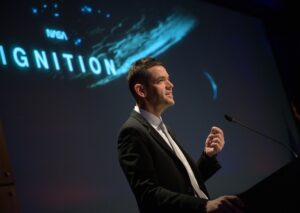
With the Artemis 2 around-the-moon launch just eight days away, NASA announced ambitious long-range plans Tuesday to spend $20 billion over the next seven years to build a moon base near the lunar south pole featuring habitats, pressurized rovers and nuclear power systems.
NASA Administrator Jared Isaacman kicked off a series of meetings with contractors at NASA Headquarters in Washington saying he envisioned launching two moon landing missions per year to establish semi-permanent astronaut occupation on the lunar surface to explore, conduct research and develop the technology needed for eventual flights to Mars.
“This revised, step-by-step approach to learn, to build muscle memory, to bring down risk and gain confidence is exactly how NASA achieved the near impossible in the 1960s,” he said, referring to the agency’s Apollo program. “But this time, the goal is not flags and footprints. This time, the goal is to stay.
“Today, we are providing a demand for frequent crewed missions well beyond (previously announced moon landings in 2028). We intend to work with no fewer than two launch providers with the aim of crewed landings every six months, with additional opportunities for new entrants in the years ahead. America will never again give up the moon.”
The revised Artemis program envisions a transition from the government owned-and-operated Space Launch System rocket that will send the next several Artemis crews to the moon in favor of competitive commercial rockets like those being developed by SpaceX, Blue Origin and others.
It also will “pause” a program to build the Gateway space station in lunar orbit and “repurpose” components of that project for surface operations more in keeping with the moon base called for in the Trump administration’s national space policy.
Along with plans for a moon base, senior NASA managers also outlined work to develop nuclear power systems for use on the moon and Mars to keep astronauts, habitats and other equipment warm while providing the electricity needed for research, construction and daily operations.
First out of the gate will be the “Skyfall” mission to Mars in 2028 in which a fission reactor — Space Reactor 1, or SR-1, will power a nuclear-electric propulsion system to deliver three small helicopters that will be dropped in the thin martian atmosphere to fly about and study a possible landing zone for future astronauts.
SR-1 will be the first in a series of new nuclear power technologies NASA plans to deploy in the next few years on the moon.
Closer to home, agency managers vowed to continue efforts to encourage development of commercial space stations to keep American astronauts and researchers in low-Earth orbit after the International Space Station is retired in the 2030 timeframe.
Officials acknowledged the ISS program and commercially-developed crew ferry ships have not generated the private sector interest once envisioned and said the agency was exploring ways to encourage and hasten commercial development.
That includes allowing more privately financed non-astronauts to conduct research aboard the ISS, “selling” commander slots to qualified non-astronauts and even using the lab as a staging base for assembly of private-sector modules that later could be separated to fly on their own.
Isaacman said NASA would be able to afford the new Artemis architecture, space nuclear power development, ongoing science missions and new exploration ventures as well as working to facilitate the commercialization of low-Earth orbit with its existing budget, repurposing hardware to focus on the moon and by trimming bureaucratic waste and inefficiency.
“A lot of people ask us, you know, how are you going to be able to do all this within the resource you have available?” Isaacman said. “And I continue to tell them NASA does not necessarily have a top-line problem. We get a lot of resources. We may not always allocate them that efficiently.”
The revised Artemis program was unveiled just a few weeks after Isaacman ordered major changes to near-term missions, adding a flight in low-Earth orbit next year to test rendezvous and docking procedures using Orion crew ships and moon landers being built by SpaceX and Blue Origin.
Based on the results of the Artemis 2 and 3 missions, NASA now plans to launch at least one and possibly two moon landing missions in 2028 — Artemis 4 and 5 — using one or both privately developed moon landers before pressing ahead with a steady stream of flights to develop a base on the moon.
In the process, NASA will forego development of a planned space station in lunar orbit — the Gateway — and repurpose modules and systems already under development to serve as components of the planned moon base.
Under the old architecture, Gateway would have operated in a highly elliptical orbit where Orion crew ships from Earth would meet up with already docked lunar landers for descents to the surface. As it now stands, Orion astronauts will transfer directly to their landers without stopping at an orbital way station.
Gateway was intended to accommodate the propulsion capabilities of the Orion crew ship and its service module engine, which does not have the power to get into and out of a low-lunar orbit like the one used by Apollo crews.
What sort of orbits might be possible in the absence of Gateway was not addressed, but NASA is asking its contractors to help come up with workable alternatives.
“It should not really surprise anyone that we are pausing Gateway in its current form and focusing on infrastructure that supports sustained operations on the lunar surface,” Isaacman said. “Despite some of the very real hardware and schedule challenges, we can repurpose equipment and international partner commitments to support surface and other program objectives.”
He added that “shifting NASA workforce priority” to the lunar surface will enable the agency to use the moon as a “proving ground for future Mars initiatives” and that the policy change “does not preclude revisiting the orbital outpost in the future.”
The Planetary Society, a space advocacy organization co-founded by the late astronomer Carl Sagan, estimates NASA will have spent about $107 billion on return-to-the-moon plans through 2026 in inflation-adjusted dollars. That’s thanks in large part to repeated program changes over the past 20 years by successive presidential administrations.
In the wake of the shuttle Columbia disaster in 2003, President George W. Bush ordered NASA to retire the shuttle, build new rockets and return astronauts to the moon by 2020 in what became known as the Constellation program. The Obama administration concluded that program was not sustainable and ordered NASA to focus instead on a flight to a nearby asteroid.
In his first term, President Trump ordered NASA to shift its focus back to the moon for a proposed 2024 landing in what became known as the Artemis program. The Biden administration generally left Artemis alone, but the program had been slowed by the COVID pandemic, budget shortfalls and a variety of other factors.
Isaacman has repeatedly talked of Trump’s continued support of the Artemis program, and the revised architecture the administrator outlined Tuesday clearly has the approval of the White House.
Speaking of past delays and budget overruns, Isaacman said “the programs we left behind in this effort were not success stories. NASA takes ownership for the shortcomings, but contributing billions more and time that we do not have was not a pathway to success.”
The moon base will be built in three phases. Phase 1 will transition from infrequent, once-a-year moon missions to “a templated approach that will generate significant learning through experimentation,” he said.
“We will dramatically expand lunar landings … delivering rovers, instruments and technology payloads that test mobility, power systems … communications, navigation, surface operations and all the science payload that can be incorporated.”
Phase 2 will see development of habitats and infrastructure “supporting regular astronaut operations on the surface.” Phase 3 will enable “the permanent infrastructure necessary to sustain a human presence,” Isaacman said.
That includes nuclear and solar power systems, crewed and uncrewed rovers, including machines to prepare sites for construction, a cellphone-like communications network, a lunar GPS system and constellations of lunar observation and communications relay satellites.
“The moon base will not appear overnight,” Isaacman said. “We will invest approximately $20 billion over the next seven years and build it through dozens of missions, working together with commercial and international partners towards a deliberate and achievable plan.”
Isaacman made it clear that failure is not an option when it comes to beating China back to the lunar surface.
“Should we fail, and should we look on as our rivals achieve their lunar goals ahead of our own, we are not going to celebrate our adherence to excess requirements, policy or bureaucratic process,” he said, adding later that “we are not going to sit idly by when schedules slip or budgets are exceeded.”
“Expect uncomfortable action if that is what it takes, because the public has invested over $100 billion and has been very patient with respect to America’s return to the moon. Expectations are rightfully very high.”
Facts Only
NASA announced a $20 billion plan to build a moon base near the lunar south pole over seven years.
The base will include habitats, pressurized rovers, and nuclear power systems.
NASA Administrator Jared Isaacman outlined plans for two crewed moon landings per year.
The revised Artemis program will transition from the Space Launch System rocket to commercial rockets from SpaceX, Blue Origin, and others.
The Gateway lunar orbit station program will be paused, with its components repurposed for surface operations.
A 2028 "Skyfall" mission to Mars will deploy a nuclear reactor (SR-1) to power helicopters for landing site reconnaissance.
NASA aims to develop nuclear power for lunar and Martian operations, starting with SR-1.
The agency will encourage commercial space stations to replace the International Space Station after its retirement in the 2030s.
The moon base will be built in three phases: experimentation, habitat development, and permanent infrastructure.
NASA plans to allow private research and non-astronaut commander slots on the ISS to boost commercialization.
The Planetary Society estimates $107 billion has been spent on return-to-the-moon programs since 2003.
The Artemis program has undergone multiple revisions under different presidential administrations.
Isaacman cited competition with China as a key motivator for accelerating lunar plans.
Executive Summary
NASA has unveiled an ambitious $20 billion plan to establish a semi-permanent moon base near the lunar south pole over the next seven years, featuring habitats, pressurized rovers, and nuclear power systems. The revised Artemis program, announced by NASA Administrator Jared Isaacman, shifts focus from the previously planned Gateway lunar orbit station to direct surface operations, aiming for two crewed moon landings per year. The agency will transition from government-operated rockets like the Space Launch System to commercial providers such as SpaceX and Blue Origin. Key initiatives include the "Skyfall" mission to Mars in 2028, deploying a nuclear-powered reactor to support exploration, and repurposing Gateway components for the moon base. NASA also plans to encourage commercial space station development to replace the International Space Station post-2030. The program reflects a strategic pivot to sustainable lunar presence, with phased development of infrastructure, power systems, and research capabilities. While the plan aligns with Trump-era space policy, it faces challenges from past program delays, budget constraints, and competition with China’s lunar ambitions.
The announcement follows recent adjustments to near-term Artemis missions, including a 2025 low-Earth orbit test of docking procedures. NASA asserts the revised architecture can be funded within existing budgets by improving efficiency and repurposing hardware. However, the Planetary Society estimates over $107 billion has already been spent on return-to-the-moon efforts since 2003, highlighting the program’s history of shifting priorities across administrations. The agency emphasizes urgency, framing the moon base as a stepping stone for Mars missions and a counter to geopolitical rivals.
Full Take
**Steelman:** NASA’s revised Artemis plan represents a bold strategic shift toward sustainable lunar exploration, leveraging commercial partnerships and repurposed hardware to achieve long-term goals. The agency deserves credit for adapting to past failures—acknowledging inefficiencies, trimming bureaucratic waste, and refocusing on surface operations over orbital waypoints. The emphasis on nuclear power and phased infrastructure development reflects a pragmatic approach to deep-space habitation, while the urgency to counter China’s lunar ambitions adds geopolitical weight to the mission.
**Pattern Scan:** The narrative employs several framing techniques worth noting. First, the repeated invocation of "failure is not an option" and competition with China taps into **ARC-0012 Fear Appeals**, using geopolitical rivalry to justify accelerated timelines and budgetary trade-offs. Second, the dismissal of past programs as "not success stories" while repurposing their components risks **ARC-0024 Ambiguity**, glossing over the systemic causes of delays (e.g., shifting administrations, COVID-19) in favor of a "clean slate" narrative. Finally, the claim that NASA can achieve this within existing budgets by cutting "inefficiency" borders on **ARC-0031 Overpromising**, given the Planetary Society’s $107 billion estimate and the agency’s history of cost overruns.
**Root Cause:** The paradigm driving this narrative is **technological nationalism**—the belief that space dominance is a zero-sum game where U.S. leadership must be asserted against rivals like China. The unstated assumption is that lunar infrastructure is a prerequisite for Mars missions, a claim that sidesteps debates about whether the moon is the best proving ground or a costly detour. Historically, this echoes Cold War-era space races, where symbolic victories (e.g., "flags and footprints") were later reframed as stepping stones to grander goals—a pattern NASA explicitly invokes while insisting "this time, the goal is to stay."
**Implications:** For human agency, the plan could democratize space access by integrating commercial partners, but it also centralizes power in NASA’s vision, potentially sidelining alternative approaches (e.g., asteroid mining, robotic-only missions). The $20 billion price tag, while substantial, pales beside past expenditures, raising questions about opportunity costs—what other scientific or humanitarian projects might this funding displace? The focus on nuclear power, while innovative, may face public resistance or regulatory hurdles. Second-order effects include the militarization of lunar resources (e.g., water ice for fuel) and the precedent of privatizing orbital assets, which could exacerbate inequality in space access.
**Bridge Questions:**
1. If the moon base is framed as a "proving ground for Mars," what evidence would falsify this assumption? Could robotic missions or alternative architectures achieve the same goals more efficiently?
2. How might the repurposing of Gateway components affect international partners who contributed to the project? Does this shift undermine trust in NASA’s long-term commitments?
3. The narrative pits U.S. and Chinese lunar programs as rivals, but could collaboration on shared infrastructure (e.g., power grids, navigation) yield better outcomes for both?
**Counterstrike Scan:** A coordinated influence campaign pushing this narrative would likely amplify the China threat, downplay budgetary risks, and frame commercialization as an unalloyed good—all while suppressing critiques of NASA’s track record. The actual content aligns partially with this playbook, particularly in its geopolitical framing and efficiency claims, but it also includes transparency about past failures and acknowledges the need for commercial buy-in. The absence of overt demonization of China or unchecked corporate cheerleading suggests this is not a cynical manipulation but a genuine strategic pivot—albeit one with embedded biases toward institutional self-preservation.
**Patterns detected: ARC-0012 Fear Appeals, ARC-0024 Ambiguity, ARC-0031 Overpromising**
Sentinel — Human
This analysis suggests the article is likely human-written, with signs of idiosyncratic writing style and lack of mechanical repetition in sentence structure. However, it's important to note that these indicators can also be present in high-quality AI-generated content.