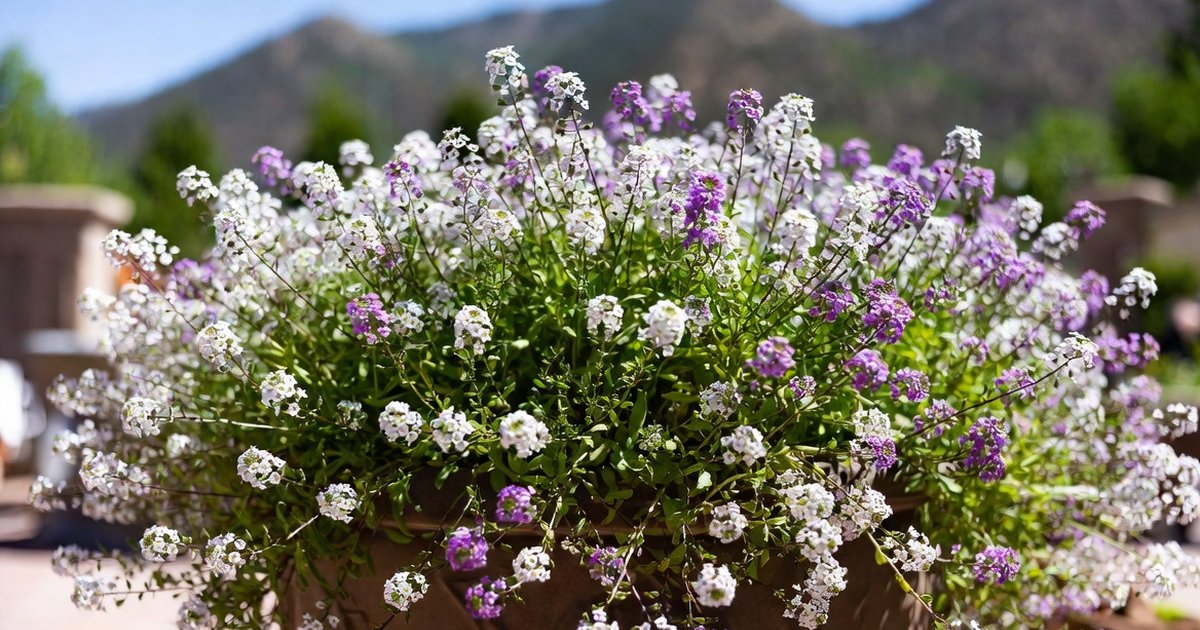
Lobularia maritima (Sweet Alyssum, especially trailing varieties) is a delightful, low-growing annual known for its masses of tiny, fragrant flowers in white, purple, lavender, or pink. Trailing types are excellent “spillers” that cascade beautifully over pot edges, adding softness and sweetness to container combinations.
It pairs wonderfully with your other plants: the cool tones complement Lobelia’s blues, contrast nicely with Lantana’s bright colors, and look lovely draping alongside Sweet Potato Vine.
Growing Conditions in Fort Collins
Sweet Alyssum is a cool-season annual that performs best in Colorado’s spring and fall, though some modern varieties handle summer heat better.
- Hardiness: Grown as an annual in Zone 5b. It will not survive winter outdoors but can reseed mildly in favorable spots.
- Planting time: Early to mid-May (it tolerates light frost better than many tender annuals). You can also plant a second round in late summer for fall color.
- Sun: Full sun to partial shade. In Fort Collins’ intense summer sun, afternoon shade helps extend bloom time.
- Soil: Well-draining, average to slightly rich soil. Excellent in containers, hanging baskets, or as a groundcover edging.
- Water: Moderate and consistent. Keep soil moist but not soggy. It is fairly drought-tolerant once established but blooms best with regular watering in dry Colorado air.
Care Tips
- Growth habit: Low mounds or trailing 6–12 inches tall and spreading 12–24+ inches. Trailing varieties like ‘Snow Princess’, ‘Big White’, or ‘Aphrodite’ cascade nicely.
- Bloom time: Long season from spring through fall, with a possible midsummer slowdown in extreme heat.
- Fragrance: Delightfully honey-scented — great near patios and seating areas. Excellent for attracting bees, butterflies, and beneficial insects.
- Maintenance: Trim or shear back by 1/3 when blooms slow down to encourage fresh growth and more flowers. Deadheading isn’t necessary but helps.
- Fertilizer: Light feeder. Use a balanced or bloom-boosting fertilizer every 3–4 weeks in containers.
- Pests/Diseases: Very easy and tough. Occasional aphids or downy mildew if too crowded/wet, but generally problem-free and deer-resistant.
Pro tip for Fort Collins: Plant trailing Alyssum in mixed containers with Lobelia, Sweet Potato Vine, Juncus (for height), and Lantana for a stunning, pollinator-friendly pot that looks good from spring through frost.
Would you like recommendations for specific varieties or companion planting ideas?
Facts Only
Executive Summary
Full Take
The narrative positions the plant not merely as a botanical subject but as an aesthetic and functional component of a specific regional lifestyle. The advice is highly localized, emphasizing optimal growing times and sun management specifically for Fort Collins, which implies that generalized horticultural knowledge is insufficient without contextual adaptation. This framing establishes a hierarchy where local conditions dictate optimal outcomes, implicitly validating location-specific knowledge as superior.
The promotion of trailing varieties as "spillers" and their pairing with other plants creates an idealized, curated vision of a pollinator-friendly, harmonious garden, moving beyond simple cultivation to lifestyle design. This aesthetic focus leverages the plant’s fragrance and cascading habit to appeal to sensibilities about softness and sweetness.
The treatment of pest management is permissive, focusing on the plant’s inherent resilience ("very easy and tough") rather than demanding rigorous intervention, which shifts the responsibility for successful outcomes onto the user's management style. This approach minimizes potential anxiety while still delivering actionable, yet context-dependent, instructions.
The Pro tip, linking specific plants to a shared aesthetic outcome (pollinator-friendly pot), functions as a form of cognitive shortcut, offering a packaged solution that simplifies complex environmental interactions into an attractive, manageable system. The underlying pattern is the commercialization of natural beauty and ease, where scientific facts are layered with localized, aspirational experience to guide consumption and engagement.
Sentinel — Human
The text reads like well-researched, practical gardening advice, likely authored by a human expert or enthusiast, characterized by clear structure and local context.