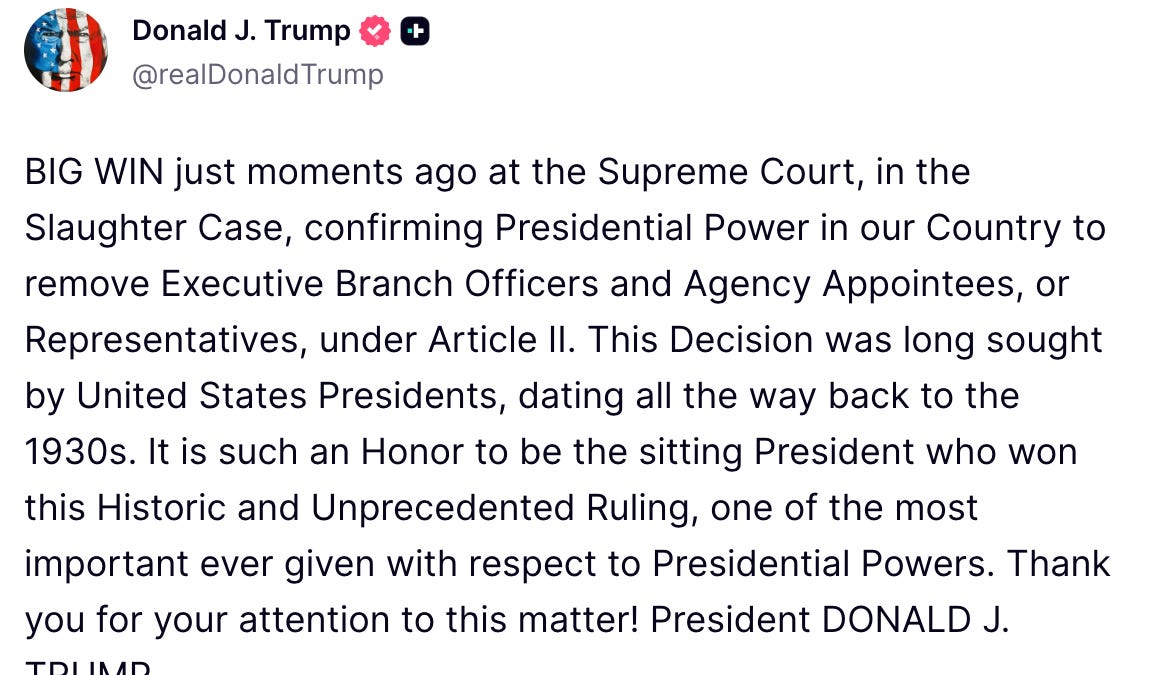
The Roberts Supreme Court delivers another blow against Americans and for Donald Trump
Never mind the Supreme Court upholding birthright citizenship — that was a foregone conclusion given that it is a totally unambiguous provision of the Constitution (although three Republican justices voted against it!). The important decision was handed down yesterday, when the Court, ruling on the Slaughter case — brought on behalf of an FTC commissioner arbitrarily fired by Donald Trump — overturned 90 years of precedent to give Trump dictatorial power over the regulatory machinery of the US government. The Court has now stripped regulatory agencies of their independence from Trump’s whims and corrupt practices. Even for an agency created by Congress with a specific mandate and responsibilities, Trump is now free to direct that agency to do something completely different, to fire any civil servants who don’t do whatever he wants, or to completely gut it so that it is unable to serve its function.
Notice that I said that Trump has been given dictatorial power. There have been many comments to the effect that a future Democratic president could make extensive use of these new powers, but this Court is utterly partisan. The moment a Democrat takes office, it will instantly decide that he or she has almost no discretionary power.
Various MAGA-adjacent parties, along with willfully blind centrists, are trying to sweep this ruling under the rug, hoping that the public doesn’t understand its meaning. In fact, even I am startled that the Wall Street Journal, whose reporting is normally excellent, barely mentions this astonishing act of Trump empowerment in its news section. Instead, it has posted only a misleading editorial, repeating the tendentious legal arguments of the Roberts radicals.
But you don’t have to take my word for how much this travesty matters. As the screenshot at the top of this post shows, the wannabe dictator is fully aware of how much the Roberts Court has undermined democracy in his favor. And he’s celebrating.
What I want to do in today’s post is enlarge on why Slaughter matters — and just how bad it is.
First, this decision is (almost) all about enabling corruption. Yes, there are ideological and policy aspects. But this Court decision is fundamentally about empowering Trump, not the presidency in general. And we know who and what Trump is. The normally soft-spoken Jared Bernstein says it clearly:
[G]iving this president such carte blanche is crazy. Name one firing or removal he’s made or attempted to make that was motivated by anything other than personal retribution, prejudice (it is not a coincidence that Lisa Cook is a Black woman), or personal greed.
The Court’s decision effectively eliminates government by professional civil servants who do their best to implement the law with government by henchmen and lackeys who will do whatever Dear Leader wants. And what he wants depends, above all, on who is most willing and able to enrich him, his family, and his cronies.
In my conversation with Lisa Graves posted yesterday, she gave the example of Jeff Yass, a billionaire who clearly purchased a complete reversal of Trump’s position on TikTok. The same has been true, on an even bigger scale, for policy toward cryptocurrency — which Trump denounced until it became clear that crypto was a way for corporations and super-rich individuals to funnel billions of dollars directly to him and his family.
Second, the Court’s sort-of carve-out for the Federal Reserve — for which, for the moment, the Court has preserved some of the protections the whole government had until now — looks even more hypocritical once we recognize the centrality of the issue of corruption.
As many people have noted, there is no conceivable argument under which the independence of monetary policy is somehow more sacred than the independence of regulation of critical areas such as antitrust policy, environmental policy, food and drug standards, and air safety.
Beyond that, Fed policy stands out as an arena in which the scope for corruption is relatively limited. While the Fed does play a role as a financial regulator, its key job is interest rate policy — and that’s basically choosing the setting on a single dial, with no room for favoritism. When the Fed raises rates, it raises rates for everyone, when it cuts rates it cuts them for everyone, with no way to exempt Trump cronies from rate hikes or give them selective rate cuts.
By contrast, the Federal Trade Commission can selectively reward some corporations by granting approval for the mergers they want while selectively punishing some corporations by denying approval for mergers. The Environmental Protection Agency can waive pollution regulations for some companies while enforcing them for others. And so on. And we know exactly what will determine which companies get favored treatment: It will be all about who greases Trump’s palm and puffs up his ego.
Why, then, give the Fed special treatment? Probably because the Court feared the market reaction if it allowed Trump to take immediate control. The Wall Street Journal editorial openly acknowledged this concern, explaining the carve-out for the Fed by saying: “the Chief and Justice Kavanaugh made the pragmatic judgment that they simply don’t trust Mr. Trump to run monetary policy.” But the last time I looked at the Constitution there wasn’t a special “unless it adversely affects the stock market” clause. Evidently, the Journal editorial board thinks it is only the little people who will be victims of Trump’s destruction of America’s regulatory institutions, while those who have big stock portfolios will be A-okay.
And they might be right given the trends in our economy. A headline in yesterday’s Journal:
“Resilient” is one way to put it. But who pays for this “resilience”? Profits have been soaring even as many workers’ wages fail to keep up with inflation. Indeed, profits as a share of national income keep rising:
It’s highly likely that a significant fraction of this rise reflects increased monopoly profits in an age of enshittification and the destruction of workers’ rights. And a major share of the rise in monopoly profits has, in turn, gone to enrich America’s oligarch class — the same class that is generously sharing some of its wealth with Trump and his family, in return for the favors. Now, thanks to the Supreme Court, he can grant those favors free from legal restraint, as he completes his evisceration of the Federal Trade Commission — which is supposed to limit monopoly power — and the National Labor Relations Board, which is supposed to protect workers’ rights.
The stench of corruption and dictator-worship is overpowering.
NONMUSICAL CODA
The next three days are the anniversary of the battle of Gettysburg — days that deserve to be remembered. July 1:
I have no doubt that the instant a Democrat becomes president, the Roberts Court will discover that the President actually has no powers at all and is merely a ceremonial head-of-state position. Some might think this is an inconsistency, but it's not. The Rightwinger view of how the world should work is that Republicans always and everywhere have all the power. That's why over the last half century, we've seen a merry-go-round of reasoning like so:
When a Republican is president, all power resides with the executive as that most accurately reflects the will of the people.
When a Democrat is president, all power rests with Congress as that most accurately reflects the will of the people.
When a Democrat is president and Democrats control Congress, all power resides with the states as that most accurately reflects the will of the people.
When a Democrat is president and Democrats control Congress and Democrats control most state legislatures, then all power resides with the Court as the guardians of The Sacred Constitooshun.
250 years was a good run. It's time for some major revisions.
Sentinel — Human
This text exhibits clear human authorship characterized by a strong, polemical voice and an intentional, non-neutral synthesis of legal and economic themes against specific political figures.