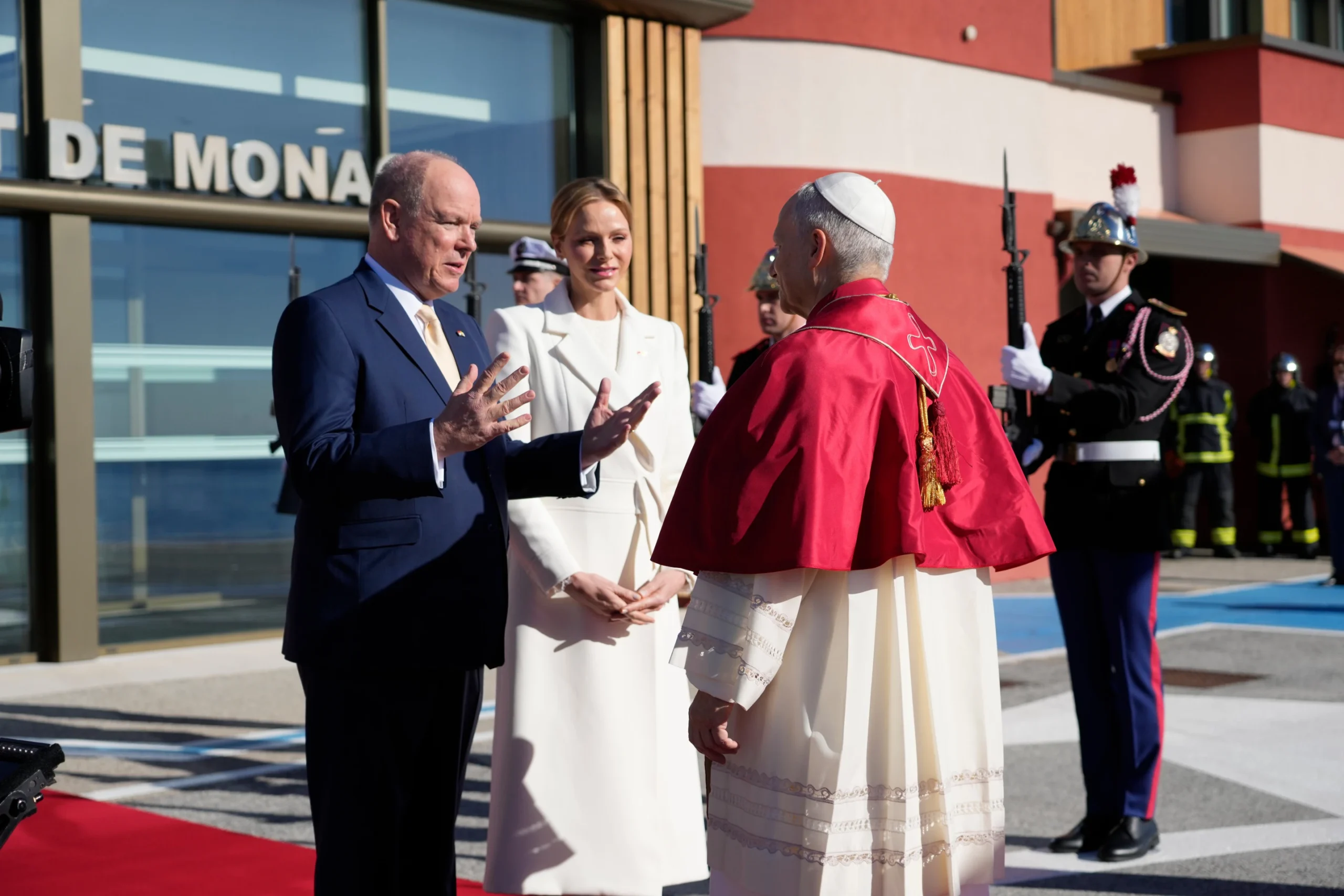
MONACO — Pope Leo XIV urged residents of the cosmopolitan Mediterranean principality of Monaco on Saturday to use their wealth, influence and Catholic faith for good, especially to uphold Catholic teaching on protecting the sanctity of life.
Leo made a one-day trip to the glitzy enclave, becoming the first pope to visit since Pope Paul III came in 1538. As a cannon boomed, Prince Albert and Princess Charlene met Leo at the Monaco heliport, just down the coast from the marina that is home to the megayachts of the rich and famous.
At the palace, members of the royal family stood in the courtyard waiting for Leo, the women dressed in black and with lace head coverings. Charlene wore white — a protocol privilege granted by the Vatican to Catholic royal sovereigns when meeting popes, known in diplomatic terms as “le privilège du blanc.”
In his opening greeting from the palace balcony, Leo urged Monaco to use its wealth, influence and “gift of smallness” for good.
It was important, he said, “especially at a historical moment when the display of power and the logic of oppression are harming the world and jeopardizing peace.”
Speaking in French, Leo urged Monaco’s people to use their faith and be “always ready to protect every human life with love, at any time and in any condition, so that no one is ever excluded from the table of fraternity.”
Monaco is one of the few European countries where Catholicism is the official state religion. And Prince Albert recently refused a proposal to legalize abortion, citing the important role Catholicism plays in Monaco society.
The decision was largely symbolic, since abortion is a constitutional right in France, which surrounds the coastal principality of about 1 square mile.
But in refusing to allow it in Monaco, Albert joined other European Catholic royals who have taken a similar stand over the years to uphold Catholic doctrine on an increasingly secular continent. When Pope Francis visited Belgium in 2024, he announced he was putting the late King Baudouin on the path to possible sainthood because he abdicated for a day in 1990 rather than approve legislation to legalize abortion.
A coastal playground for the rich and famous, Monaco is renowned as much for its tax-friendly incentives and Formula 1 Grand Prix as its glamorous royal family. The son of the late American actress Grace Kelly, Albert spoke in perfect, unaccented English when he greeted Leo at the heliport. Leo was heard noting that he landed three minutes late.
Leo’s one-day visit includes a meeting with Monaco’s Catholic community in the cathedral and Mass in the sports stadium.
Monaco’s population of 38,000 is heavily Catholic and also multinational, with only a fifth of the population actually citizens of the principality.
Winfield reported from Rome.
This has been updated.
Facts Only
Pope Leo XIV visited Monaco on Saturday, the first papal visit since Pope Paul III in 1538.
Prince Albert and Princess Charlene greeted Leo at the Monaco heliport.
Princess Charlene wore white, a protocol privilege known as "le privilège du blanc" for Catholic royal sovereigns meeting popes.
Leo addressed the crowd from the palace balcony, urging Monaco to use its wealth and influence for good.
He emphasized protecting human life in accordance with Catholic teachings.
Monaco is one of the few European countries with Catholicism as the official state religion.
Prince Albert recently refused to legalize abortion in Monaco, citing Catholic values.
Abortion is a constitutional right in France, which surrounds Monaco.
Monaco’s population is 38,000, heavily Catholic, and multinational, with only 20% being citizens.
Leo’s visit included a meeting with Monaco’s Catholic community and a Mass in a sports stadium.
The visit highlights Monaco’s role as a cultural and religious outlier in secular Europe.
Executive Summary
Pope Leo XIV made a historic one-day visit to Monaco, marking the first papal visit since 1538. He was received by Prince Albert and Princess Charlene, who wore white as a protocol privilege granted to Catholic royal sovereigns. In his address, Leo urged Monaco to leverage its wealth, influence, and "gift of smallness" to promote good, emphasizing the protection of human life in alignment with Catholic teachings. Monaco, where Catholicism is the official state religion, recently upheld its abortion ban, a decision supported by Prince Albert, who cited the principality's Catholic values. This stance contrasts with neighboring France, where abortion is a constitutional right. The visit included meetings with Monaco’s Catholic community and a Mass in a sports stadium. Monaco’s population of 38,000 is predominantly Catholic and multinational, with only a fifth being citizens. The event highlights the intersection of faith, wealth, and political symbolism in a highly secularized Europe.
The visit underscores the tension between traditional Catholic doctrine and modern secular values, particularly in Europe. While Monaco’s abortion ban is largely symbolic due to its proximity to France, it reflects a broader pattern of Catholic royals resisting liberal social policies. The papal visit also serves as a reminder of the Vatican’s diplomatic influence, even in a principality known more for its glamour and tax incentives than its religious adherence.
Full Take
The strongest version of this narrative frames Pope Leo XIV’s visit as a reaffirmation of Catholic values in a secularizing Europe, using Monaco’s unique status as a wealthy, influential principality to amplify the message. The visit is portrayed as a symbolic stand against liberal social policies, particularly abortion, with Prince Albert’s refusal to legalize it presented as a principled defense of Catholic doctrine. The contrast with France’s constitutional right to abortion underscores Monaco’s role as a bastion of traditional values, even if its ban is largely symbolic due to geographic proximity.
However, the narrative also subtly reinforces a binary framing—Catholic tradition versus secular progressivism—without exploring the nuanced realities of Monaco’s multinational population or the practical implications of its abortion ban. The emphasis on Monaco’s wealth and influence could be seen as an appeal to authority, suggesting that its stance carries moral weight simply because of its status. Additionally, the focus on Prince Albert’s decision risks oversimplifying the complex interplay between religion, politics, and human rights in modern Europe.
Root cause: The paradigm here is the Vatican’s strategic use of symbolic gestures to reinforce its moral authority in a continent where secularism is dominant. The unstated assumption is that Monaco’s wealth and Catholic identity make it an ideal platform for this message, even if its policies have limited practical impact.
Implications: For human agency, this narrative elevates institutional religious authority over individual autonomy, particularly in matters like abortion. The beneficiaries are the Vatican and traditionalist Catholic leaders, while the costs are borne by those who may seek reproductive rights within Monaco’s borders. Second-order consequences could include heightened polarization between religious and secular factions in Europe, as well as potential diplomatic tensions with France.
Bridge questions: How does Monaco’s abortion ban affect its residents in practice, given France’s proximity? What perspectives from Monaco’s multinational population are missing from this narrative? Would evidence of widespread support for abortion rights in Monaco change the Vatican’s stance?
Counterstrike scan: If this were part of a coordinated influence campaign, the playbook would involve leveraging Monaco’s glamour and Catholic identity to frame abortion opposition as a noble, high-status position. The actual content aligns with this pattern but does not appear manipulative—it is a straightforward report of a diplomatic and religious event. No structural alignment with a hypothetical attack version is detected.
Patterns detected: none