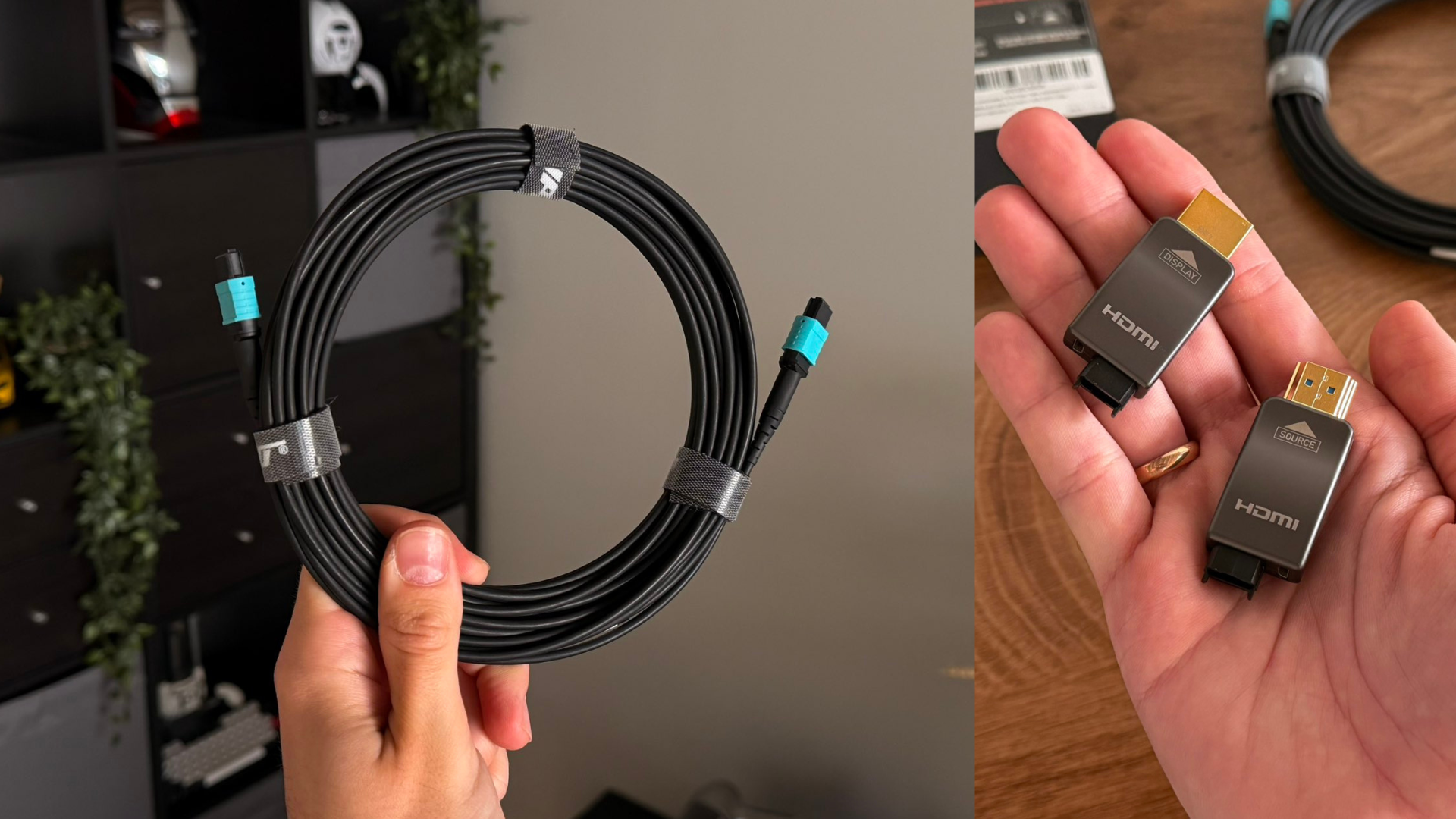
An expensive HDMI cable that's not snake oil?
Get Tom's Hardware's best news and in-depth reviews, straight to your inbox.
You are now subscribed
Your newsletter sign-up was successful
Ultra-expensive cables positioned as a miracle cure have been around forever. Most of these are obviously shams, but some are actually really worth the price, such as those that use fiber optics. Cables ditching copper wires to improve signal integrity are not exactly rare, but they were a new discovery for this Twitter user, who got their hands on an $116 fiber-optic HDMI cable from Ruipro with detachable ends.
The X post below went viral, garnering almost a million views for what seems like a perfectly ordinary product. Be that as it may, most people don’t actually care for, or even know, tech specs off the top of their head, especially when it comes to confusing standards like HDMI. What we’re looking at here is an active optical cable (AOC), which carries its signal over fiber optics instead of traditional copper wiring.
It’s called “active” because there’s a signal conversion taking place inside the cable, where electrical HDMI signals are converted into optical signals between the two ends. The cable isn’t entirely devoid of copper wires; some are still used for low-priority communication and power, but the majority of the signal is carried via fiber optic strands. This allows for significantly longer cables that can travel long distances without degradation.
Article continues belowLook at this HDMI cable I just got 👀This isn’t a regular HDMI cable, it’s fiber optic. The signal is transmitted with light instead of copper, so there’s basically zero signal loss even over long distances.It’s HDMI 2.1, so it supports everything you’d want: 8K60, 4K120,… pic.twitter.com/T5ZnQOrf3CMarch 26, 2026
Because this is an HDMI 2.1 cable in the post, it's capable of 8K output at 60 Hz, or 4K at 120 Hz without DSC, and supports 10-bit HDR. It's a full-fat 48 Gbps cable, which isn't always guaranteed, given how loose the HDMI Forum is with its branding. In fact, this is why people often buy overpriced cables: to circumvent the marketing red tape and get the best possible option that'll cover all their needs.
Now, these specs aren't special in a vacuum, but the fact that the cable can enable them over (up to) 990 feet — that's the impressive bit. The "entry-level" $116 version is only 3 feet long, and for that, it's quite expensive because you don't need fiber optic for this length. The best deal here is probably the 100-foot cable priced at $150, so only about $30 more for an extra 97 feet of fiber-optic goodness.
Ruipro has made the HDMI connectors on both ends removable, so you won't have to replace the entire cable if a plug breaks. When removed, the end of the cable can slot into keystone jacks and wall plates as well for easy storage. The cable itself is relatively thin for its size, and the connectors are made entirely of metal to ensure durability.
Another benefit of fiber optic is its resistance to electromagnetic interference, though that's not a huge issue to begin with for HDMI, and EMI is notoriously used as the bait to sell those aforementioned miracle cures. Regardless, this is still a solid HDMI 2.1 cable for those who value signal integrity, and even though the starting price is certainly not enticing, the subsequent options are priced rather fairly.
Get Tom's Hardware's best news and in-depth reviews, straight to your inbox.
Follow Tom's Hardware on Google News, or add us as a preferred source, to get our latest news, analysis, & reviews in your feeds.
Hassam Nasir is a die-hard hardware enthusiast with years of experience as a tech editor and writer, focusing on detailed CPU comparisons and general hardware news. When he’s not working, you’ll find him bending tubes for his ever-evolving custom water-loop gaming rig or benchmarking the latest CPUs and GPUs just for fun.
-
Spuwho It's not the fiber that is special, its the transceivers in those dongles that are driving the price. Probably HDMI over 100GbE.Reply
Facts Only
A Ruipro fiber-optic HDMI cable with detachable ends was featured in a viral Twitter post.
The cable uses active optical technology to convert electrical signals to optical signals.
It supports HDMI 2.1 specifications, including 8K at 60 Hz and 4K at 120 Hz without compression.
The cable achieves 48 Gbps bandwidth, a full-fat HDMI 2.1 standard.
Maximum supported distance is 990 feet.
The 3-foot version costs $116, while the 100-foot version costs $150.
Connectors are removable and made of metal for durability.
The cable is thinner than typical copper HDMI cables.
Some copper wires remain for low-priority communication and power.
The product resists electromagnetic interference.
The Twitter post garnered nearly a million views.
The cable can be used with keystone jacks and wall plates.
Executive Summary
Full Take
The strongest version of this narrative is that fiber-optic HDMI cables represent a legitimate, if niche, solution for high-bandwidth, long-distance signal transmission. The article rightly highlights the technical advantages—minimal signal degradation, resistance to interference, and support for cutting-edge resolutions—while acknowledging the premium cost. However, the framing leans into a familiar tech-media trope: the "miracle cure" product that defies skepticism. The viral Twitter post serves as social proof, but the piece doesn’t critically examine whether most consumers actually need such capabilities. The emphasis on "crushing" 8K and 4K performance over long distances may appeal to enthusiasts, but it risks obscuring the reality that most users don’t require 990-foot cables.
Pattern scan: The article employs a subtle form of **ARC-0024 Ambiguity** by conflating technical legitimacy with consumer necessity. It also flirts with **ARC-0043 Motte-and-Bailey**—the "miracle cure" framing (bailey) retreats to the defensible claim that fiber optics *do* work (motte). The viral post’s role as evidence leans on **ARC-0012 Appeal to Popularity**, though the piece stops short of outright hype.
Root cause: This narrative reflects a broader paradigm in tech media where innovation is often framed as a binary—either a scam or a revolution—rather than a spectrum of use cases. The unstated assumption is that "better specs" equate to "better value," ignoring context like user needs or cost-effectiveness.
Implications: For human agency, this reinforces a consumerist mindset where cutting-edge tech is positioned as inherently desirable, regardless of practical utility. The beneficiaries are likely niche professionals (e.g., AV installers) and enthusiasts, while casual users bear the cost of over-engineered solutions. Second-order effects could include normalized overpricing for "premium" cables, even when cheaper alternatives suffice.
Bridge questions: How often do real-world use cases demand 990-foot HDMI runs? What trade-offs exist between fiber-optic and copper solutions for shorter distances? Would broader education on HDMI standards reduce reliance on premium branding?
Counterstrike scan: A coordinated influence campaign would amplify the "miracle cure" angle, downplay alternatives, and use viral social proof to manufacture urgency. This article avoids outright manipulation but still leans into the tech-media playbook of framing innovation as a must-have. No structural alignment with a malicious campaign is detected.