March 29, 2026
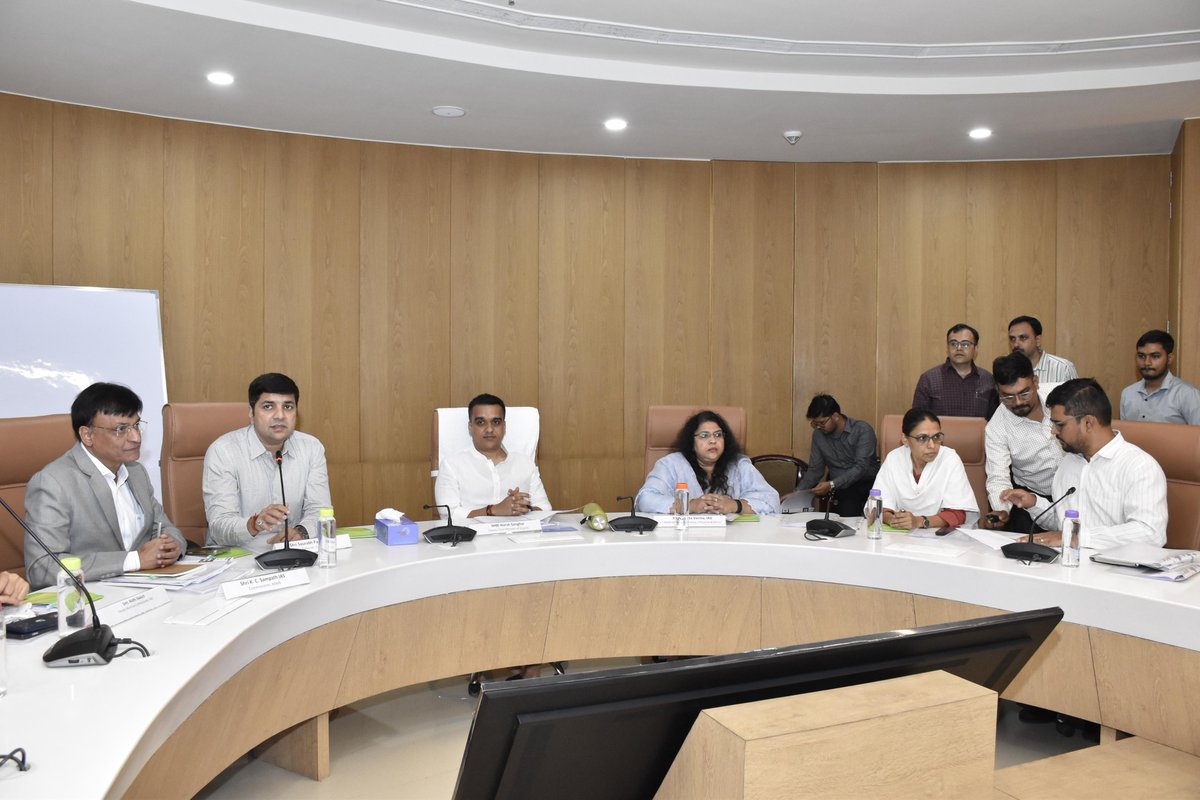
Surat: A high-level review meeting was held at the ICC Centre in Surat under the chairmanship of Deputy Chief Minister Harsh Sanghvi, with representatives from industry associations in Surat, Ankleshwar, Vapi, and Bharuch. The meeting focused on issues related to workers, gas supply, and arrangements for laborers.
Discussions were held between industry bodies and senior state officials on ensuring continuity of gas supply and improving facilities for workers.
Speaking to the media after the meeting, the Deputy Chief Minister said that 118 community kitchens (industrial canteens) have been made operational in Surat and surrounding areas. He added that Gujarat is role-model of nation and industries and traders in Gujarat have coordinated with the government to maintain stability.
To address concerns arising from rumours, industry bodies in South Gujarat have arranged food distribution for workers through industrial kitchens and warehouses. Industries in areas such as Pandesara, Vapi, Ankleshwar, and Dahej are also making arrangements for workers’ accommodation and meals.
The state government is facilitating the availability of five-kilogram LPG cylinders for workers. Citizens were advised not to believe or circulate misleading information on social media and to report such instances to authorities. The Deputy Chief Minister stated that legal action would be taken against those spreading false information.
He further said that there is adequate availability of essential commodities, including gas, petrol, and diesel, in the state, and supplies are being maintained as per Central Government guidelines.
The Deputy Chief Minister added that dedicated teams have been formed in each district to monitor black marketing. Strict action will be taken against anyone found involved in black marketing of LPG cylinders, petrol, diesel, or essential commodities.
Officials were instructed to expedite PNG connections in areas where infrastructure is available, particularly for users currently dependent on LPG. Areas located near main gas pipelines have also been prioritised for immediate connections.
During the meeting, District Supply Officer Darshan Shah presented details of the current LPG supply to households, educational institutions, hospitals, and industries in accordance with Government of India guidelines. Representatives of various industries also shared their inputs.
Additional Chief Secretary (Industries and Mines) Mamta Verma, MSME Commissioner K.C. Sampath, District Collector Dr. Saurabh Pardhi, and representatives from industry associations were present. DeshGujarat
Leave a Reply
Related Stories
Surat Textile Units Mull Two-Day Weekly Closure Due to Yarn Price Hike
100 Applications Approved for Commercial Gas Cylinders in Surat; Priority to Essential Services
No Worker Exodus from Surat; Viral Videos Misleading: Western Railway
Recent Stories
- Meals for 10,000 Pilgrims Daily, No LPG, No Firewood: Inside Gujarat’s Largest Biogas-Powered Mega Kitchen
- Surat Metro Project Achieves Landmark as 8.5 km Viaduct Completed, Trials Begin
- PM Modi to Launch Tourism Projects Worth Rs. 67 Crore in North Gujarat
- Prime Minister Narendra Modi to inaugurate semiconductor OSAT plant in Sanand on March 31
- PM Modi to Inaugurate 38,949 Rural Houses in Gujarat Under PMAY-G on March 31st
Facts Only
A high-level review meeting was held at the ICC Centre in Surat on March 29, 2026.
The meeting was chaired by Deputy Chief Minister Harsh Sanghvi.
Representatives from industry associations in Surat, Ankleshwar, Vapi, and Bharuch attended.
The focus of the meeting was on gas supply and arrangements for workers.
118 community kitchens (industrial canteens) are operational in Surat and surrounding areas.
Industry bodies in South Gujarat have arranged food distribution for workers through industrial kitchens and warehouses.
The state government is facilitating the availability of five-kilogram LPG cylinders for workers.
Citizens were advised not to believe or circulate misleading information on social media.
Legal action will be taken against those spreading false information.
Adequate availability of essential commodities, including gas, petrol, and diesel, was confirmed.
Dedicated teams have been formed in each district to monitor black marketing.
Officials were instructed to expedite PNG connections in areas where infrastructure is available.
District Supply Officer Darshan Shah presented details of the current LPG supply to households, educational institutions, hospitals, and industries.
Additional Chief Secretary (Industries and Mines) Mamta Verma, MSME Commissioner K.C. Sampath, and District Collector Dr. Saurabh Pardhi were present.
Executive Summary
A high-level review meeting was convened in Surat, chaired by Deputy Chief Minister Harsh Sanghvi, to address concerns regarding gas supply and worker arrangements in the region. Representatives from industry associations in Surat, Ankleshwar, Vapi, and Bharuch participated, focusing on ensuring continuity of gas supply and improving facilities for laborers. The meeting highlighted the operational status of 118 community kitchens in Surat and surrounding areas, aimed at providing meals for workers. Industry bodies in South Gujarat have also arranged food distribution and accommodation for workers to counter rumors and maintain stability.
The state government is facilitating the availability of five-kilogram LPG cylinders for workers and has warned against the spread of misleading information on social media, threatening legal action. Officials were instructed to expedite PNG connections in areas with existing infrastructure, prioritizing users dependent on LPG. The meeting also addressed concerns about black marketing of essential commodities, with dedicated teams formed to monitor and take strict action against violations. Representatives from various industries and government officials, including Additional Chief Secretary Mamta Verma and District Collector Dr. Saurabh Pardhi, were present to discuss these measures.
Full Take
The strongest version of this narrative presents a proactive government and industry collaboration to address worker welfare and essential commodity supply in Surat. The emphasis on operational community kitchens, legal action against misinformation, and monitoring of black marketing paints a picture of stability and coordination. The government’s role in facilitating LPG cylinders and expediting PNG connections underscores a commitment to infrastructure and worker support.
However, the narrative also reflects a pattern of centralized control and potential suppression of dissent. The warning against spreading "misleading information" and the threat of legal action could be seen as a way to stifle criticism or alternative viewpoints. The focus on black marketing and misinformation might also serve to distract from deeper systemic issues, such as labor rights or economic disparities.
Root cause: The paradigm here is one of state-led industrial stability, where the government and industry work together to maintain order and productivity. The unstated assumption is that worker welfare is secondary to industrial continuity, and that centralized control is necessary to prevent disruption.
Implications: For human agency, this means workers are dependent on government and industry initiatives for basic needs like food and shelter. The cost of this dependency is the potential loss of autonomy and the risk of exploitation. Second-order consequences could include a chilling effect on free speech, as the threat of legal action for "misleading information" may discourage legitimate criticism.
Bridge questions: What mechanisms exist for workers to voice grievances independently of industry and government structures? How does the government ensure that the distribution of essential commodities is equitable and not influenced by political or industrial interests? What safeguards are in place to prevent the misuse of legal action against dissent?
Counterstrike scan: If this were part of a coordinated influence campaign, the playbook would involve emphasizing government and industry collaboration to create an image of stability and control, while suppressing alternative narratives through legal threats and monitoring. The actual content aligns with this pattern to some extent, particularly in its focus on centralized control and the warning against misinformation. However, the presence of concrete measures like community kitchens and LPG distribution suggests a genuine effort to address worker welfare, rather than pure propaganda.
Patterns detected: ARC-0024 Ambiguity (potential suppression of dissent under the guise of combating misinformation), ARC-0043 Motte-and-Bailey (emphasizing worker welfare while potentially restricting criticism).